


Egypt is nearly broke, diplomatically cautious and armed to the teeth. That is not a contradiction, but a strategy of retaining relevance as a respected regional player.
Egypt was once the epicentre of the Arab world. Beginning in the 1950s, Egypt’s charismatic President Gamal Abdel Nasser transformed Cairo into the capital of pan-Arab nationalism, captivating tens of millions from the Atlantic to the Gulf with a promise of unity, dignity and independence in a post-colonial age. He stared down the old imperial masters, championed sovereignty and made Egyptian military and political power the fulcrum of a new pan-Arab order
The Arab League established its headquarters in Cairo; Egypt helped found the Non-Aligned Movement, extending its influence well beyond the Arab world. Arab audiences enthusiastically consumed the films of Omar Sharif, the music of Umm Kulthum and the works of other Egyptian cultural icons, cementing Egypt’s old nickname Umm Al-Dunya (“Mother of the World”). Today, Cairo can only look back nostalgically at that golden age.
Egypt’s unbroken cycle of decline
The Arab world’s former beating heart has steadily fallen from its Nasser-era zenith. The 1967 defeat was the first blow, and not just to Egyptian military power; decades of institutional paralysis, economic stagnation and growing dependence on wealthier Arab rivals did the rest. Egypt’s long-term decline owes less to governments reversing each other’s policies than to each trying to fix the last one’s failures while leaving the structural weaknesses untouched. Nasser built an industrial base and expanded education, healthcare and social mobility, but placed the economy under an overextended state while military ambitions consumed resources. His successor, Anwar Sadat, loosened the system with his capitalist-leaning infitah (“openness”) and made peace with Israel. Yet the economy that followed relied on unstable external flows — remittances, US aid, tourism and Suez Canal fees — rather than exports or innovation.
During Hosni Mubarak’s 30-year rule, liberalisation created pockets of growth but often entrenched cronyism, while the state, subsidies and military remained dominant and a rapidly expanding population outpaced the creation of productive jobs. The military greatly expanded its role in industry, food production, construction, real estate and infrastructure, further weakening private competition. Thus was created a cycle in which state intervention crowded out the very private sector Egypt needed to escape its dependence on the state.
Abdel Fattah El-Sisi, in power since 2013, has responded with ambitious infrastructure projects, including new megacities, a new capital, an expanded Suez Canal, renewable energy initiatives and military investments. Yet much of this has been financed through borrowing and foreign aid rather than accompanied by equivalent gains in productivity, technological sophistication or export competitiveness. In recent years, and especially since this year’s Iran War, Egyptians have contended with inflation, currency depreciation and budget deficits. Egypt has become exceptionally good at building more of itself without fundamentally transforming itself: each era has cosmetically changed the model without breaking the cycle of state dominance, external dependence and insufficient productivity.
A military that bit off more than it can chew
Given these economic hardships, Egypt’s ever-growing military procurements are puzzling. According to SIPRI, between 2015 and 2019 Egypt became the third-largest arms importer in the world, and its buying spree has accelerated since the Hamas-led attacks on Israel of 7 October 2023. A US congressional report from February 2026 put the value of American arms supplied to Egypt in 2024–25 at $12.018 billion, including Hellfire and Stinger missiles, advanced air-defence systems, upgraded Abrams tanks and other equipment.
Despite Egypt’s official claims of spending only $3.8 billion annually, between 2019 and 2020 El-Sisi’s government signed major arms deals worth $16 billion, including Su-35 combat aircraft from Russia, MEKO-A200 and FREMM frigates from Germany and Italy, and AW-149 and AW-189 helicopters. These followed the purchase of Rafale fighters and a FREMM frigate from France, S-300 air-defence systems and MiG-29 fighters from Russia, alongside the F-16s, Abrams tanks and Apache gunships supplied by America since 1979.
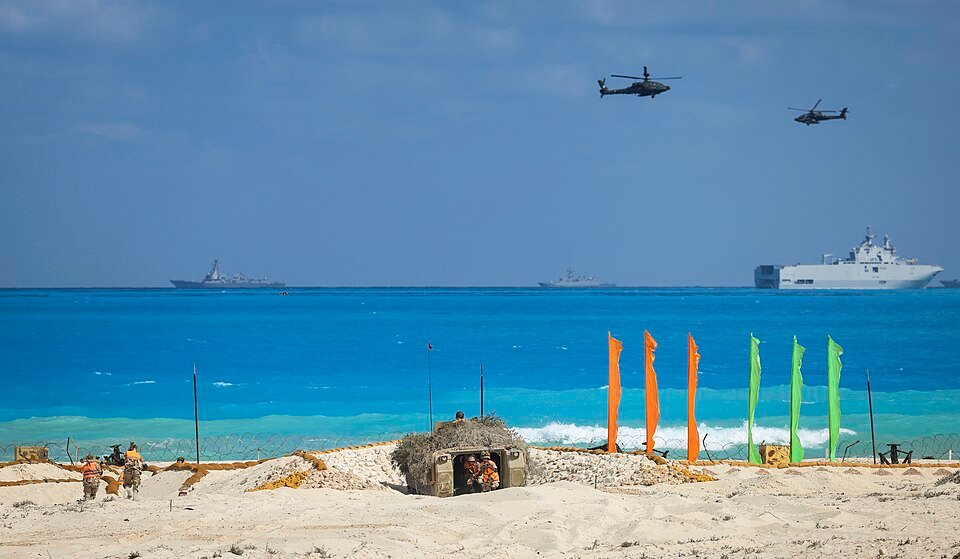
Egyptian military power is increasingly projected through conspicuously ambitious military exercises. Bright Star, its flagship exercise with the US and other allies, resumed in 2017 and has evolved into a major multinational drill involving land, air and naval forces, live fire, amphibious operations, counter-drone warfare and command-and-control exercises. Egypt has simultaneously conducted Medusa exercises with Greece, Cyprus, France and Saudi Arabia, Nile Eagles and Guardians of the Nile with Sudan, and Protectors of Friendship with Russia. More recent drills with China, including Eagles of Civilization 2026, have focused on advanced air combat and air-to-air refuelling. Taken together, the pattern suggests that Egypt is not merely maintaining a large military, but making its presence conspicuous on the international stage.
The inward-looking warrior
Egypt’s military build-up is striking enough to raise the question: to what end? Cairo insists the arsenal is defensive — and recent history is largely on its side. For most of the past half-century, Egypt’s security doctrine has sought to avoid fighting at all, especially abroad, and concentrate on national defence.
Egypt was not always so restrained. In the 1960s it fought a bloody proxy war in Yemen (1962–67), losing 1,500 soldiers propping up republican forces against Saudi-backed monarchists. Two wars with Israel then cured it of any remaining appetite for military assertiveness: Egypt lost the Sinai in 1967, and in the 1973 war its Third Army was encircled and facing destruction before Cold War diplomacy intervened. Its 1979 peace treaty with Israel came with an enticing reward — American diplomatic cover, aid and arms that modernised its military even as the need for military force diminished.
Since then, every Egyptian government, regardless of who led it, has stuck to the same script: stay out of other people’s wars and confine the armed forces to securing Egypt’s own borders. It sat out the recent war between Iran, Israel and America. Egyptian military power was not deployed in response to Houthi attacks that scared shipping away from its own Suez Canal — a direct hit to national revenue — nor when critical infrastructure in Damietta was struck, likely by Iran or its allies.
Similarly, the real-world effectiveness of Egyptian military power in recent years leaves much to be desired. The campaign against the local ISIS-Sinai affiliate in northern Sinai exposed significant weaknesses in Egypt’s counter-insurgency capabilities, with years of extensive ground manoeuvres and airstrikes failing either to dislodge the militants or curb their capacity to execute spectacular attacks. ISIS-Sinai blew up a Russian passenger jet as it took off from Sharm el-Sheikh in 2015, killing all 224 people on board. Two years later, the group attacked the Al-Rawda Sufi Mosque in northern Sinai, slaughtering more than 300 worshippers in Egypt’s deadliest terrorist attack. The army eventually contained and degraded the insurgency, but its years-long struggles against a relatively lightly equipped jihadist force exposed the limits of an institution whose vast arsenal seemed to bear little relation to its actual battlefield effectiveness.
In sum, Egypt’s arsenal has grown enormously, but its willingness to use it externally has not. And when compelled to confront a genuine threat within its own borders, the well-equipped military has often struggled to translate hardware into capability.
Cairo’s geopolitical fine line
Geopolitically, Egypt faces a web of competing interests. In Libya, it sides with the UAE in supporting Field Marshal Khalifa Haftar and his eastern Libya-based forces against the Tripoli-based government and its Turkish-backed allies. In Sudan, Egypt is allied with Turkey in supporting General Abdel Fattah Al-Burhan and the Sudanese Armed Forces against the UAE-backed Rapid Support Forces. Meanwhile, Egypt depends heavily on other countries: the Gulf states and Israel supply it with energy; Ethiopia controls the Nile’s headwaters and the Grand Renaissance Dam threatens its water security; and its economy relies on foreign aid and investment from Europe, China, the Gulf and America.
Egypt’s caution extends to alliances, too. Take the Mecca Defence Pact. Saudi Arabia did not keep Egypt out — Turkey repeatedly invited Cairo to join — so it was most likely Egypt itself that declined. Joining risked souring relationships Egypt has worked hard to preserve. It already runs a joint gas project with Greece and Cyprus, has deepened economic ties with India, Pakistan’s chief adversary, and depends heavily on the UAE, which has poured tens of billions of dollars into its economy. Cairo also had reason to fear that membership could be read by America and Israel as a hostile act, particularly by the latter, whose threat perception of its neighbours had sharpened considerably in the post-7 October context.
The military as diplomatic currency
Yet Egypt does not shy away from international affairs. It has taken a role in stabilising Gaza and, in January 2026, accepted the Trump administration’s invitation to join the Board of Peace. Cairo cannot afford to behave like a great power economically, but neither does it want to accept the diminished strategic role that its economic constraints imply. Egyptian military power, even if more projected as optics than substance, offers a partial solution, as an instrument of diplomatic weight.
The armed forces are one of the few institutions through which Egypt can demonstrate international clout. A large military allows Egypt to participate in international wargames, project potential military power and preserve strategic autonomy despite economic weakness. If not to be deployed in regional conflict, it may simply be there to ensure Egypt has a place at the geopolitical table.
None of this quite adds up to a country arming for war. It adds up to a country arming for standing. Egypt can no longer behave like the region’s leading country, but it will not accept the diminished role that implies. Its role in stabilising Gaza and its seat on the Board of Peace both came at Washington’s invitation — proof that a large, visible military can still buy Egypt a hearing its GDP no longer would. The grandiose military exercises are not necessarily preparation for war, but demonstrations of relevance performed for an audience of great powers.
But “diplomatic currency” is not the whole story. The army that supplies Egypt’s prestige abroad is also the army that runs a large slice of its economy at home, giving serving officers a direct financial stake in new contracts. Sisi came to power in a coup; a lavishly equipped and frequently fêted officer corps is also, not incidentally, a loyal one. Some of this arsenal buys Egypt a seat at the table. Some of it buys the president a quiet barracks.
Either way, the logic holds better than a purely military one would. If the tanks are never meant to fight, they do not need to win — they only need to be seen. For a country that has run out of other ways to matter, that may be argument enough.