

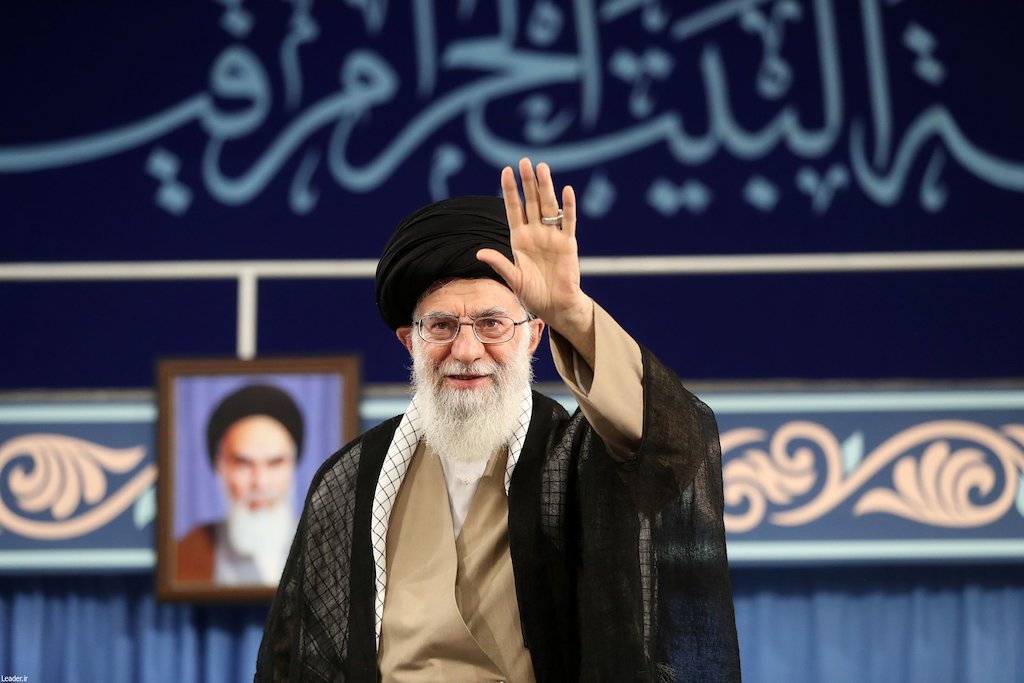
More than four months after Ali Khamenei was killed in the opening strikes of the war between Iran, Israel and the United States, Iran has begun a six-day state funeral spanning five cities in two countries. The ceremonies have become a test of the Islamic Republic’s ability to project continuity after the loss of its long-serving supreme leader, a measure of Iran’s diplomatic standing after the war, and an opportunity for the state to demonstrate that its institutions remain intact despite the conflict’s upheaval.
The ceremonies, which began on 4 July in Tehran and will conclude with Khamenei’s burial in Mashhad on 9 July, have drawn delegations from dozens of countries, statements from Iranian and foreign officials, and a range of reactions from the Iranian public. Taken together, they offer an early indication of how Iran’s leadership, allies and population are navigating one of the most consequential transitions in the Islamic Republic’s history.
The ceremonies opened on 3 July, when Khamenei’s coffin, alongside those of four family members killed in the same strike, was placed in state at Tehran’s Imam Khomeini Grand Mosalla, where foreign delegations and religious leaders filed past to pay their respects. Public mourning continued there on 4 and 5 July, with authorities bracing for crowds in the tens of millions, before a funeral procession wound through the capital on 6 July. The cortege then moved to Qom, Iran’s clerical capital, on 7 July, and on to Najaf and Karbala in Iraq the following day for processions at two of Shia Islam’s holiest sites. The body finally returned to Iran for burial on 9 July at the Imam Reza shrine in Mashhad—Khamenei’s birthplace.
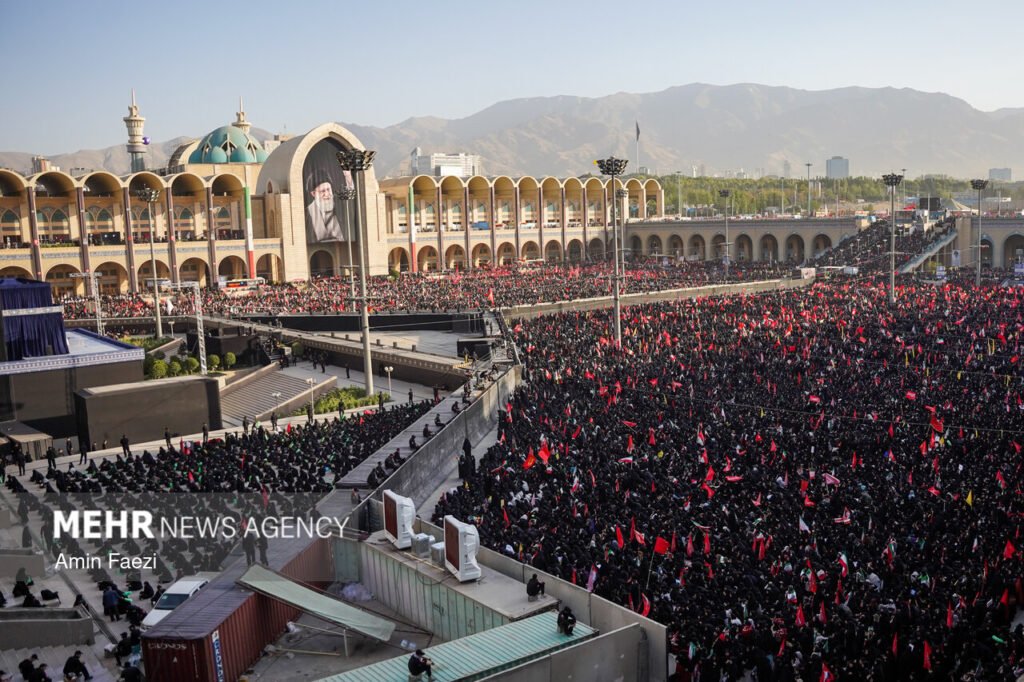
Iranian officials have described the event as one of the largest public funerals in modern history, forecasting total attendance across all stages of the funeral could reach between 15 and 35 million people, although these figures cannot be independently verified. Organisers say participation could surpass the roughly 10 million people who attended Ayatollah Ruhollah Khomeini’s funeral in 1989, an event to which the current ceremonies have repeatedly been compared.
The comparison is significant. Khomeini’s funeral marked the passing of the founder of the Islamic Republic and the transition to a new political era. Iranian authorities appear intent on portraying Khamenei’s death not as a moment of uncertainty, but as evidence of continuity between successive generations of the revolutionary state.
Diplomatic attendance, domestic leadership and absence
Iran’s foreign ministry says representatives from more than 70 countries, and by some counts more than 100, have travelled to Tehran. More telling than the turnout, however, was its seniority, or lack of it. Even among Iran’s closest allies, few sent their most senior figures. Russia dispatched Dmitry Medvedev, a former president now serving as deputy chairman of the Security Council, as Vladimir Putin’s special envoy; Mr Putin himself stayed away. China’s delegate was He Wei, a vice-chairperson of the National People’s Congress Standing Committee, rather than a member of the country’s top leadership. Pakistan was the exception. Shehbaz Sharif, the prime minister, attended in person, alongside the army chief, Asim Munir — a measure of how close Pakistan and Iran have grown, particularly given Pakistan’s role in the ongoing negotiations with the United States. The turnout suggests recognition rather than endorsement. Most governments seem to have wanted to mark the moment without the symbolism that a head of state or government would carry.
Regional states generally opted for ministers, deputy ministers or special envoys. Afghanistan’s Taliban government sent Foreign Minister Amir Khan Muttaqi, while Iraq sent its president, Turkey its vice-president and Lebanon its defence minister. Saudi Arabia and Qatar were represented by deputy ministers or special envoys. Non-state actors were out in force too. Hezbollah, Hamas, Yemen’s Houthi movement and Palestinian Islamic Jihad all sent representatives—hardly a surprise, given that all four militant groups owe much of their strength to longstanding Iranian backing as part of the “Axis of Resistance”.
So far, neither Mohammad Khatami nor Mahmoud Ahmadinejad, Iran’s two most prominent living ex-presidents, has been reported at the funeral, whether by choice or by omission from the guest list is unclear. Europeans governments too were absent: no EU head of state or government attended, nor did any senior official from Britain, France or Germany.
Within Iran, the civilian leadership has turned out in force. President Masoud Pezeshkian, parliament speaker Mohammad Bagher Ghalibaf, judiciary chief Gholam-Hossein Mohseni-Eje’i and Foreign Minister Abbas Araghchi have all been present during the ceremonies.
Conspicuously absent, however, has been Khamenei’s son and successor, Mojtaba Khamenei. Elected supreme leader in March under reported pressure from the Revolutionary Guards, he was wounded in the strike that killed his father and has not appeared publicly since. The election was contentious: several assembly members reportedly boycotted the vote, and critics accused the clerical body of trading religious vetting for hereditary succession, as in the days of the Shah the Islamic revolution toppled. According to the New York Times, Mojtaba has pushed to attend his father’s burial rites in person but has so far been refused by his own security detail, who fear he could either be targeted by Israel or tracked down. Mojtaba’s three brothers, Masoud, Meysam and Mostafa, have all appeared at funeral events, making his own absence harder to explain away on security grounds alone. Unverified reports have gone further still, with some outlets claiming he remains gravely injured, or even that he may not have survived at all. Whatever the reason, his absence has left the funeral’s choreographed unity to be led by figures like Ghalibaf and Abdollahi rather than the supreme leader himself.
Weeping for the ayatollah
Speaking to Axios, President Donald Trump said the talks had been paused for a week to allow for the funeral. With Iran’s entire leadership gathered in one place, he mused, America could have eliminated them all in a single strike, before adding that doing so would leave no one left to negotiate with. He also professed surprise at the sight of mourners in tears, having assumed most Iranians despised Khamenei. “Maybe it’s fake tears,” he suggested. Iran’s embassy in Armenia did not take kindly to the remarks, retorting on X that Mr Trump’s failure to grasp “these things” was down to America having “neither civilisation, nor history, nor honour.”
Meanwhile, Saeed Jalili, a member of the Supreme National Security Council and formerly Iran’s chief nuclear negotiator, declared that avenging the late supreme leader’s death was now an official duty. Naser Makarem Shirazi, the same grand ayatollah who, in June 2025, issued a fatwa branding Donald Trump and Benjamin Netanyahu “enemies of God”, warned that the culprits would face divine retribution, insisting that the war, and the broader struggle against the “front of arrogance,” was far from over. Some mourners on the streets chanted “kill Trump” and “kill Bibi,” brandishing banners demanding revenge for their fallen leader.
Major General Ali Abdollahi, commander of Iran’s Khatam al-Anbiya Central Headquarters, cautioned Washington and Israel on 2 July against any “miscalculation,” warning that Iran’s armed forces would respond harshly to any threat during the funeral period. Foreign Minister Abbas Araghchi issued a similar warning on 1 July, after Israeli Defence Minister Israel Katz said Mojtaba Khamenei, Ali Khamenei’s son and successor, was “marked for death.” Mohammad Bagher Ghalibaf, the parliament speaker who has also led ceasefire negotiations with Washington, described attending the funeral as a patriotic duty and called for the “nation’s call for vengeance” to be heard around the world.
Public reaction has been mixed, with the large crowds shown by Iranian state media contrasting with evidence of continued divisions within Iranian society. Official broadcasts have depicted mourners at Tehran’s Imam Khomeini Grand Mosalla and along the funeral route, with participants performing traditional Shia mourning rituals and describing their attendance as an expression of religious devotion, respect for Ali Khamenei or a sense of national duty.
At the same time, interviews conducted by foreign media present a more varied picture. While some Iranians intended to participate, others said they would avoid the ceremonies altogether. Among the reasons cited were concerns about overcrowding and public safety, fears of violence or security incidents, opposition to the government’s spending priorities during an economic crisis, and a belief that the funeral primarily serves as a political demonstration rather than a national event. Several residents also questioned official attendance projections, reporting that parts of Tehran appeared quieter than expected as some people chose to leave the capital before the main procession.
The financial cost of the ceremonies has emerged as a significant source of criticism. Some Iranians questioned how authorities were able to finance extensive transport, accommodation, food and logistical support while inflation, rising food prices and broader economic hardship continue to affect much of the population. Others argued that the logistical effort behind the funeral highlighted what they saw as the government’s failure to devote similar resources during previous natural disasters and times of national hardship.
The ceremonies have also highlighted the political divide between supporters of the Islamic Republic and many of its critics. Some Iranians interviewed by foreign media said Khamenei’s death brought them little personal sense of loss given his role in overseeing decades of repression, including the government’s response to the 2025–2026 anti-government protests. Others argued that official religious and state ceremonies increasingly resonate with the government’s existing support base rather than Iranian society as a whole. Tellingly, most critics spoke only under cover of anonymity, a sign that voicing dissent in Iran remains risky.
A Carefully Choreographed Transition
For all the attention devoted to the funeral itself, the real significance of the ceremonies lies in what follows. The transition to a new Supreme Leader, who has yet to appear publicly, renewed negotiations with Washington, the implementation of the ceasefire and Iran’s efforts to rebuild after the war will ultimately determine whether the image of stability projected this week reflects political reality. The funeral marks the end of Ali Khamenei’s era; the durability of the one that follows has yet to be tested.