


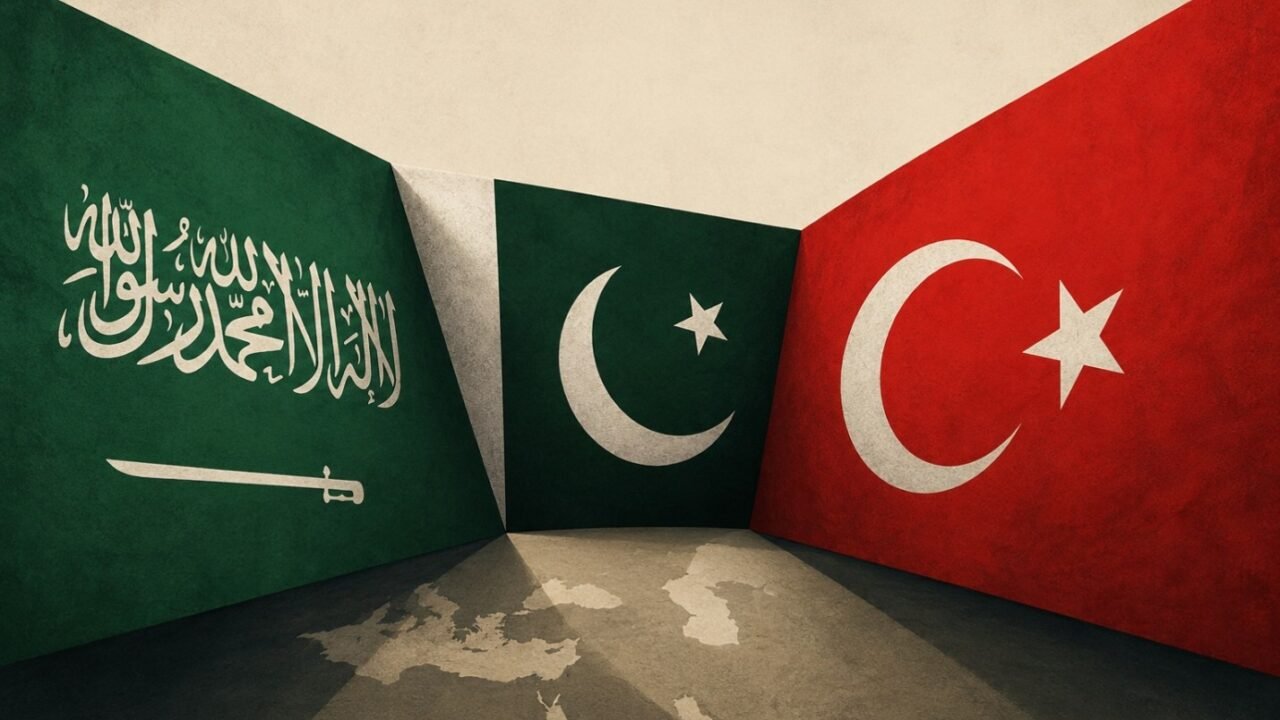
A new “NATO-style” pact says less about a shared vision of collective defence than about three very different powers seeking insurance against an uncertain regional order
The choice of Mecca and the timing were hardly incidental. On 7 August — a Friday, the day of congregational prayer — Saudi Arabia’s Crown Prince and heir-designate Mohammed bin Salman, Turkey’s President Recep Tayyip Erdoğan and Pakistan’s Prime Minister Shehbaz Sharif met at Al-Safa Palace in Islam’s holiest city to sign a collective security pact declaring that an attack on any one of their countries would be treated as an attack on all three. Turkey’s influential foreign minister, Hakan Fidan, characterised the Mecca Defence Pact as “technically the same” as NATO’s Article 5. He may have overstated its likely applicability: the pact leaves crucial questions about implementation unresolved. Nevertheless, its significance lies less in the creation of a functioning alliance than in what it says about how three very different powers are preparing for a rapidly-shifting regional order.
The agreement’s essentials
Formerly titled the “Mecca Joint Defence Agreement”, the pact commits its signatories to treat “any armed attack against any one of the three states” as “an attack against them all” — language that closely echoes NATO’s founding text. It creates a ministerial committee, political and military sub-committees and a permanent secretariat in Saudi Arabia. But the operational detail — including the threshold for invoking the agreement, troop contributions and command arrangements — remains to be negotiated.
The trilateral deal builds on a bilateral pact that Saudi Arabia and Pakistan signed in September 2025. That agreement formalised decades of bilateral defence cooperation between the Sunni powers, including a 1982 accord that opened the door to Pakistani training and advisory deployments on Saudi soil. Turkey is the genuinely new addition, bringing NATO’s second-largest standing army and extensive regional combat experience into a Gulf security order that has, since the 1980s, depended heavily on American guarantees.
America’s shale boom turned the United States from a buyer of Gulf oil into a competitor, weakening a relationship originally built on mutual dependence. Successive administrations, Republican and Democrat alike, have devoted strategic attention away from the Middle East in favour of China and the wider Indo–Pacific region. Regional governments have consequently questioned whether American military protection will remain commensurate with their own security needs. Saudi Arabia, the UAE, Egypt and Qatar have diversified their defence relationships, buying more from France, Britain, South Korea and China. None has abandoned the United States, which remains the source of the region’s most sophisticated military technology. But dependence on the United States is becoming less absolute.
A pact forged in wartime
The question of America’s future role has become harder to ignore because the pact was signed during an unresolved conflict. Since 28 February, the United States and Israel have been at war with Iran. Saudi Arabia has been drawn directly into the conflict, coming under Iranian fire while retaliating against the Islamic Republic, even as it keeps diplomatic channels with Tehran open. Turkey has avoided direct military involvement and instead pursued a diplomatic role, although Turkish and NATO air defences have been forced to intercept Iranian ballistic missiles approaching its airspace.
Washington remains the region’s indispensable military power. But the war has reinforced the risks of relying on a distant ally whose priorities appear to be shifting. Much depends on how the conflict ends. A settlement that preserves a substantial American presence would reinforce the existing order; a significant US drawdown would encourage regional powers to invest more heavily in their own defences. Riyadh and its neighbours are preparing for either possibility and avoid being caught off guard.
Division of labour
Each partner brings something different. Pakistan offers a battle-tested army and the only nuclear arsenal in the Muslim world, consisting of roughly 170 warheads, according to the Bulletin of the Atomic Scientists. Turkey contributes advanced drone technology and considerable military experience beyond its borders. Pakistan alone bought 16% of Ankara’s weapon technology exports, a sector that SIPRI says surged 122% between 2021 and 2025. Turkish industry also serves Riyadh, which recently secured a $3.1 billion deal for Bayraktar Akıncı drones, including local manufacturing rights.
Saudi Arabia, meanwhile, provides the financial muscle. Its $1.39 trillion GDP gives it the economic weight to finance defence cooperation with its partners. Pakistan’s economy is much smaller despite its much larger population, making Saudi financial backing particularly valuable to Islamabad as it seeks to offset India’s conventional military advantage.
Yet the partnership also exposes a common weakness: none of the three countries is primarily structured for sustained combat far from home. Saudi forces remain focused on territorial and air defence. Pakistan’s military is organised principally around its rivalry with India, while its overseas role has historically centred on training and advisory missions rather than expeditionary warfare. That caution has already been evident this year: Islamabad did not send forces to Saudi Arabia’s aid despite the 2025 pact. Turkey is the partial exception, having deployed troops to Syria and Libya and supplied the drones that helped Azerbaijan win its 2020 war with Armenia.
Egypt could eventually join. Fidan has described Cairo as a possible addition “once certain technical matters are resolved”, consistent with Erdoğan’s desire to widen the framework. But Egypt’s position is more complicated than talk of future membership suggests. Egypt, Saudi Arabia, Turkey and Pakistan have spent nearly a year operating a parallel consultation channel, informally dubbed the “R4”. The four countries have met repeatedly to coordinate their positions on the Iran war. At their fourth meeting, in June, Egypt’s President Abdel Fattah Al-Sisi called for the mechanism to become a proper institution. The International Crisis Group, however, continues to describe the grouping as a “loose” and “informal consultative forum“.
The Iranian calculus
Tehran’s response has been sceptical, if not hostile. When Riyadh and Islamabad signed their bilateral pact last September, Iran’s president welcomed it at the UN as a possible foundation for regional security. The trilateral agreement has prompted a markedly different reaction. Iranian parliamentarian Ebrahim Rezaei dismissed it as a “paper agreement” that would not make Saudi Arabia more secure, arguing that decades of dependence on the United States had failed to do so either.
More concretely, the Mecca Defence Pact was concluded amid a Houthi–Saudi escalation. Two days after the signing, on 9 August, the Iran-backed militia struck a Saudi Aramco refinery in Jazan with a drone. On the same day, Houthi projectiles struck Saudi-backed Yemeni government forces at the Red Sea port of Al-Makha, reportedly killing seven. Whatever the precise circumstances, Iran’s allies now have a relatively inexpensive way to test the new accord’s credibility. The central question is whether such attacks would trigger the agreement. Would a drone launched by a militia, a missile fired directly by Iran, or an attack by another proxy constitute the “armed attack” envisaged by the pact? The text does not say.
Pakistan may be the the Mecca Defence Pact’s most constrained member. Its relationship with Riyadh is deep, but its geography makes confrontation with Iran particularly costly: the two countries share a roughly 900-kilometre border. Islamabad has also positioned itself as a mediator in the wider US–Iran conflict, hosting talks with Turkey, Saudi Arabia and Egypt aimed at de-escalation. That role sits uneasily alongside an obligation that could, in some circumstances, require Pakistan to enter a conflict with Tehran. Like Saudi Arabia’s Houthi problem, Pakistan’s security challenges expose an important gap in the pact: it offers no clear indication of whether, or how, the other signatories would respond to attacks by non-state actors, including Baloch separatists and Taliban-backed militants operating from Afghanistan.
Wider implications and perceptions
For Turkey, the Mecca Defence Pact raises questions about how it fits alongside its NATO commitments. Fidan has repeatedly stressed that the Mecca agreement is defensive, “not directed against any country” and complements rather than replaces Turkey’s existing alliances. Yet, as Turkish political analyst Murat Yetkin has observed, there is still uncertainty in Ankara over how the two commitments would coexist. A NATO member co-founding a parallel Muslim security framework modelled in part on NATO’s own structures deserves greater scrutiny in Brussels and Washington.
The accord invites scrutiny in Israel and India, particularly after Pakistan’s defence minister, Khawaja Asif, branded it an “Islamic NATO” designed to counter perceived challenges from both countries. India’s Ministry of External Affairs said it was “closely following the development” while rebuffing rumours that it and Israel were already preparing a counter-pact. Israel, on the cusp of an October election, has likewise avoided an official stance, perhaps to avoid further straining its already difficult ties with the three signatories. But a mid-level minister from Prime Minister Benjamin Netanyahu’s party, ostensibly speaking in a personal capacity but possibly testing the waters for the government, criticised the deal over Turkish participation and urged a tightening of defence ties with the UAE, Greece and Cyprus. The latter two of those countries also have reason for concern: a flare-up with Turkey over Cyprus or the Aegean could now draw additional belligerents into the mix.
But such calculations overlook the partners’ competing interests, which are likely to constrain any expansive interpretation of the Mecca Defence Pact. Saudi Arabia relies on Greece to help intercept Houthi and Iranian missiles and protect important infrastructure. On 25 July, a Greek-operated Patriot battery at the Red Sea port of Yanbu shot down two ballistic missiles aimed at Saudi refineries. Athens has since increased the frequency of its review of the mission from annual to monthly, citing concerns about Riyadh’s new alignment.
India, meanwhile, accounted for 13% of Saudi oil exports in 2025. Riyadh is hardly likely to jeopardise such an important market to support a Pakistani confrontation with New Delhi. These contradictions underline the limits of the “Islamic NATO” analogy.
More than symbolism, less than NATO
The Mecca Defence Pact is therefore less the birth of an “Islamic NATO” than a symptom of a Middle East in which governments are no longer willing to hedge all their security bets on one power. Saudi Arabia wants greater protection against Iran without abandoning its American relationship. Pakistan seeks strategic and financial backing without tying itself irrevocably to either Riyadh or Tehran. Turkey hopes to extend its influence beyond NATO without leaving it.
Their interests are too divergent for the pact to become a coherent war-fighting alliance any time soon. But that may miss the point. Its real significance is not what the three countries would fight for together, but what they may now be able to deter by acting in concert.