

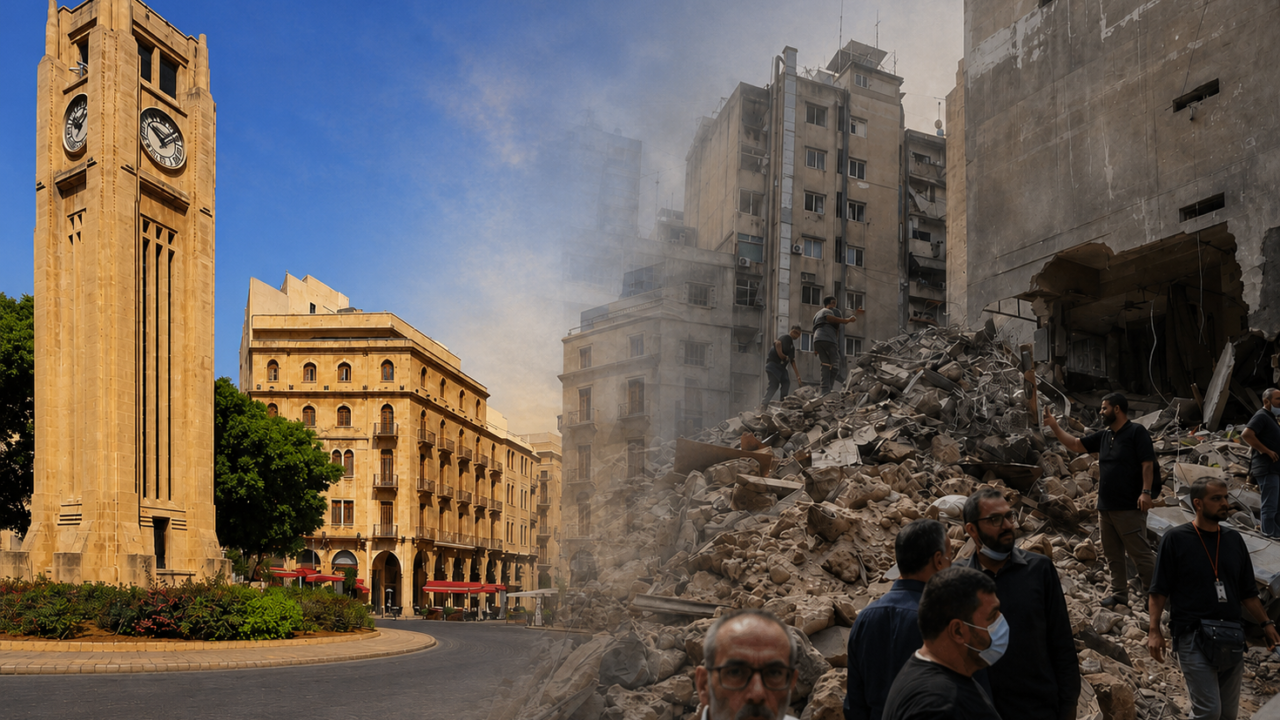
The hidden rewards of disarmament — and the heavy costs of remaining armed.
Almost four decades have passed since a historic accord was signed in a certain country, under which militias were stripped of their weapons. Almost every militia, besides one, which was exempted from the deal and remained armed — turning it into a military monopoly whose political clout vastly exceeds its electoral weight.
Consider this: 37 years have gone by, and the balance of power has not shifted. What do you suppose has become, over the years, of the militias that disarmed, and of the ethnic groups they represented? Are those that gave up their weapons now weak, persecuted and vulnerable? And, conversely, are those that kept their weapons thriving, enjoying high living standards and personal security?
Have you settled on an answer? Now consider that the country in question is an Arab state in a Middle East defined by tribe, sect and instinct.
An armed group more equal than others
The Taif Accord, signed in October 1989, brought an end to Lebanon’s bloody 14-year civil war. One of its central provisions stated unambiguously that all armed militias in the country were to be disbanded, handing over their weapons to the Lebanese army and swearing loyalty to the Lebanese state.
Nearly every faction that had fought in the sectarian war fell into line. The Lebanese Forces, the largest Christian militia, laid down their arms under Samir Geagea; so did their Muslim and Druze counterparts, the Shia’s Amal among them, trading rifles for seats in parliament. Only General Michel Aoun held out, rejecting the accord outright — a defiance the Syrian army soon put to an end on the battlefield.
One faction, however, never even had to make that choice. Hezbollah, despite the accord’s unambiguous language, was quietly exempted from it altogether. It alone kept its weapons while simultaneously entering the political system — a combination no other faction was allowed, and one that made it, by some distance, the most powerful player in the country.
In truth, this was a Syrian–Iranian deception. At the moment of signing, it appeared that every militia would be dismantled. But once the ink was dry, Syria — the true power broker in Lebanon — imposed its own interpretation of the accord. The pro-Syrian government defined Hezbollah as a national resistance movement against the Israeli occupation of southern Lebanon, rather than as a militia. This exemption served the elder Assad’s interests and allowed Hezbollah to preserve and expand its power under legal cover.
The Maronite community stood helpless before the armed might of Syria and Hezbollah. The new order bred deep frustration and a bitter sense of dispossession, leading to prolonged electoral boycotts and a mass emigration of hundreds of thousands of educated, well-established Lebanese to Western countries — to the point that the Lebanese diaspora came to outnumber the population of Lebanon itself.
From exempted militia to national power broker
In the years following Taif, Hezbollah exploited its official exemption and the close patronage of Syria and Iran to embark on an unprecedented build-up, transforming itself from a local militia into an independent force many times stronger than the Lebanese army itself. Tehran funnelled hundreds of millions of dollars to the organisation each year and armed it with precision-guided missiles and advanced weaponry, while Damascus provided political cover and free rein across its territory for the transfer of arms. This accumulated strength allowed Hezbollah to dictate to the government the formula of “army, people, resistance”, which enshrined the legitimacy of its arsenal — and, when it judged necessary, to turn its guns inward to remind any doubters exactly who held the reins in Lebanon, as it did in 2008.
The Christians paid the price. Their demographic and political weight eroded, and by then their authentically representative leaders had been swept aside in favour of a pro-Syrian puppet administration. Had the Christians made a historic mistake?
The Shia Amal movement, too, dismantled its military apparatus and handed it over to the Lebanese army. In hindsight, Nabih Berri’s decision, as Amal’s leader, to disband his militia looked like suicide. For three years before the accord, a vicious and bloody civil war had raged between the secular, patriotic Amal and the fundamentalist religious Hezbollah, claiming the lives of thousands of Shias. Amal’s disarmament left it exposed to blood feuds and score-settling while the wounds were still fresh. Did Amal make a historic mistake?
The logic of laying down arms
In the course of armed conflicts and civil wars, a militia’s or an ethnic group’s decision to give up its weapons is widely seen as a dangerous, even suicidal, gamble. In a jungle-like reality devoid of central rule of law, weapons serve as a psychological anchor. Many fighters believe that laying down their arms will strip them of security, expose them to reprisals and deprive them of bargaining power. And yet, a historical and comparative look at disarmament processes around the world reveals a fascinating picture: groups that laid down their weapons under the right conditions went on to achieve political ascendancy, international legitimacy and economic prosperity, while rival factions in the same countries squandered their strength and energy on continued war.
The central mechanism behind this pattern is the conversion of firepower into political power. When an armed group agrees to take part in an organised disarmament programme, the international community and the local government reward it with a ticket into the establishment. A clear example is the Kosovo Liberation Army in 1999. With the war’s end and the arrival of NATO forces, most of the KLA leadership chose to disarm and transform into a legitimate political party. This paved the way for field commanders to become prime ministers, presidents and ministers who helped shape the new state. Extremist factions that refused to disarm and went underground, by contrast, were declared terrorist organisations, hunted by the state and by international forces, and lost all ability to influence the country’s future.
Beyond political power, the economic arena offers a further, powerful incentive to disarming groups. The international community and donor states tend to channel billions of dollars into reconstruction and infrastructure for regions that have demonstrated complete demilitarisation. It is typically the fighters who laid down their arms who end up controlling these budgets, alongside personal reintegration grants, land allocations and vocational training.
After apartheid ended, Umkhonto we Sizwe (MK), the ANC’s armed wing, accepted the negotiated settlement, suspended its armed struggle, and saw thousands of its fighters integrated into the new South African National Defence Force, while many of its political leaders entered government and the country’s new elite. The Pan Africanist Congress (PAC), by contrast, remained far more resistant to the negotiated settlement. Although many members of its armed wing, APLA, were eventually integrated into the SANDF, the PAC rapidly became politically marginal, and many former APLA combatants experienced poor reintegration and long-term economic hardship.
This legitimacy was also conferred by the broader public. In Northern Ireland, following the Good Friday Agreement of 1998, the Official IRA disarmed, and its political wing, Sinn Féin, grew into a strong and legitimate party, while breakaway factions that refused to disarm were shunned by their own communities, which had grown thoroughly weary of the war.
When disarming doesn’t pay
But there is a second side to the coin — a darker and more lethal one, known as the disarmament trap. History is equally replete with tragic examples of groups that agreed to lay down their weapons, paid for it in blood and lost all bargaining power.
In political frameworks defined by corrupt or dictatorial rule, or ones lacking any real enforcement capacity, giving up weapons leaves a group entirely exposed and can even invite aggression from its rivals. In Colombia in the 1980s, for example, when the FARC rebel movement tried to enter the political mainstream through the Patriotic Union (UP) party, its now-unarmed members were left defenceless. Drug lords and extremist militias, working alongside elements of the state, exploited that helplessness ruthlessly. The Inter-American Court of Human Rights and Colombia’s own transitional justice court have since ruled that the campaign amounted to a “political genocide“. More than 6,000 UP members and candidates were murdered or forcibly disappeared over the following decades. Another example is the fate of rebel groups in Myanmar and Sudan that signed ceasefire agreements and disarmed: once the military threat had been lifted, the governments broke their promises of autonomy and rights, leaving those groups weak, unrepresented and unable to defend their land against invasion.
Taif’s balance sheet
So, to return to the question posed at the start: how, in truth, have the consequences of the Taif Accord affected Lebanon’s ethnic groups? Have they harmed or benefited the living standards and personal security of the Christians and of Shia Amal? And have they harmed or benefited those of Hezbollah?
Amal read the new rules of the game correctly, disarmed, and focused on exerting influence through the institutions of the state. Its gamble proved successful and profitable: the movement underwent a fundamental transformation from armed militia to mainstream political party. Meanwhile, Nabih Berri, the movement’s leader, cemented his political standing and was elected in 1992 as Speaker of the Lebanese Parliament — a post he has held continuously to this day. Over the years he has become the most powerful man in Lebanon, in spite of — or perhaps because of — his considerable age (88). Unlike Hezbollah, designated a terrorist organisation in many countries, whose members are hunted and wanted, Amal remains a legitimate and popular political party in Lebanon.
The Christians, by contrast, who effectively lost out under the accord, underwent a curious transformation of their own. The beginning was bleak: it did not look as though anything good could come of the hand they had been dealt. Repesentative Christian leaders were politically neutralised — Samir Geagea was arrested and imprisoned for many years, and Michel Aoun was exiled to France. The powers of Lebanon’s president, who by convention must be a Maronite Christian, were significantly curtailed, while those of the Sunni prime minister and the Shia speaker of parliament were expanded at his expense. Many young Christians emigrated to Western countries, further reducing their demographic and electoral weight within Lebanon.
Yet, over the years, the accord that seemed to curse the Christians by stripping them of their weapons turned out to be something of a blessing. The sectarian balance it produced allowed Hezbollah to direct its energies and its weapons towards the Sunni–Shia axis of conflict and towards its enduring confrontation with Israel, which had occupied southern Lebanon.
The Christian communities, freed of the need to bear arms, remained largely uninvolved in regional confrontations and instead channelled their energies into Lebanese politics and the rebuilding of their community. While the Shia, who never disarmed, exhausted their money and blood in war after war, the Christians were spared that burden. They invested in themselves and preserved their economic edge — a strong private education system, businesses, banking and the professions. Meanwhile, the young Christians who had emigrated west put down roots there and began sending substantial remittances home. While Hezbollah invested in networks of social welfare and relief, the Christians had no need of for handouts.
When the gun boomerangs
And the situation is unlikely to change. The Shia community is now mired up to its neck in conflicts on every front. The price of its involvement in these confrontations has brought it to the brink of a Shia Nakba.
To the south, the confrontation with Israel — in the wars waged in support of Gaza and of Iran — has brought total devastation to southern Lebanon and the displacement of more than a million residents, living without shelter or certainty, dependent on the mercy of charitable and welfare organisations, their villages ground to dust. There is little sign that the Israeli occupation will end any time soon, whether one looks with the naked eye or through a telescope. To the north and east, Sunni jihadist forces alongside the Syrian national army under Ahmed Al-Sharaa are massing along the border, waiting for the order to enter Lebanon and take revenge on the Shia for their extensive involvement in the massacres carried out against them by the younger Assad during the Syrian civil war. Should this nightmare scenario materialise, a Syrian pincer movement would close in from several directions, and the Shia would be able to retreat only to the sea — and it is far harder to swim while carrying a weapon.
The lesson is this: weapons in Lebanon feel like security, strength and control. In practice, they have proved a millstone, blocking development rather than guaranteeing it. The global experience shows that disarmament is no magic formula. It brings lasting prosperity only where governance is stable and real economic and political alternatives exist — where the weapon becomes a means, not an end. Absent those conditions, refusing to disarm can become its own trap, political and physical alike. For Lebanon’s Shia today, as for so many armed communities before them, holding on to the gun remains, to their own misfortune, the only way to survive.