

As the war intensifies and both sides maintain deliberate opaqueness — denying responsibility for attacks and instinctively blaming the other side — the danger grows of miscalculations that could extend the civil war beyond Sudan’s borders. Sudan’s war endures not because its stakes are low, but because the international community regards them as insufficiently consequential.
A drone strike on a hospital levelled the facility and killed 70 medical professionals and patients, including children. Around two million people are now denied basic healthcare after this sole medical centre within a 150-kilometre radius was put out of commission. The strike was preceded by the deaths of more than 500 civilians in UAV attacks over a two-and-a-half-month period. Under most circumstances, such an incident would dominate global headlines and provoke widespread outrage. Instead, this attack on 20 March in Sudan was just one atrocity among countless others in a civil war now approaching its fourth year, with no credible prospect of resolution on the horizon.
The internecine strife in the Arab world’s third most populous country and Africa’s third largest, pitting a central government against a rebel paramilitary organisation, has failed to command high-priority international attention, overshadowed by conflicts elsewhere in the Middle East and beyond. Sudan’s war has already produced more death, displacement and food insecurity than any other active conflict. Left unchecked, it threatens to spill across Sudan’s borders, adding additional chaos to an already fragile North Africa and the larger Middle East.
A war of duelling narratives, but shared brutality
The Sudanese Civil War erupted in April 2023 after four years of uneasy joint rule by two rival movements that together had overthrown Islamist autocrat Omar al-Bashir following his 30 years in power. The Sudanese Armed Forces (SAF) represented the conventional military of the central government based in the capital Khartoum. The Rapid Support Forces (RSF) evolved from the state-backed Janjaweed militia, which had been deployed to ruthlessly suppress an insurgency in western Sudan’s Darfur region during the mid-2000s — a campaign widely defined by observers, including the United States, as genocide.
The 2019 coup established a military-led transitional authority headed by SAF commander Abdel Fattah al-Burhan, with RSF leader Mohamed “Hemedti” Dagalo as his deputy. A civilian technocrat, Abdalla Hamdok, was installed as caretaker prime minister, ostensibly to guide the country towards democratic rule. Yet within two years, Hamdok was removed and the post-Bashir constitution suspended. The move provoked mass protests and prompted the World Bank and IMF to suspend aid and technical assistance critical to Sudan’s economic development.
Hamdok briefly returned in early 2022 but resigned within weeks, citing the two generals’ violent repression of peaceful demonstrators. Burhan and Hemedti then governed uneasily for another year, unable to resolve disputes over a post-military transition — most notably the integration of the RSF’s estimated 100,000 fighters into the national army. That deadlock collapsed into open warfare in April 2023, when RSF forces seized Khartoum’s airport and other vital national institutions.
The capital remained under RSF control for nearly two years, forcing the SAF to relocate its headquarters to Port Sudan on the Red Sea. Khartoum was eventually retaken by Burhan’s forces in May 2025, but by then the conflict had evolved into a struggle over ideology and historical grievances as much as over power.
As the fighting dragged on, it acquired sharper socio-cultural and class-based dimensions, drawing on long-standing domestic friction points. The national army consolidated control over the north and east, including the strategically vital Nile River corridor and Red Sea coast. It retained the backing of much of Sudan’s Arab Muslim urban and agrarian elite, framing the war as a principled defence of national sovereignty against a “terrorist militia“. The SAF has relied heavily on Muslim Brotherhood remnants of the Bashir-era security apparatus, while allying with homegrown, ideologically similar Islamist militias in certain areas.
Since losing Khartoum, the RSF has entrenched itself in the south and west and branded its struggle as a revolt against an established military autocracy. It portrays the SAF-led government as the continuation of a centralised, Khartoum-centric order that has marginalised Sudan’s peripheries since independence in 1956. From Darfur, Hemedti proclaimed a self-governing authority and openly declared his intention to seize control of the entire country. The RSF has presented itself as a champion of often-neglected nomadic Arab communities and forged alliances with local tribal militias.
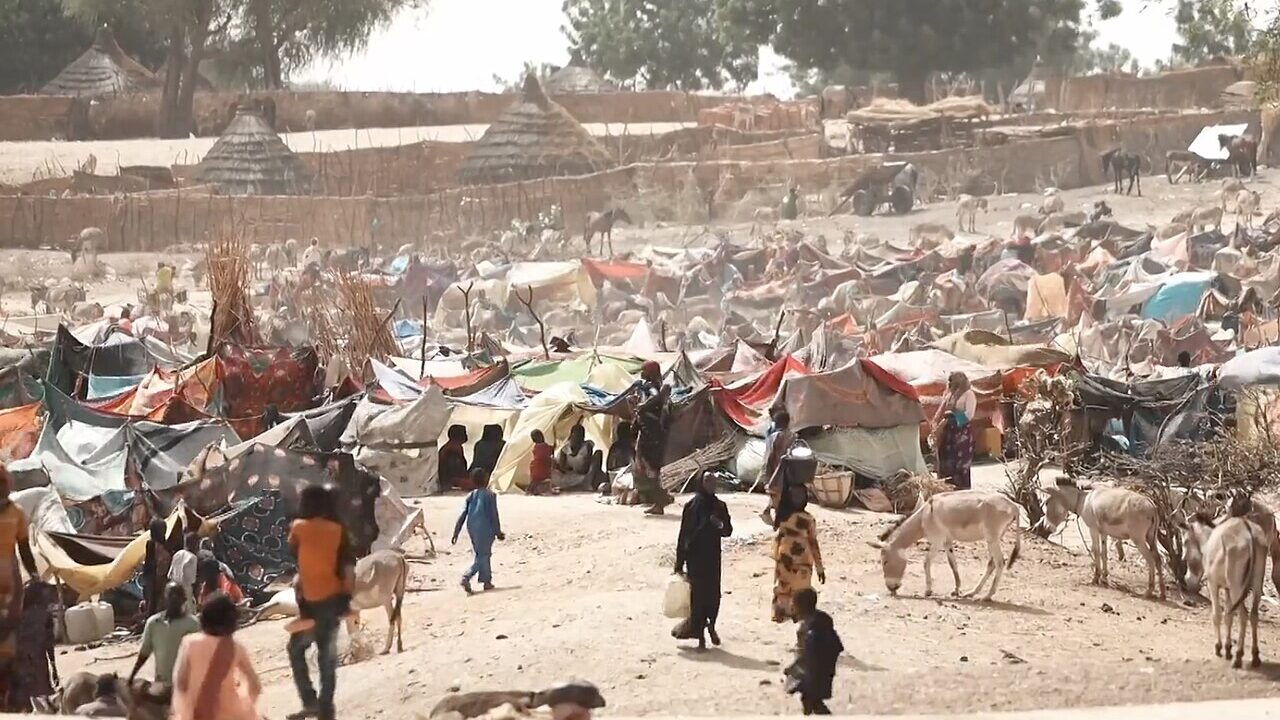
Ideological positioning and rhetoric, however, do not mask the civil war’s unbridled brutality. Both sides have engaged in sexual violence, starvation tactics, ethnic cleansing and indiscriminate killings of noncombatants. As of late 2025, the death toll was conservatively estimated by the BBC at 150,000; Tom Perriello, a former US special envoy to Sudan, placed it at 400,000, prompting successive presidential administrations to characterize it as a genocide. A six-week RSF assault on North Darfur’s capital el-Fasher, in autumn 2025, may alone have killed up to 100,000 people, many from non-Arab, Black communities. According to the UN, upwards of 8.6 million Sudanese have been internally displaced, with a further 3.8 million fleeing to neighbouring states such as Egypt, Chad and South Sudan. Nearly half the population now faces acute food insecurity, with hundreds of thousands at risk of famine.
Sudan as a proxy war for geopolitical interests
Much like its north-eastern neighbour, Libya, Sudan seems to have reached a grim stalemate, with neither side capable of a decisive victory. Likewise, as in Libya, the Sudanese civil war is sustained by the involvement of a myriad of external actors pursuing their own geostrategic ambitions. International involvement has done little to encourage compromise; instead, it has solidified the battlefield deadlock.
The SAF has drawn primary support from powerful Muslim states. Turkey has supplied drones, munitions and advisers as part of its broader ambition to expand influence along the Red Sea, while Qatar has financed the SAF’s purchase of such weapons. Egypt and Saudi Arabia, prioritising border security and state continuity, have provided diplomatic backing to the SAF in its quest for recognition as Sudan’s legitimate government. Russia initially aligned with the RSF, facilitating gold and oil smuggling to finance its war in Ukraine, before pivoting in 2024 towards the SAF in exchange for access to a Red Sea naval facility. Iran has also furnished the SAF with attack drones and is reportedly exploring the use of its Russian ally’s planned port as a hub for Red Sea power projection and increased support for its Houthi partner in Yemen.
The RSF’s most significant foreign patron is the United Arab Emirates. Abu Dhabi has reportedly provided financial and military support, assisted in exporting Sudanese gold, and received RSF fighters in return to reinforce Emirati-backed forces in southern Yemen. The RSF alliance fits conveniently into the UAE’s regional strategy: countering Islamist movements, projecting influence through economic leverage and competing with Saudi Arabia for leadership in the wider Middle East. Ethiopia, a close UAE partner and at odds with Sudan over its controversial Nile River dam, has trained RSF troops on its soil. China has officially declared neutrality, seeking primarily to safeguard its Belt and Road investments, while allowing weapons manufactured by Chinese firms to reach both sides through third parties.
Diplomatic efforts have failed to de-escalate the situation. Mediation has fractured across three overlapping initiatives, which more often undermine rather than complement one another. The African Union track has been constrained by Sudan’s earlier suspension from the body and accusations of pro-SAF bias. A dialogue effort by the Intergovernmental Authority on Development (IGAD), an eight-member East African bloc that reinstated Sudan in 2026, faces similar impartiality problems. A separate “Quad” initiative — bringing together the United States, Egypt, Saudi Arabia, and the UAE — has been hamstrung by the conflicting interests of its Arab members. The Trump administration’s engagement, meanwhile, has been inconsistent: sanctions have been limited, enforcement uneven, and Sudan has rarely featured among its top foreign-policy priorities.
A rising risk of regional spillover
As the war intensifies and both sides maintain deliberate opaqueness — denying responsibility for attacks and instinctively blaming the other side — the danger grows of miscalculations that could extend the civil war beyond Sudan’s borders. Days before the hospital strike, a Sudanese drone attack killed 17 civilians in neighbouring Chad, prompting threats of retaliation from President Mahamat Idriss Déby. Sudan’s western neighbour had already closed its border following repeated clashes between RSF fighters and SAF-aligned militias that crossed into its territory. Yet, as with the hospital strike, both the RSF and the SAF denied responsibility, leaving it unclear as to how — or against whom — N’Djamena might respond.
Other events in the first three months of 2026 suggest that Sudan’s neighbours anticipate an internationalisation of the conflict. Egypt’s recent deployment of drones along its southern border suggests that Cairo’s support for the SAF could escalate from diplomacy into overt military involvement. Meanwhile, the RSF’s recent capture of a southern border town near Ethiopia has fuelled suspicions in Khartoum of Addis Ababa’s tacit backing for Hemedti. Retaliatory SAF measures — potentially involving arming northern Ethiopian Tigrayan insurgents seeking autonomy from Addis Ababa — could draw Sudan’s neighbours into a larger East African conflagration.
This diplomatic inertia carries acute consequences. Sudan’s war endures not because its stakes are low, but because the international community regards them as insufficiently consequential. Overshadowed by other crises, the SAF–RSF conflict drags on, with no end in sight and a mounting human toll. Yet this wilful neglect risks backfiring, as recent developments indicate the war’s potential to expand beyond Sudan’s borders. Against the backdrop of the region-wide, globally-impactful Iran conflict and persistent tensions across the Arab world, an internationalised Sudanese war would further destabilise the Middle East — an outcome the world can ill afford.