

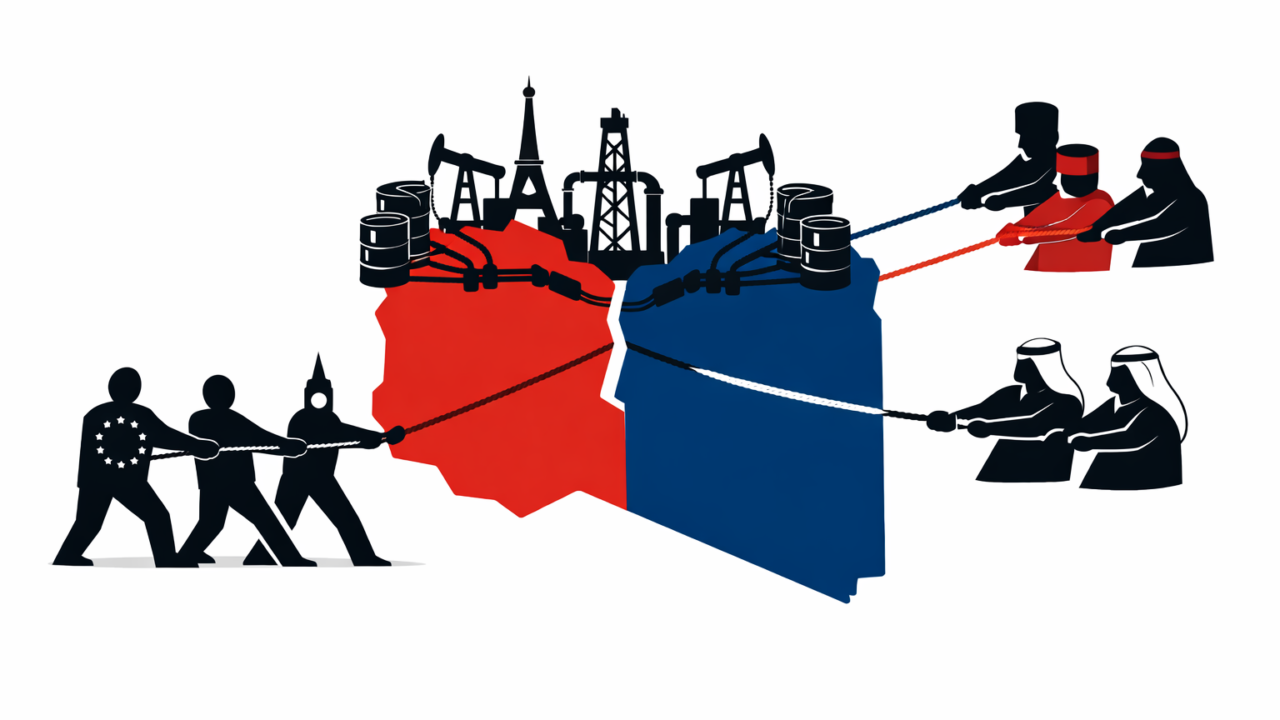
An orderly Libya offers badly needed remedies for global energy markets, particularly for at-risk Europe. At a time of prolonged global energy insecurity, all the more exacerbated by the uncertain trajectory of the Iran War, the international community can ill afford to overlook Libya’s potential.
Libya emerged from the Arab Spring as one of the most battered states in the region, making headlines for all the wrong reasons: lawlessness, jihadist insurgency, regional fragmentation and even the reappearance of slave markets. In the final decade of his 42-year rule, Muammar Qaddafi had sought rapprochement with the international order, renouncing terrorism and weapons of mass destruction and securing the lifting of UN sanctions to revive hydrocarbon exports. Yet homegrown protests inspired by Cairo’s Tahrir Square soon escalated into an armed uprising, culminating in a US-backed intervention that deposed the Libyan dictator.
The aftermath proved anything but stable. Years of multi-factional civil war left the country divided between rival governments. Libya’s once formidable energy sector deteriorated, while the security vacuum turned it into a key departure point for irregular migration to Europe. Entrenched corruption, competing local factions and the involvement of external powers have since complicated any path towards national recovery.
A state divided
Today Libya’s division appears entrenched. Neither side appears capable of reunifying the country by force, while foreign actors continue to compete for influence based on their own interests. The northwest is controlled by the internationally recognised Government of National Unity (GNU), based in Tripoli and led by Abdul Hamid Dbeibeh, whose UN mandate officially expired in 2021. The GNU’s authority remains fragile, constrained by rival militias that frequently clash with it and against each other, even in the capital. Its survival depends heavily on external support from Turkey, Qatar and European partners.
Turkey’s role extends well beyond diplomacy. Its 2019 military intervention prevented the fall of Tripoli to the rival government and evolved into a lasting presence, securing Ankara a strategic foothold in the southern Mediterranean. A controversial maritime agreement with the GNU has further strengthened its position, challenging the interests of Greece and Egypt and complicating efforts to jointly develop Eastern Mediterranean gas resources and infrastructure.
The less populated east and much of the south are controlled by the Libyan National Army (LNA). Although nominally governed by a House of Representatives, real power rests with Khalifa Haftar, a former Qaddafi-era general. After his failed 2019 offensive against Tripoli, Haftar consolidated control in the east and appears to be positioning his sons for succession. Despite lacking formal international recognition, his administration enjoys tacit backing from several regional and global actors.
The United Arab Emirates provides financial and military support, viewing Haftar as a counterweight to Islamist factions aligned with the GNU. Egypt supplies intelligence, security training and logistical assistance, seeking stability along its western border. Russia has entrenched its presence through the mercenary Afrika Corps (successor to the Wagner Group), which protects energy infrastructure and operates airbases, using eastern Libya as a platform for broader influence in Africa. For Moscow, Libya offers both strategic reach and a means of countering Turkish ambitions in the Mediterranean — especially after losing its Syrian foothold following the ouster of Bashar Al-Assad.
Energy dynamics drive policy focus
This geopolitical “great game” across Libya’s chessboard is driven above all by energy. The North African state possesses one of the world’s ten-largest proven oil reserves — around 48 billion barrels. Natural gas deposits are almost as significant, at 1.5 trillion cubic meters, positioning it within the world’s twenty largest reserves. Although years of conflict severely disrupted production, a fragile stalemate since 2023 has allowed output to gradually recover. Crude oil production has risen from a low of 400,000 barrels per day (bpd) in 2016 — the height of the civil war — to approximately 1.4 million bpd in 2025, most of it exported to Europe, with smaller volumes reaching Asia.
The partial stabilisation of the security environment has spurred renewed foreign investment from global supermajors such as ExxonMobil, Chevron and TotalEnergies. The National Oil Corporation (NOC), aligned with the Tripoli government, has signed exploration and development agreements with various international firms and completed Libya’s first licensing round in the post-Qaddafi era. These efforts aim to expand production output and, in the longer term, increase oil and gas exports to Europe and elsewhere.
Libya’s importance has grown amid global energy uncertainty in recent years, especially amid Russia’s prolonged war in Ukraine. Yet realising its potential depends on political cohesion, which remains elusive. Fragmentation continues to undermine infrastructure, disrupt production and deter sustained investment. Armed groups frequently halt output to extract economic and political concessions, while parallel financial systems weaken institutional credibility.
The Central Bank in Tripoli has been forced to accommodate eastern spending with counterfeit currency and other dubious financial practices, effectively sustaining a dual fiscal structure. This arrangement perpetuates inefficiency and opacity, at times delaying payments to foreign operators. Although contracts are administered through the NOC, it lacks the authority to resolve these systemic challenges and serves as a deterrent for meaningful actualisation of the state energy firm’s agreements with multinationals.
Against this backdrop, the United States has advanced Libya’s reintegration as a foreign policy objective. Washington views the North African state’s stability as integral to its regional security architecture and global energy supply diversification, as well as a means of curbing Russian influence. In late 2025, it spearheaded a joint statement with European, Gulf Arab and Turkish partners supporting UN-led reconciliation and encouraging greater coordination between Libya’s rival authorities. Russia’s absence from the initiative underscored the geopolitical stakes.
Washington’s on-the-ground efforts have prioritised military cooperation between the two governments as a precursor to political and economic rapproachment. Senior commanders from US Africa Command (AFRICOM) have met counterparts on both sides, promoting professionalisation and increased cooperation. This spring, AFRICOM will convene the annual Flintlock training — its largest special operations drill — on Libyan soil, with each government’s armed forces participating. This approach has also led to a pragmatic policy shift: General Haftar is increasingly treated as an essential asset to any future settlement rather a hindrance to integration. The Trump administration’s hosting of the LNA strongman invited at this year’s Munich Security Conference served to normalise him on the world stage.
Libya’s stabilisation remains critical for maximising reliable energy exports. Years of conflict have left petroleum infrastructure degraded, post-war patronage networks institutionalise corruption, and the bifurcated state fragmentation enables local actors to disrupt production according to their whims.
Yet the stakes are urgent. An orderly Libya offers badly needed remedies for global energy markets, particularly for at-risk Europe. At a time of prolonged global energy insecurity, all the more exacerbated by the uncertain trajectory of the Iran War, the international community can ill afford to overlook Libya’s potential. Achieving this will require consistent, coordinated international leadership, as well as a willingness among domestic actors to compromise. Washington’s recent initiative to promote national reintegration may be just the essential formula needed to make Libya great again.