

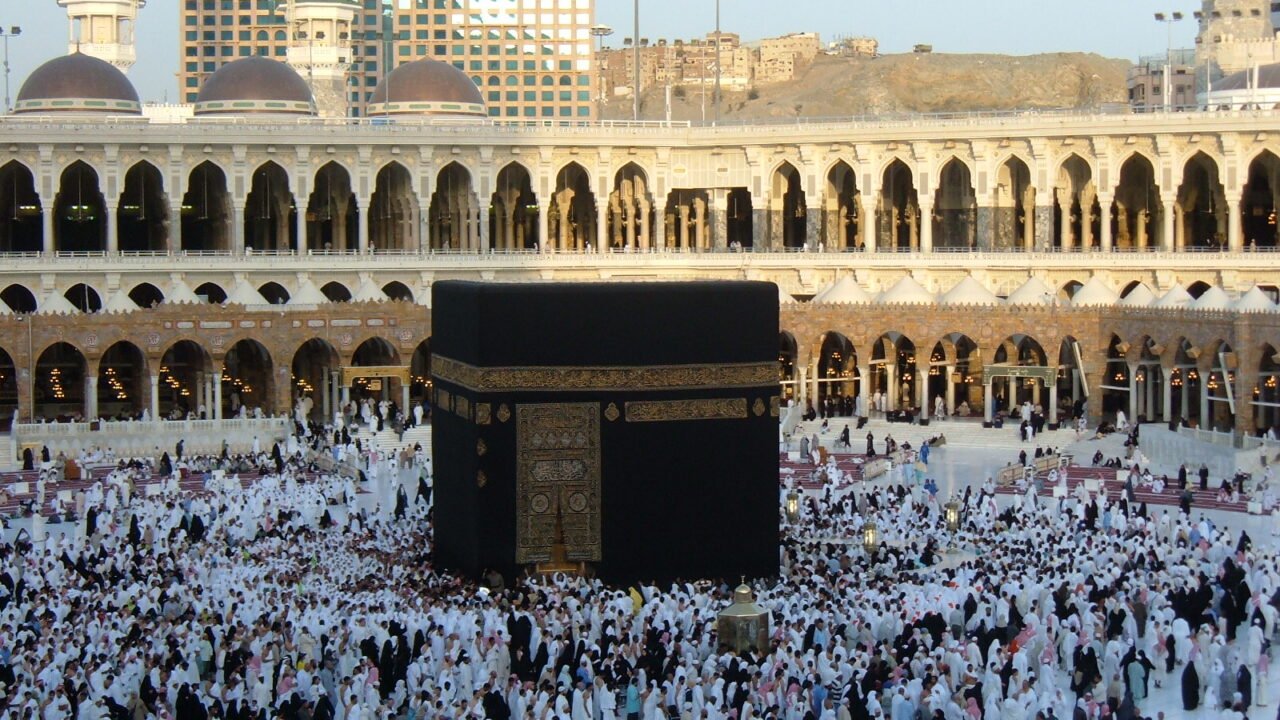
Riyadh’s reputation is at stake against the backdrop of the Iran War and its ongoing fallout. Saudi Arabia’s de facto ruler, Crown Prince Muhammad Bin Salman, is therefore striving to ensure an incident-free Hajj in order to recalibrate the kingdom’s standing.
This week, roughly 1.5 million Muslim pilgrims will converge on Mecca to fulfill their religious obligation of Hajj. Visitors will spend several days in and around Islam’s holiest city, performing rituals that must be undertaken at specific times and places beginning on 25 May. Overlapping with this key tenet of faith is Eid Al-Adha, one of the two primary holidays in the Islamic calendar and an essential feature of the Muslim seasonal rite. Whilst 1.5 million is no small number, it nonetheless represents a decline from 1.675 million in 2025 and a significant fall from the pre-COVID peak of nearly 2.5 million in 2019, a downturn undoubtedly shaped by both official and personal security concerns amid still-unresolved tensions with Iran.
In the Hajj of 2026 — or its Islamic equivalent of 1447 AH — the Saudi Arabian authorities overseeing this complex but prestigious pilgrimage face more than the usual logistical challenges of mass crowd management. This season more than any other, Riyadh’s reputation is at stake against the backdrop of the Iran War and its ongoing fallout. With its economy battered by Tehran’s closure of the Strait of Hormuz and attacks on energy infrastructure, and its territory still subject to aerial threats despite the ceasefire, the Saudi kingdom’s image as a stable and secure Muslim Middle Eastern power was significantly dented.
Saudi Arabia’s de facto ruler, Crown Prince Muhammad Bin Salman, is therefore striving to ensure an incident-free Hajj in order to recalibrate the kingdom’s standing both within the Islamic world and on the broader geopolitical stage. Faced with unprecedented US and European travel advisories warning their Muslim citizens against making the pilgrimage due to regional Middle East hostilities, Riyadh additionally seeks to reassure over a million foreign visitors that this year’s Hajj is no more dangerous than any prior season. In parallel, it is actively lobbying the Trump administration to forgo renewed military action against its northern Shia neighbour — at least until the pilgrimage has concluded and the million-and-a-half pilgrims have returned home.
One of Islam’s five core pillars, the Hajj is composed of a number of ritualistic ceremonies and acts, which must be performed by all able-bodied Muslims at least once in their lifetime. The mandatory pilgrimage must take place within a specific timeframe, between the 8th and 12th or 13th of Dhu al-Hijjah, the twelfth and final month of the Islamic calendar. (This is in contrast to the lesser, non-obligatory Umrah, which may be completed at any other time of year.)
Given this narrow window in which masses of believers travelling from across the globe must perform rituals at fixed sites, culminating in the circumambulation of the Kaaba and the Grand Mosque, the need for centralised logistical authority has long been apparent. Historically, Muslim empires such as the Ottomans and the Mughals coordinated Hajj visits for their subjects through secured caravans to reach Mecca and fend off occasional Bedouin raids, uneasily coexisting once their respective delegations converged on the holy city.
In the modern era, the Saudi state has consolidated control over the Hajj process, becoming the exclusive authority empowered to determine how many Muslims from across the world may receive specialised visas each year, and from which countries. On the ground, Saudi authorities oversee all aspects of one of the world’s largest annual gatherings, including site security, flights, food and beverage provision and lodging. The government has also been compelled to address persistent crowd management challenges such as stampedes, as well as hazards unique to the location — most notably, protecting pilgrims from Mecca’s harsh year-round desert climate. The urgency of this unique concern was underscored by the deaths of more than 1,300 pilgrims in 2024 due to extreme heat.
Saudi management of Islam’s most sacred sites, and by extension the Hajj, has long served as a tool by which the monarchy reinforces its legitimacy at home and abroad, and counters rival claimants to Islamic leadership. Since 1986, the Saudi king has formally held the title of “Custodian of the Two Holy Mosques” — the second mosque being the Prophet’s Mosque in Madinah, some 450 kilometres to the north — in favour of the hitherto used “His Majesty”. The title, which had been used by earlier Islamic rulers from Saladin to the Ottomans, was adopted by King Fahd in order to emphasise the monarchy’s transnational religious stewardship over its territorially bounded secular role. The decision followed several years of sustained attack from conservative Muslim forces accusing the kingdom of insufficient Islamic governance: both from the revolutionary Iranian regime and from homegrown Sunni radicals seized the Grand Mosque in 1979.
The Hajj has indeed served as a recurring arena for Iranian-Saudi strategic competition. Post-1979, revolutionary Iran has periodically sought to exploit the pilgrimage to challenge Saudi Arabia’s custodianship of Mecca and to contest broader influence over the Muslim world. In 1987, Tehran organised rallies among its pilgrims in the holy city, denouncing the Saudi royal family and its alliance with the United States; the resulting clashes with Saudi security forces left more than 400 people dead, of whom 275 were Iranian.
The Islamic Republic subsequently boycotted the Hajj for three years. Against the backdrop of deepening regional sectarianism in the 2010s and the two powers’ clash via proxies in Yemen, the 2015 Hajj stampede further inflamed relations, with Iranians accounting for more than 1,000 of the victims. Diplomatic ties were severed the following year, after Iranian protestors damaged Saudi consular premises in Tehran and Mashhad in protest of Riyadh’s execution of a prominent dissident Shia cleric.
In recent years, Riyadh has pursued deconfliction and détente with its Shia rival, deploying a non-confrontational, pragmatic Hajj policy as one such instrument to limit friction. Following the 2023 bilateral normalisation agreement, diplomatic ties were restored and Saudi Arabia incrementally raised its annual Hajj quota for Iranian pilgrims to 87,500, introducing dedicated pilgrim flights from several Iranian cities. The Saudis have sought to sustain this diplomatic track even after coming under direct Iranian attack this year, and at times contrary to the preferences of fellow Gulf Arab states such as the UAE. Within weeks of the early April ceasefire — and despite considerable economic damage from Iranian strikes and vocal criticism of Iranian conduct from within the country’s Sunni religious establishment — Saudi authorities concluded Hajj arrangements with Iranian service providers to accommodate 30,000 pilgrims. Iranian state media indicate that this agreement has been upheld as the pilgrimage gets under way.
Against this backdrop of seeking to reclaim its credibility and religious leadership, it is unsurprising that Saudi Arabia has a strong interest in opposing any US plans to renew military action against Iran until the Hajj season is over. Several media reports have suggested that the pilgrimage was a factor in President Trump’s 19 May statement calling off fresh strikes on Tehran at the last minute, with accounts indicating that Saudi Arabia and other regional allies explicitly appealed to the need to safeguard the fulfilment of a time-honoured Muslim obligation.
In the contest for influence and prestige across the global Muslim community, Riyadh understands the importance of ensuring the safe passage of pilgrims even under the most taxing circumstances. The monarchy’s relations with Muslim demographic and geostrategic heavyweights such as Egypt, Pakistan, Indonesia and Turkey are in no small part conditioned on guaranteeing the well-being of thousands of each country’s citizens during this week-long period, arguably as important a factor in shaping bilateral relations as the kingdom’s oil resources and migrant workers’ remittances.
Saudi fears that Iranian missiles could strike key regional aviation hubs — whether on Saudi soil or in neighbouring Arab states such as Qatar and the UAE — used to transport pilgrims, or cause damage to critical infrastructure and the holy sites themselves, represent a scenario too risky to contemplate. Whatever the economic costs of the current conflict, the reputational harm of a Saudi Arabia unable to ensure the safety of its Muslim guests could take a generation to repair. As the kingdom’s young, forward-looking leadership seeks to diversify its economy beyond hydrocarbons and cultivate its tourism potential, the stable and predictable flow of Hajj pilgrims constitutes one vital growth engine that it must protect at all costs.