

The 24 May attack was one of Pakistan’s deadliest in recent years and follows a growing pattern of BLA assaults on railway infrastructure. Coupled with Islamabad’s escalating “Open War” with its former Taliban ally in Afghanistan, Pakistan’s US-Iran mediator role risks being derailed from the prestigious position it has long worked to cultivate.
Members of Pakistani security forces and their families in Quetta, the capital of the Balochistan province, were looking forward to spending the upcoming Eid al-Adha holiday at home, unaware that a single morning would put Pakistan’s US-Iran mediator role and its image as a stable regional power to the test. On the morning of Sunday 24 May, a special shuttle train was ferrying them from military bases in north-western Pakistan to connect with the Jaffar Express, a country-spanning passenger line offering onward connections to their home towns. For many of those aboard, however, the festival was not to be.
A suicide bomber driving an explosive-laden vehicle rammed the train, derailing the engine car, overturning several carriages and scattering debris along the tracks. Pakistani authorities have put the death toll at 47, including 20 military personnel, with 98 wounded — figures expected to rise. The Baloch Liberation Army (BLA), an armed separatist organisation representing the country’s Baloch minority, claimed responsibility. The group, which the United States designated as a terrorist organisation in August 2025, asserted that its dedicated suicide-attack unit, the Majeed Brigade, had inflicted far greater losses: 82 Pakistani soldiers killed and a further 121 wounded.
Prime Minister Shahbaz Sharif was swift to denounce the attack, and Pakistan secured a quick condemnation from the UN Security Council. Within hours, Sharif was in Beijing to court Chinese involvement in a prospective American–Iranian agreement, accompanied by his military chief, Field Marshal Asim Munir. Islamabad’s optics sought to convey a domestic situation under control — a managed conflict that does not impede Pakistan’s ability to act meaningfully on the international stage. Above all, by projecting a “business as usual” narrative, Pakistan’s ruling elite seeks to preserve the country’s US-Iran mediator role, advancing a durable diplomatic solution to a major source of global instability., a task in which Munir has invested considerable personal capital and for which he has earned praise from President Trump.
Yet Sharif and Munir may be compelled to reorient priorities towards security at home, as the challenges grow too grave to ignore. The 24 May attack was one of Pakistan’s deadliest in recent years and follows a growing pattern of BLA assaults on railway infrastructure — part of an increasingly brazen campaign against security forces and state assets in pursuit of Baloch independence. Coupled with Islamabad’s escalating “Open War” against its former Taliban ally in Afghanistan, with its rising human costs and international opprobrium, Pakistan’s US-Iran mediator role risks being derailed, and with it the prestige it has long worked to cultivate.
The disenfranchised Baloch escalate an autonomy bid
The BLA’s armed struggle represents a long-running, unresolved conflict between a marginalised minority and a security-obsessed central government. Living primarily in the south-western province that bears their name, the Baloch people numbered 8.1 million in the most recent census, held in 2023 — just over 3% of the country’s 241 million citizens and slightly more than half of the estimated 15 million global Baloch population. The community developed a distinct ethnic identity over centuries in the arid plateau where Pakistan, Iran and Afghanistan converge, bound by two languages (Balochi and Brahui) and a tribal social structure.
The Kalat Khanate united most Baloch tribes into a self-governing state between the 17th and mid-19th centuries, after which it functioned as an autonomous entity within British India from 1877 until the 1947 Partition. Some Baloch leaders sought to preserve self-rule after the United Kingdom’s departure; instead, the territory was merged into the newly created Pakistan in 1948. What Islamabad called legal integration was denounced by many Baloch as unjust annexation that contravened the community’s aspirations.
This fateful sequence of events forged a historic grievance narrative of independence denied that has inspired successive uprisings in the decades since. Islamabad’s heavy-handed responses — jailing community leaders, conducting lethal airstrikes and imposing martial law — further fuelled separatist sentiment. A subsequent moderation of demands, for economic and political autonomy, have been rebuffed, with Baloch leaders accusing the state of centralising power and failing to honour constitutional commitments to minority rights.
Baloch alienation has also been deepened by decades of socio-economic neglect. Though Balochistan accounts for more than 40% of Pakistan’s land area and holds substantial natural gas and mineral reserves, the revenues from those resources, discovered in 1952, have largely been siphoned off to development projects elsewhere in the country. Punjabis from the north-east have been favoured in whatever commercial initiatives have taken root in the province. In the past decade, new resentment has accrued over China’s Belt and Road investment in the Gwadar port — the so-called China–Pakistan Economic Corridor (CPEC) — in which Chinese expatriates and transplanted Punjabis have secured the well-paying positions. More than half of Baloch citizens live below the poverty line or are illiterate, and the community’s representation in Pakistan’s business sector, diplomatic corps and military is virtually non-existent.
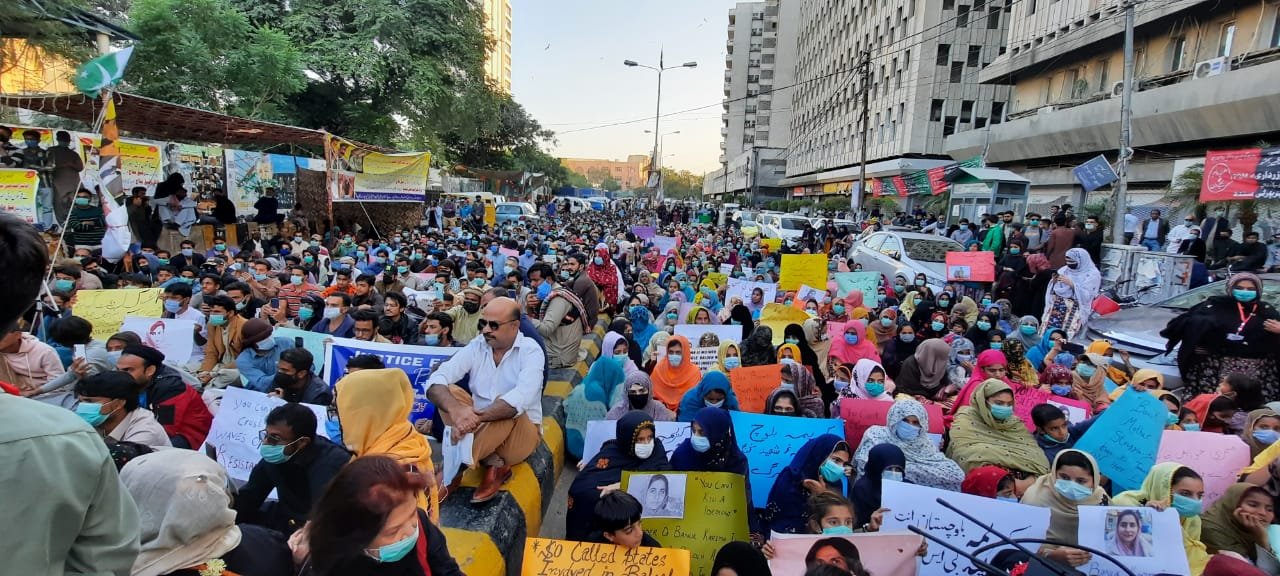
Compounding these long-standing frustrations, Islamabad has waged a concerted campaign of enforced disappearances against community leaders. Pakistani security services have widely expanded this practice since the outbreak of a low-level Baloch insurgency in the 2000s. Community activists claim that more than 7,000 people — especially politicians, journalists, lawyers and students — have been abducted without legal basis since 2004, their whereabouts unknown to families and authorities refusing to account for them. Some Baloch have turned to protest, assembling years-long encampments in Quetta and other cities to demand answers. Advocates of armed struggle, however, argue that such measures fall on deaf ears, accusing Islamabad of avoiding political dialogue and treating Baloch identity as an inherent security threat.
The BLA has capitalised on these long-standing feelings of humiliation and marginalisation, drawing recruits with appeals to gender equality, democratic internal governance and savvy social media messaging directed at a growing educated Baloch middle class. The movement claims between 5,000 and 6,000 fighters — eclipsing legacy separatist groups that relied on traditional tribal patronage. Despite its secular, left-leaning character, it began deploying suicide attacks through its Majeed Brigade in 2018, including female recruits. In parallel, the BLA refined its tactics from simple guerrilla hit-and-run operations to sophisticated assaults on state infrastructure and security forces, demonstrating capabilities that caught Pakistani authorities off guard.
Since 2023, the BLA has carried out around 50 attacks on railroad targets alone, including a suicide bombing at Quetta station in November 2024 and the 30-hour hijacking of the Jaffar Express in March 2025, which ended in a deadly assault by security forces that killed both passengers and militants. The group has also intensified attacks on Chinese infrastructure projects in the region. In January of this year, it demonstrated a new degree of operational sophistication by simultaneously storming police stations, military bases and highways in a three-day battle across the province that compelled Pakistani forces to unprecedentedly deploy air power. Several weeks ago, the BLA added a maritime dimension to its combat capabilities, killing three Pakistani coastguard personnel in its first seaborne attack.
Measured against these trends, the Quetta suicide attack represents a logical continuation of the BLA’s armed escalation and a demonstration of strengthening intelligence and logistical capabilities. Such attacks are likely to persist amid Islamabad’s failure to mount a credible military or political response, further draining the human and financial resources the state needs to sustain its international ambitions.
The former Afghan ally turned adversary
If Field Marshal Munir can plausibly frame the Baloch threat as a containable insurgency in sparsely populated western hinterlands, he will find it harder to dismiss the escalating conflict with Afghanistan’s Taliban government and the affiliated domestic jihadist movement it has emboldened. The Tehrik-e-Taliban Pakistan (TTP) has sharply intensified its militant activities in recent years, destabilising Pakistan from within and damaging its international standing.
Since reasserting control of Afghanistan in 2021, the Taliban have grown increasingly estranged from their former Pakistani patron. Islamabad has repeatedly accused the Islamist government of harbouring and training TTP militants to carry out cross-border attacks. By March 2024, heated rhetoric had given way to kinetic action, with Pakistan launching airstrikes against suspected militant hideouts in Afghanistan. Over the following two years, the sides clashed repeatedly — generally characterised by Pakistani strikes on TTP assets and retaliatory Taliban ground assaults on Pakistani border outposts.
By October 2025, both sides were describing a state of war, with the Pakistani Air Force bombing Kabul for the first time in response to a TTP attack that killed 11 Pakistani troops. A Turkish and Qatari-brokered ceasefire held until late February 2026, after which both parties escalated once more, seemingly emboldened by the international community’s overwhelmingly preoccupation with the Iran War and its global economic consequences. That window of reduced scrutiny encouraged unparalleled brutality, epitomised by a Pakistani airstrike on a Kabul rehabilitation facility. The attack killed at least 269 people, according to the United Nations, and is believed to be the deadliest single incident in Afghanistan’s recorded history.
The fighting has killed hundreds of civilians on both sides of the border and displaced at least 100,000 people. Chinese mediation efforts to secure a ceasefire have so far proved elusive. Relations have been further strained by Pakistan’s accelerated deportations of Afghans, many of whom have resided in the country for more than a generation; in 2025, Pakistan forcibly removed more than one million Afghans from its territory. The ongoing war has not slowed the campaign; rather, it has quickened it, raising the prospect that aggrieved deportees may be drawn to the TTP.
Against this backdrop, the Global Terrorism Index — published by the Institute for Economics and Peace think tank — ranked Pakistan as the world’s most affected country by terrorism in 2025, with 1,045 attacks and 1,139 deaths, the highest figures since 2013. Released in March 2026, the report landed as an embarrassment for Islamabad just as it was cultivating its image as an indispensable Iran War diplomatic broker.
A diplomatic role under strain?
As if these security burdens were not enough, Sharif and Munir must also contend with a persistent transnational jihadist threat. The Islamic State, though less active in Pakistan than the TTP, has demonstrated an equally formidable capacity for harm. In February 2026, the group dispatched a suicide bomber to a Shia mosque in the capital, killing 31 people and injuring 170 in the deadliest attack in the capital since 2008.
To the east, the military and political leadership watches apprehensively as the country marks the anniversary of last year’s four-day war with India. While the Washington-brokered ceasefire has tenuously held, the two sides have suspended all trade and cultural exchanges, closed borders and halted co-operation on the strategically beneficial Indus Waters Treaty. Both militaries remain deployed in force along the frontier, raising the risk of miscalculation between the two nuclear-armed states.
A Qatari negotiating team‘s reported arrival in Tehran in late May was interpreted by observers as a signal that Washington may be losing confidence in Pakistan’s capacity to facilitate a comprehensive deal with Iran and is seeking to broaden its roster of intermediaries. Whether the White House chooses to downgrade Islamabad’s role or not, Pakistan’s formidable adversaries at home and along its borders may leave the government with no choice but to attend to the threats for which time is rapidly running out. The worsening security environment in South Asia, which Islamabad appears unable to contain, could ironically leave Pakistan’s bid to end Middle East strife dead in its tracks.