

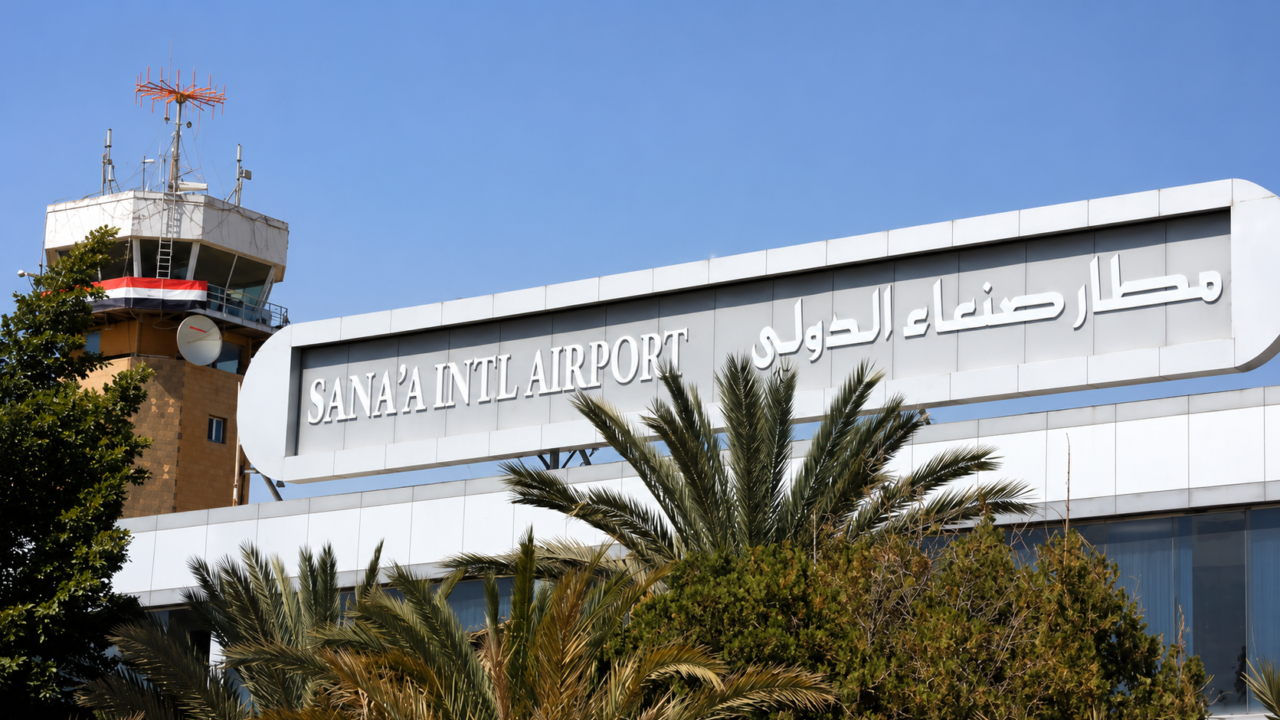
Four years of quiet ended over a runway. On 13 July Saudi-backed forces bombed the airport at Sana’a, Yemen’s Houthi-held capital, to stop a plane from completing its journey. The Houthis, an Iran-backed militia ruling Yemen’s north, replied within hours with ballistic missiles and drones aimed at Abha, a Saudi holiday town near the border. A week later they went further still, declaring today a full naval Houthis blockade of Saudi Arabia, in their own words an “eye for an eye” for a Saudi siege they say has lasted almost 12 years.
The proximate cause was a seemingly minor argument over which aircraft could land where. The consequences may not be. What looks, at first glance, like a parochial spat over Yemeni airspace sits atop a truce that both Riyadh and the Houthis had many reasons to preserve, at a moment when a far larger war between Iran, Israel and America is already reshaping the entire region. A local fire, in other words, is burning next to a great deal of fuel. The blockade may prove to be the moment that fragile balance finally breaks down.
The flight that broke the truce
The trouble began not with a bomb but a funeral. When Iran’s supreme leader, Ali Khamenei, was buried earlier this month, a Houthi delegation flew to the ceremony aboard a Mahan Air jet — the commercial arm, more or less, of Iran’s Revolutionary Guard, and a firm already under American sanctions. For more than a decade, aircraft entering Yemeni airspace have needed clearance from the Saudi-led coalition, which has used that leverage specifically to stop Iranian flights from reaching Houthi territory, for fear they would ferry arms or advisers. Saudi jets reportedly tried and failed to intercept the plane on its way out; the Houthis warned that a repeat attempt would spark attacks on Saudi airports.
It came anyway. As the delegation’s plane made its return journey, Yemen’s internationally recognised government — based in Aden, armed and bankrolled by Riyadh, though not Saudi Arabia’s air force itself — struck Sana’a’s runway to force it down elsewhere. The plane diverted to Hodeidah, a Houthi-held Red Sea port. Whatever the technical distinction between “Saudi Arabia” and “the Saudi-backed government of Yemen”, the Houthis drew none and treated the strike as Riyadh’s own. Within hours, missiles and drones hit Abha; the Saudi-led coalition said its defences intercepted them without casualties. Within a week, the Houthis had escalated again, this time targeting merchant shipping rather than military infrastructure. The blockade, unlike an airport strike, cannot easily be contained to two capitals.
Why Riyadh took the risk
The Yemeni government’s official account is that it was protecting its own sovereignty, not doing Saudi Arabia’s bidding. Few believe that is the whole story. According to Axios, Saudi Arabia briefed Washington in advance and asked for political cover before acting: the Saudi ambassador met America’s secretary of state, the two countries’ foreign ministers spoke, and President Donald Trump personally gave Crown Prince Mohammed bin Salman his backing for military action in a phone call two days before the strike. That MBS sought Mr Trump’s blessing before, rather than after, the fact suggests Riyadh knew it was taking a gamble — and wanted an ally on hand if the gamble went wrong.
The gamble looks larger set against the wider war. Saudi Arabia had spent the months since fighting broke out between Iran, Israel and America working hard to stay out of it, maintaining a careful diplomacy with the Houthis to keep them from joining in. American and Israeli planners, for their part, avoided provoking the Houthis for the same reason. The Sana’a strike puts that restraint at risk just as clashes between America and Iran escalate again: CENTCOM confirmed a third American service member’s death in recent days, following Iranian drone and missile strikes across Jordan, Iraq, Bahrain and Kuwait.
The landward workaround
That is the detail likely to alarm oil traders more than the missiles themselves. Saudi Arabia’s size has let it weather the Iran war better than smaller Gulf neighbours partly because it can move crude overland to a Red Sea port, bypassing Hormuz entirely. That workaround, however, depends on tankers sailing past hundreds of miles of Houthi-controlled coastline before reaching Bab-el-Mandeb, the strait linking the Red Sea to the Gulf of Aden. The Houthis have form here: during the Gaza war their drone and missile campaign brought traffic through the Red Sea and Suez Canal to a near-standstill for the best part of two years, and even after an American bombing campaign left the group battered, it retained the means to do so again. A declared blockade, even a loosely enforced one, threatens the very route Riyadh built to insulate itself from the Iran war.
A diplomatic vacuum
International reaction has been swift. At an emergency session of the UN Security Council, the organisation’s Middle East official warned that the region “cannot afford another cycle of escalation” and called for talks under UN auspices; Britain’s representative condemned the Houthi strikes on Saudi Arabia as reckless. Iran, unsurprisingly, condemned the Saudi-linked strike on Sana’a airport as a violation of international law. Tehran has every incentive to support a Houthi blockade at Bab-el-Mandab, effectively mirroring its own strategy in the Strait of Hormuz to squeeze global energy chokepoints simultaneously.
The Houthis have shown before that a limited, symbolic dispute can curdle into a maritime campaign with real economic teeth within days. If sustained, the Houthi blockade of Saudi Arabia could reshape regional energy routes, accelerate investment in alternative pipelines and draw the Red Sea back into the centre of Middle Eastern geopolitics.