

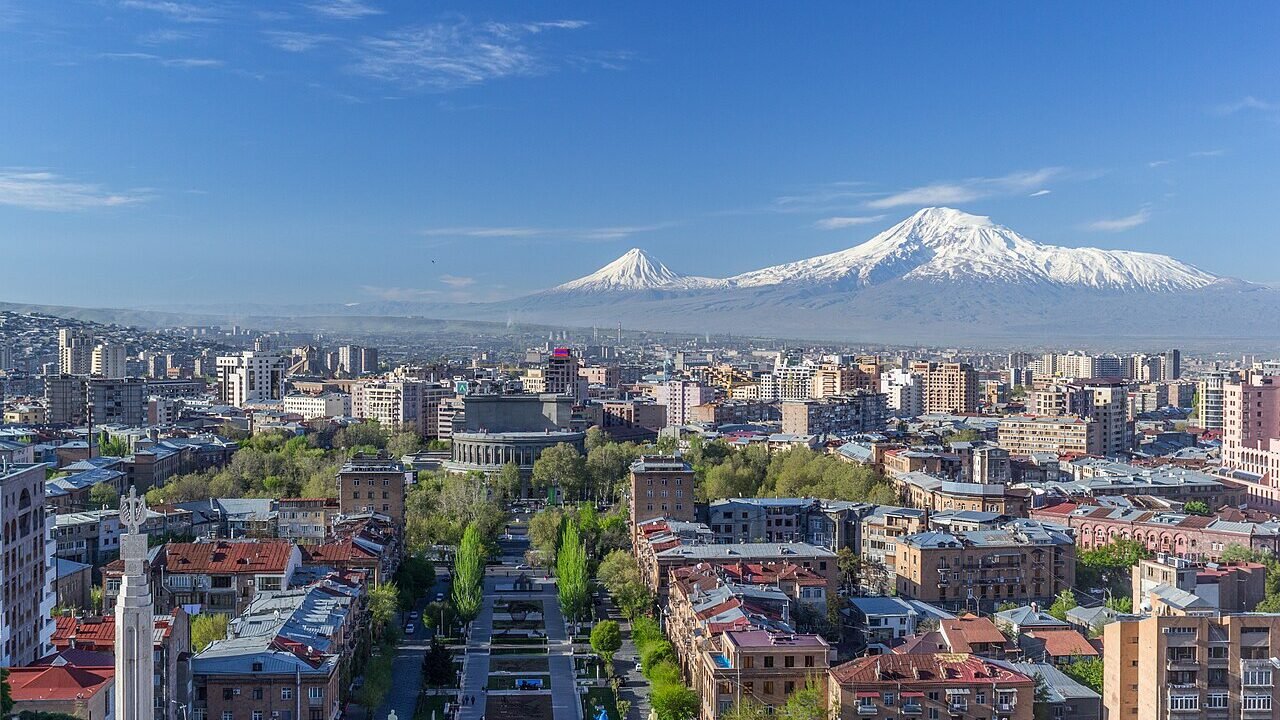
Since coming to power during the 2018 Velvet Revolution, Pashinyan has sought to reduce Armenia’s reliance on Russia, pursue closer ties with the West and prioritise regional adaptation over entrenched historical grievances. In Armenia’s 2026 election, the public endorsed the incumbent’s vision, choosing continued alignment with the West.
Armenians went to the polls on 7 June in a parliamentary election widely regarded as the country’s most consequential since independence from the Soviet Union in 1991. At stake was a fundamental foreign policy choice: whether to continue incumbent Prime Minister Nikol Pashinyan’s westward pivot towards the United States and the European Union, or return to strategic alignment with Russia, Armenia’s traditional security patron and largest trading partner.
Another issue of almost equal weight dominated the campaign: Pashinyan’s support for normalising relations with Armenia’s historic adversaries, Azerbaijan and Turkey, and his willingness to make previously taboo concessions in exchange for economic opportunities and regional integration. Armenia’s 2026 election was consequentially the first since its defeat in the 2023 war with Azerbaijan, which resulted in the loss of Nagorno-Karabakh, the dissolution of its self-governing administration (known by Armenians as the Republic of Artsakh) and the displacement of more than 100,000 ethnic Armenians.
Opposition parties campaigned on reversing the perceived national humiliation that occurred under Pashinyan‘s stewardship. They accused the incumbent of legitimising the loss of historic Armenian lands and surrendering to Baku’s conditions for reconciliation. Pashinyan countered that Armenia must realistically play the hand it was dealt, pragmatically engaging its longstanding foes to achieve long-term security and prosperity.
In Armenia’s 2026 election, voters endorsed the incumbent’s stance. Pashinyan’s Civil Contract party won 49.8% of the vote, compared with 23.2% and 9.9% for the pro-Moscow parties Strong Armenia and Armenia Alliance respectively. Although many voters expressed dissatisfaction with his leadership during the Karabakh crisis, even more rejected the notion that Armenia’s future lay in dependence on Russia. The result reflected widespread disillusionment with Moscow’s performance as a self-proclaimed security guarantor, especially after its peacekeeping force stood aside as Azerbaijan captured the autonomous Armenian enclave.
Armenia’s geopolitical limitations and Russian dependency
Since independence from the Soviet Union, Armenia has faced severe obstacles to its development, amplified by geography and history. It is a small, landlocked country with limited natural resources and a narrow industrial base. Economic underperformance has fuelled emigration, leaving the population stagnant at around 3 million and the state ill-equipped to confront threats from far more numerous and better-armed adversaries.
Border crossings have been closed with two of its four neighbours — Azerbaijan and Turkey — since the early 1990s due to unresolved conflicts. This semi-blockade forced reliance on Georgia and Iran for maritime access to global markets, with the former handling 70% of Armenian imports and exports and the latter the remaining 30%. Trade via these countries is susceptible to disruption, however, whether from Georgia’s conflicts with Russian-backed separatists in the Caucasus or recurring Israel–Iran confrontations.
These circumstances fostered overwhelming dependence on Russia. Moscow supplies 85% of Armenia’s natural gas, 60% of its petroleum products and 70% of its electricity, while Russian firms control key domestic infrastructure. Since independence, Armenia has been induced into hosting thousands of Russian troops and joining Russian-dominated institutions, including the Collective Security Treaty Organisation (CSTO) and the Eurasian Economic Union (EAEU), further keeping it within the Kremlin’s orbit.
The roots of the greater Western pivot
Since coming to power during the 2018 Velvet Revolution, Pashinyan has sought to reduce Armenia’s reliance on Russia, pursue closer ties with the West and prioritise regional adaptation over entrenched historical grievances. His approach survived the political fallout from Armenia’s defeat in a 2020 war with Azerbaijan. Voters re-elected Pashinyan in a snap election held months later, despite Yerevan’s losing significant lands adjacent to Karabakh, rejecting opposing parties that advocated for a restrengthened alignment with Moscow.
For Pashinyan, losing Karabakh itself served as a strategic wakeup call to Armenia. He suspended participation in the CSTO, arguing that Russia had failed to honour its collective defence commitments. He is now moving to reduce Russia’s military deployment in Armenia while expanding cooperation with Western powers.
In 2024, Yerevan launched a strategic dialogue with the European Union aimed at securing investment, visa liberalisation and, eventually, a pathway towards EU membership. Last month, Armenia hosted back-to-back EU economic summits in Yerevan, the highest-level engagements ever between Armenia and the bloc. The pre-election conferences intended to publicly telegraph Pashinyan’s commitment to a European economic orientation. Russia responded by restricting Armenian food and beverage exports and threatening to revoke discounted energy supplies should Armenia continue tilting toward Europe.
To overcome the Turkish–Azerbaijani deadlock, Pashinyan advanced his most ambitious initiative: flipping Armenia’s geopolitical isolation into a strategic advantage. His “Crossroads of Peace” proposal committed to restoring and expanding regional transport links, envisioning an Armenia at peace with its Turkic neighbours as a transit hub connecting Europe, Central Asia and the Middle East.
To advance this vision, Pashinyan lobbied the Trump administration for support, framing Armenian connectivity in “America First” terms that emphasised compatibility with US trade interests in Eurasia and counterbalancing China’s Belt and Road Initiative. The successful effort led to an August 2025 signing ceremony at the White House alongside Azerbaijani President Ilham Aliyev, establishing a road and rail corridor through southern Armenia. Formally called the Trump Route for International Peace and Prosperity (TRIPP), the project connects Azerbaijan proper with its western exclave Nakhichevan through a 43-kilometre route across Armenian territory, operating under American supervision.
Beyond its commercial value, TRIPP represented a political breakthrough, establishing a framework for Armenian-Azerbaijani negotiations to end the official state of war and reopen the borders. Turkey, seeking to leverage TRIPP’s potential to connect mainland Azerbaijan to its economically underdeveloped eastern provinces via Nakhichevan, indicated it would pursue normalisation with Armenia in parallel. Yerevan is also pitching TRIPP as an expansion of the Middle Corridor, an existing transport network linking Europe and Central Asia through the South Caucasus and Turkey while bypassing Russia, seeing its integration in the strategic Eurasian trade route as a vital asset to its relations with Washington and Brussels.
Post-election foreign policy challenges
Following certification of Armenia’s 2026 election on 14 June, the Civil Contract party secured 64 seats in the 105-member National Assembly. The two pro-Russian parties took the remaining 41 seats. The result gives Pashinyan a comfortable governing majority but falls short of the two-thirds supermajority required to amend Armenia’s constitution. This poses a challenge because Azerbaijan has conditioned a peace agreement on the removal of constitutional references to Karabakh’s belonging to Armenia.
The government proposes a referendum as an alternative, although the political and legal feasibility of such a move remains uncertain. The issue is emotionally charged among the Armenian public, particularly given the continued detention of 19 prisoners of war in Azerbaijan, including former Karabakh administration officials. Progress towards reconciliation will likely depend on both sides taking confidence-building measures and reaching compromises.
Pashinyan signals that he intends to maintain pragmatic relations with Moscow while avoiding any sudden ruptures. He has pledged to keep Armenia within the EAEU for the time being, leaving any future choice of economic orientation to the public. Nevertheless, the Kremlin was quick to allege irregularities in the election, perhaps foreshadowing a tense relationship during Pashinyan’s new term. Armenia’s continued drift away from Moscow would represent another blow to Russian power projection following recent setbacks elsewhere, including the collapse of the Assad regime in Syria and insurgencies against Russian-backed governments in Africa’s Sahel region.
Pashinyan more broadly seeks Armenia’s integration into a US-led regional security and economic order. Washington has responded enthusiastically, viewing Armenia as an opportunity to reduce Russian influence in the South Caucasus while limiting potential Chinese inroads. In February 2026, Vice President JD Vance became the first US vice president to visit Armenia, as part of a regional diplomatic initiative to promote Yerevan’s reconciliation with Baku. During the visit, Washington offered incentives including a deal on civilian nuclear energy cooperation. In May, Secretary of State Marco Rubio made a symbolic stop in Armenia while returning from India, which produced agreements establishing a joint venture to manage the TRIPP corridor and cooperating on critical minerals supply chains.
The resulting TRIPP Development Company (TDC) is tasked with constructing and managing the corridor. Initial ownership is divided between the United States and Armenia at a ratio of 74% to 26% for the first 49 years, after which Armenia’s share increases to 49%. Beyond roads and rails, the project envisions energy pipelines and fibre-optic connections, indicating broader strategic value. A day before the election, the US International Development Finance Corporation (DFC) approved $2.5 billion in funding for TRIPP and related economic projects, which was widely interpreted as a signal of Washington’s support for another Pashinyan government.
The dim view from Tehran
Iranian officials issued boilerplate diplomatic niceties, with congratulatory messages from President Masoud Pezeshkian and Foreign Minister Abbas Araghchi. Privately, however, Tehran views the outcome of Armenia’s 2026 election with concern. The party of former President Robert Kocharyan, the candidate most supportive of closer Iran ties, finished a distant third. By contrast, Pashinyan’s embrace of the United States at the expense of Russia challenges Tehran’s regional calculations.
TRIPP and its accompanying diplomatic realignment threaten the existing overland transit routes linking Iran with Russia. Armenia’s improved relations with its Turkic neighbours could lead it to replace Iran’s “gas-for-electricity” barter system with Azerbaijani energy imports and Iranian industrial and consumer goods with higher-quality, lower-cost Turkish alternatives. Indeed, ahead of the election Iran’s foreign ministry denounced TRIPP as an example of “malicious” and “destabilising” American regional influence.
Ironically, the recent war in Iran may strengthen the global commercial rationale behind Armenia’s transit ambitions. Iranian airspace closures forced many international carriers to reroute Europe-to-Asia flights through a narrow, 75-kilometre-wide corridor above Armenia and Azerbaijan. The stability provided by their ongoing normalisation process highlighted the South Caucasus as a zone of safe passage in times of crisis, especially given continued Russian airspace restrictions on Western carriers since the start of the Ukraine War.
Similarly, Iranian threats to disrupt shipping and subsea internet communications in the Strait of Hormuz have reinforced interest in stabler Eurasian trade corridors. A feasible transcontinental route transporting goods, data and energy while bypassing both Russia and Iran has become increasingly attractive to Western policymakers. The American presence in TRIPP will likely include a security component designed to protect the corridor’s infrastructure, while Turkey’s own interest in the project provides an additional deterrent to Tehran and other regional opponents seeking to disrupt its development.
Pashinyan expects his strategic reorientation to encounter resistance from both Russia and Iran, while the initial transition may be socially unpleasant. Yet he is firmly convinced that Armenia’s long-term success requires economic diversification and regional reintegration, anchored within a US-led geopolitical and defence framework. The result of Armenia’s 2026 election, however, suggests the public is willing to bet on Pashinyan making the right call.