

A government that cannot guarantee electricity supply through a heatwave, critics argue, has little claim to the sweeping authority it has accumulated in the name of efficiency and stability.
When temperatures in parts of Tunisia struck 50°C last week — 8 to 14 degrees above seasonal norms, according to meteorological authorities — air-conditioning demand overwhelmed a chronically antiquated and mismanaged national grid. State utility STEG reported consumption hitting a record 6,000 megawatts, surpassing the operator’s conventional capacity limit of 5,000 megawatts. The ESG director-general blamed the public for “excessive air-conditioning use”, and began rolling blackouts at peak-heat hours, which he described as a preventive measure to avert a total grid collapse. Little did the regulator anticipate that a perceived indifference to public struggles threatens a political crisis in Tunisia.
The consequences have been severe. Tunisian medical groups claim between 150 and 200 heat-linked deaths since the heatwave began — a toll the authorities have neither confirmed nor disputed — including at least five fatalities directly tied to power cuts disabling home medical equipment such as oxygen supply. Hospitals have reported a surge in patients suffering respiratory failure.
State failure to anticipate and prepare
The heatwave should not have been an unforeseeable shock. Tunisia had already recorded its hottest summers on record in 2021 and 2022, and the National Institute of Meteorology had issued high-level warnings covering 20 of the country’s 24 governorates days before this month’s worst outages struck. Academics studying the grid point to record demand driven by rising summer tourist arrivals—Tunisia was Africa’s third most visited country in 2025, with 11 million visitors, trailing Morocco and Egypt—and to population growth outpacing years of underinvestment in generation capacity and renewables—a striking shortcoming in a sun-rich, largely desert nation with vast solar power potential.
They also cite an overreliance on Algerian fossil fuel imports, which supply 75% of Tunisia’s natural gas, and declining domestic energy production. Whereas heatwave-prone Egypt successfully scrambled to secure additional energy supplies ahead of peak summer demand, Tunisian authorities made no comparable preparations. STEG’s public messaging, which blamed individual air-conditioning habits rather than acknowledging planning failures, has only compounded public anger.
The blackouts triggered their own wave of unrest, reviving a spirit of protest in a nation that captured the world’s imagination with its iconic 2010–11 revolution demanding greater government accountability and improved economic conditions. Residents of the mid-tier northern coastal cities of Bizerte, Zaghouan, Nabeul, Monastir and Sousse blocked roads and burned tyres over the outages — notable because grievances have typically been concentrated in the poorer southern interior, making this a broader, more consensual expression of national frustration. “Why are people out in the streets protesting? People use fridges, use oxygen, people are sick, people are tired,” one man said in a video shared by Tunisian media, capturing anger directed less at the heat itself than at a state that seemed unprepared for it.
President Kais Saied — an increasingly anti-democratic executive who has consolidated five years of one-man rule through overwhelmingly concentrating power in his own hands — broke a prolonged silence to call the pace of outages “not normal”. He vaguely insisted those responsible must “assume their responsibility”, without offering any remedies or acknowledging a link between the infrastructure failure and the centralised model of governance he has built. That link, however, is the one many Tunisians are now drawing: a government that cannot guarantee electricity supply through a heatwave, critics argue, has little claim to the sweeping authority it has accumulated in the name of efficiency and stability.
The hollowing out of a democracy
The timing could not have been worse for Saied. The blackouts peaked on 25 July, exactly five years after he invoked Article 80 of the post-revolution constitution to freeze parliament, strip its members of immunity, and assume executive authority. At the time, with Covid-19 battering both the health system and an economy regressed to its pre-revolution malaise, many Tunisians accepted the controversial move as a tolerable, temporary measure to address extraordinary circumstances.
It marked a sharp reversal of the trajectory Tunisia had followed since that fateful month of January 2011, when weeks of protest sparked by a desperate vegetable vendor’s self-immolation ousted longtime ruler Zine El Abidine Ben Ali and ignited the wider “Arab Spring” across the MENA region. What followed was, by regional standards, a genuine success: competitive elections, a new constitution guaranteeing political freedoms, and a fractious but functioning multi-party legislature that included pragmatic power-sharing between Islamists and secularists. Tunisia became the standard bearer of a successful Arab democratic experiment.
Saied, an obscure constitutional-law professor with no party affiliation, was elected president in 2019 with 58% of the vote, riding disillusionment with the revolution’s failure to tangibly raise living standards. He promised incorruptible governance and better outcomes for ordinary Tunisians, if necessary, without relying on a parliament voters increasingly associated with paralysis. Yet within two years, he moved to dismantle the post-revolution political system. On 25 July 2022 — symbolically, exactly one year after his “temporary” executive power grab — Saied pushed through a new constitution that granted the presidency sweeping powers and reduced parliament to a subordinate role. It was approved in a referendum with turnout far below that of previous elections after most opposition parties boycotted the vote.
Since then, he has dismissed dozens of judges, dissolved the body meant to guarantee judicial independence and jailed a lengthening list of politicians, lawyers, journalists and activists. Among them are Rached Ghannouchi, the 85-year-old former parliament speaker and leader of the Islamist party Ennahdha, sentenced in June to life plus 30 years on terrorism charges his supporters call fabricated, and Ahmed Nejib Chebbi, leader of the secular-leaning opposition National Salvation Front coalition. Saied claims his re-election in July 2024, with 90% of the vote, gave him a popular mandate for these changes; his critics dispute the assertion, citing a turnout of just 28.8% and his government’s disqualification or jailing of more than a dozen rival candidates.
Amid the heatwave, rights groups have raised alarm over prison conditions for detained opposition figures. Ghannouchi’s health has reportedly deteriorated sharply in custody, with his legal team saying he fainted in a cell that reached 52°C and demanding access and an official statement on his condition, neither of which the government has yet provided.
Fifteen years after citizens toppled a dictator for life and seemingly secured the Arab world’s first enduring democracy, the political crisis in Tunisia risks becoming a case study in democratic backsliding: an “Arab Summer” in which the institutions built after 2011 have been dismantled decree by decree.
The economic improvement that never came
The material promises attached to Saied’s power grab remain unmet. Economic growth is anaemic, forecast at a mere 2.1% of GDP this year. Private investment is cautious, external financing constrained and talks with the IMF have stalled repeatedly, leaving Tunisia’s heavy dependence on food and energy imports exposed to the very external shocks the president claims to shield it from. Unemployment stood at 15% in the first quarter of this year, with youth unemployment at a staggering 38%, while inflation above 5% continues to erode wages.
More than a decade after a revolution whose slogan demanded work, freedom and dignity, all three remain scarce. Rather than address these failures, Saied’s government has sought new patrons: deepening ties with Algiers, which has left Tunis more regionally isolated amid Morocco’s geopolitical outmanoeuvring of Algeria for North African influence; signing a 2023 memorandum tying EU cooperation to migration control; and expanding outreach to China and Russia as relations with Western governments and rights bodies have cooled.
Two grievances, one target
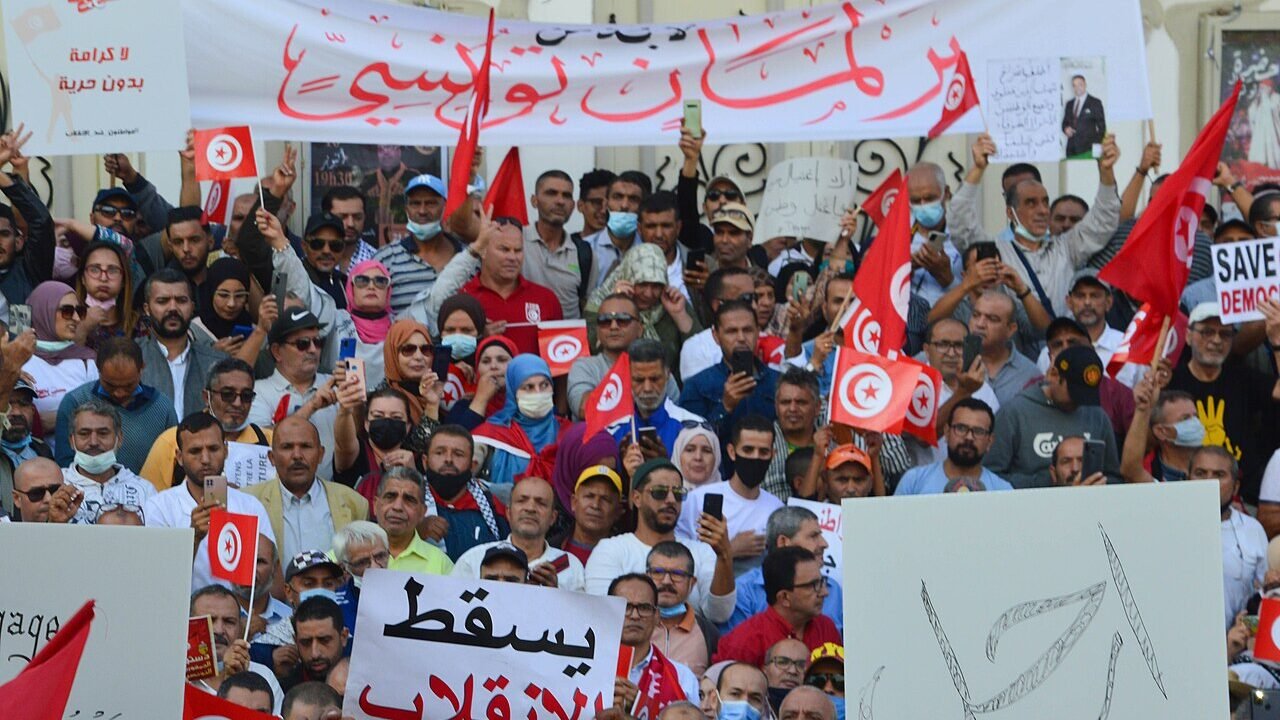
By the time the evocative 25 July anniversary arrived, the heatwave and the political calendar had fused into a single object of public anger. Thousands of protesters set out from central Tunis’s Republic Square carrying banners rejecting what Saied calls his “25 July path”, reviving the 2011 slogan “the people want the fall of the regime” on the same avenue where it was first chanted fifteen years earlier. One opposition spokesman told foreign media that demonstrators saw themselves not as tenants of the country but as its owners — framing the protest as reclamation rather than complaint. Organisers said the movement had widened beyond habitual opposition figures to include citizens angered chiefly by economic mismanagement and failing public services — precisely the audience for whom a blackout speaks louder than any legal argument about Article 80.
None of this suggests that the political crisis in Tunisia threatens Saied’s rule just yet. The state’s security apparatus remains intact, the opposition fragmented and jailed and authoritarian systems elsewhere in the region have weathered worse without cracking. But the convergence of a punishing heatwave, an inept government response, a long-stalled economy and a symbolically loaded anniversary has narrowed the gap between Tunisians’ quiet resignation and open confrontation. Saied now finds himself answering for failures measured in blackout hours and body counts — evidence, for a growing number of Tunisians, that the 2011 revolution has curdled back into the kind of one-man rule it was meant to replace.