

Morocco is preparing to co-host the 2030 FIFA World Cup alongside Spain and Portugal, mobilising massive investments in infrastructure that extend far beyond the tournament itself. Rabat strategically calibrates its World Cup spending as a catalyst for long-term economic transformation.
While geopolitical friction in the Strait of Hormuz continues to dominate global headlines and policy agendas, a quieter and more promising transformation is unfolding in the Strait of Gibraltar, at the opposite end of the Arab World. Morocco is preparing to co-host the 2030 FIFA World Cup alongside Spain and Portugal, mobilising massive investments in infrastructure that extend far beyond the tournament itself.
For the North African kingdom, football hosting is not merely a matter of national pride or cultural soft power. Rather, the preeminent quadrennial sporting match is being deployed as a strategic platform to present a captivating story of Morocco to international audiences in an increasingly polarised world: that of an ascendant, emerging-market economy ripe for foreign investment, a stable Mediterranean–African transport hub offering security and geo-commercial certainty and a politically moderate, welcoming destination for all.
Morocco’s inclusion in the winning bid, confirmed in December 2024, provided closure for the football-obsessed nation. The country proudly united around the national team’s historic advance to the semifinals in the 2022 tournament, where it became the first Arab and African team to reach that stage. Yet this celebration was long overshadowed by repeated failures to secure hosting rights for football’s penultimate event since the early 1990s. Its eventual entry into the 2030 bid came three years after the joint Spanish–Portuguese campaign had launched, reframed by Moroccan officials in historical terms, as a first-of-its-kind European–African hosting arrangement and an “alliance of genius, creativity, experience and resources”.
Pre-game preparations
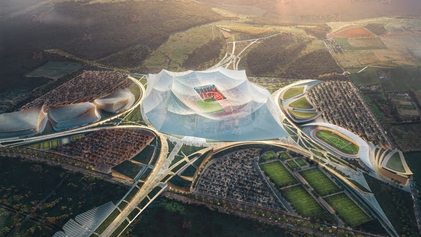
The government has allotted a provisional budget of $5–6 billion for the tournament’s logistics, infrastructure and event organisation. Around $1.4 billion is devoted to stadium development, enabling the country to host between 30 and 50 of the tournament’s 101 matches. Five existing stadiums in major cities were upgraded ahead of the Africa Cup of Nations football competition earlier this year, serving as a trial run for 2030. A sixth venue, the 115,000-seat Hassan II Stadium in Casablanca, is being constructed specifically for the World Cup and will be one of the world’s largest. Rabat is lobbying for it to host the championship game, arguably the single most-watched event in the world.
The kingdom has attracted substantial external support for financing the preparations for the games, drawing on its reputation as a fiscally responsible borrower and its pragmatic diplomacy that straddles geopolitical rivalries. In March 2025, it issued €2 billion in Eurobonds after attracting bids worth more than three times that amount. The African Development Bank has offered up to $1 billion in loans for World Cup-related infrastructure, while the Arab League and the World Bank have also pledged support.
Rabat strategically calibrates its World Cup spending as a catalyst for long-term economic transformation. Official development blueprints frame tournament-related projects as advancing ambitious national objectives over the next 10–15 years: ascending to one of the world’s top 25 economies, phasing out coal in favour of a renewables-dominated energy mix, and being recognised as a peer competitor of European countries in terms of technological development and labour productivity. In the short term, the World Cup is intended to stimulate growth and job creation after a sluggish first half of the 2020s marked by COVID-19 shutdowns, raw materials import disruptions stemming from the Russia–Ukraine War and prolonged drought that hit the agriculture sector (an industry that accounts 30% of the workforce and 12% of GDP).
Infrastructure upgrades hitch a ride on the World Cup
Tourism is the highest priority in Morocco’s World Cup calculus. The country is already Africa’s most visited destination, attracting foreigners with its evocative natural landscapes, historic bazaar cities and distinctive Afro-Arab cultural appeal. In 2025, it welcomed nearly 20 million visitors, generating around $15 billion in revenue — roughly 9 per cent of GDP. Yet the country believes it can do even better. In recent weeks, Morocco has committed $4 billion to expanding hotel capacity by 20%, adding some 25,000 rooms by the end of the decade to accommodate an estimated 1.2 million foreign fans attending the tournament.
Regional instability elsewhere has, paradoxically, worked to Morocco’s advantage. Its insulation from the ongoing Iran war has helped preserve an image of safety and predictability, with limited flight cancellations or tourist disruptions. By 2030, Rabat hopes to attract 35 million tourists annually, using the World Cup to brand the country on the UAE model: not just a leisure destination with nice weather but as a sought-after venue for global business and cultural gatherings.
Transport infrastructure is the second major vector. To sustain tourism growth and manage the anticipated surge in football fans visiting, Morocco aims to expand airport capacity from 36 million passengers last year to 80 million by 2030. A new terminal at Mohammed V International Airport in Casablanca — the country’s primary gateway — strives to boost capacity from 15 million to 35 million passengers.
Rail investment is comparably ambitious. Last year, King Mohammed VI authorised an extension of the high-speed rail network (which was inaugurated in 2018) to Marrakech, the most popular tourist destination. By 2030, trains running at up to 350 km/h along a new 430-kilometre line will link Rabat with Marrakech via Casablanca and its international airport, nearly halving travel time between Tangier and Marrakech to two hours and forty minutes. Longer-term plans envisage extending high-speed rail south to Agadir and east to Fes, quadrupling the network to 1,280 kilometres and cementing Morocco’s status as home to Africa’s most developed rapid transit system.
Seaports complete the infrastructure triad. Morocco is capitalising on its position at the intersection of Atlantic and Mediterranean trade routes, marketing itself as a stable logistics hub amid widespread supply-chain volatility elsewhere. This “friendshoring” strategy has gained traction as conflicts in the Red Sea and the Strait of Hormuz have disrupted trade and prompted companies to seek alternatives to Middle Eastern maritime chokepoints.
The flagship maritime project is Tanger Med, now Africa’s largest cargo port, handling 11.1 million containers in 2025 — an 8.4% increase on the previous year — and linked to more than 180 ports worldwide. A larger Mediterranean facility, Nador West Med, is due to come online later this year and will feature the country’s first LNG terminal to support the phased energy transition away from coal towards renewables. On the Atlantic coast, a deep-water port in Dakhla is scheduled to open in 2028, specialising in bulk commodities and heavy industry. Its location in Western Sahara, however, may yet test international willingness to separate commercial engagement from unresolved sovereignty disputes.
Avoiding a domestic own goal
The pace of development has not been without domestic political cost. Some citizens have charged that, in its seemingly single-minded pursuit of global sporting acclaim, the government has lost sight of the ball that truly matters — the basic social contract. Between September and October last year, up to 150,000 young Moroccans demonstrated in major cities. Hailing mostly from working-class backgrounds and disproportionately composed of students, they organised at the grassroots level through social media and called themselves “Gen Z 212” (the number representing Morocco’s international dialling code). The movement was roused by public outrage over a series of maternity ward deaths at a hospital in Agadir within ten days, where images of unsanitary conditions went viral, symbolising a nationwide malaise. A recurring protest slogan, “hospitals, not stadiums”, captured the mood that World Cup spending was weakening investment in essential public services.
The Gen Z 212 movement tapped into deeper, longstanding frustrations over a chronically underfunded education system, high youth unemployment and the perceived embrace of corruption within the public sector. Protesters appealed directly to King Muhammad VI for remedies. Demonstrations subsided after the monarch promised to address several core demands, including youth job-creation schemes and improvements in public services. Yet the conclusion of the events, which saw three protesters killed by security forces and more than 2,400 arrested, suggests that the underlying problems remain unresolved and are increasingly prone to resurfacing as the World Cup approaches.
The autumn 2025 movement echoed socio-economic and political grievances voiced since the 2011 Arab Spring. Morocco weathered that upheaval more successfully than many North African peers, but the lessons remain salient. Raised in a global digital universe and attuned to their peers’ political struggles abroad, Morocco’s new generation demands economic opportunity, accountability and dignity. The state’s ambitious development goals can only be achieved by maintaining social cohesion and effectively harnessing its youth to integrate into the workforce.
As Morocco prepares to shine in the global limelight for several weeks in 2030, the challenge for Rabat is to ensure that the costly and ambitious World Cup-driven modernisation campaign practically benefits Moroccans’ lives and promotes upward mobility. The state will need to demonstrate that the gleaming stadiums, state-of-the-art transport systems and infrastructure upgrades genuinely serve its citizens more so than fleeting tourists and fawning foreign media, long after the lights go out on the final World Cup match.