


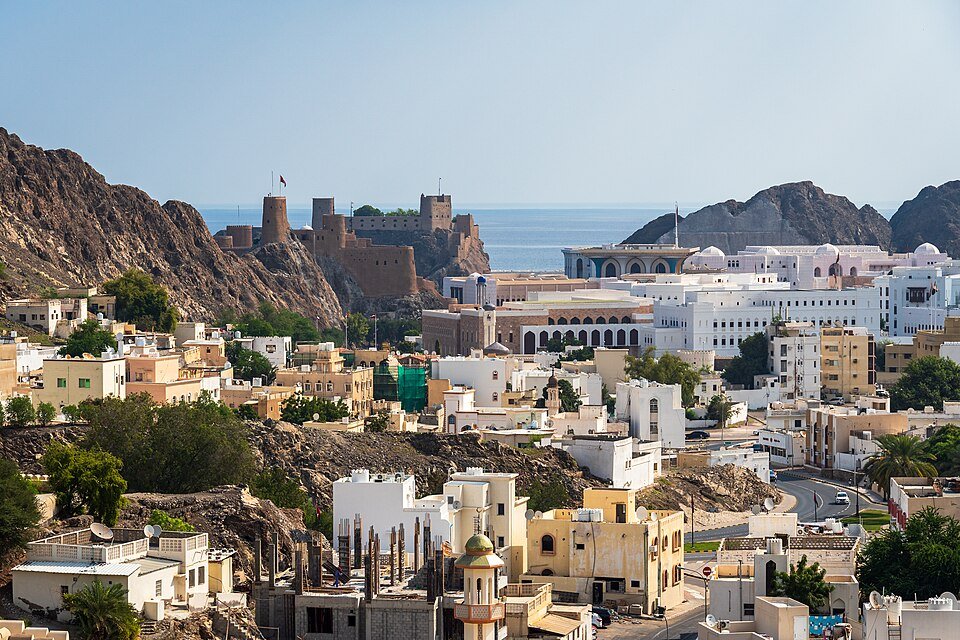
What guides Oman’s apparent sympathies to the Islamic Republic? The answer lies less in ideological affinity than in shrewd, long-cultivated realism towards the powerful sovereign country to its north.
The Iran War and the subsequent memorandum of understanding between Washington and Tehran have catapulted the Strait of Hormuz into global consciousness, as they and other consequential actors battle over the postwar status of this strategically vital waterway. International attention has increasingly turned to the country facing Iran across the strait, long one of the Arab world’s quietest and least understood states: the Sultanate of Oman. With more eyes on Muscat and its postwar interactions with the Islamic Republic, many have sought to understand the nature of Oman’s cautious Iran policy — asking whether the sultanate is a bona fide ally of Tehran or merely a vulnerable Arab monarchy delicately navigating its relations with a more powerful and aggressive neighbour.
Tucked into the south-eastern corner of the Arabian Peninsula, the conservative monarchy has tried to play it safe since Sultan Qaboos rose to power in 1970 and ended his predecessor’s isolationism. Branding itself a “friend to all, enemy to none”, Muscat has cultivated a foreign policy based on principled neutrality, which — coupled with its longstanding domestic stability — has led some observers to nickname it “the Switzerland of the Middle East“. Qaboos and his successor since 2020, Sultan Haitham bin Tareq, have pursued this policy along several consistent imperatives: practically engaging all powers near and far, refraining from antagonising neighbours, avoiding participation in others’ conflicts and remaining anchored within Oman’s Arab–Islamic identity.
This focus on neutrality has informed Oman’s fundamentally different perception of Iran compared with fellow Gulf Arab states. Muscat has long been considered the most sympathetic to Tehran among GCC members, rendering it something of an outlier within the six-nation bloc. Whereas its partners view the Islamic Republic as an aspiring hegemon to be contained, Oman regards it as an important neighbour with which to constructively engage.
This stance persisted even after Iran’s aerial attacks on the Omani ports of Duqm and Salalah in early March, with Muscat conspicuously avoiding any mention of Tehran’s culpability in its condemnatory statements. Only after two casualties in a mid-March strike on a warehouse in Sohar province did official Omani sources begin to speak of “Iranian aggression”. Within days, however, the Omani foreign minister penned an opinion piece in The Economist attributing blame chiefly to the United States and Israel for escalating tensions, suggesting that Iran’s retaliation against pro-US Gulf states — including his own — was “probably the only rational option available to the Iranian leadership”.
Whereas GCC partners such as Bahrain and the UAE were willing to enact economic, diplomatic and even military measures against Tehran, Muscat pleaded for calm and de-escalation. When reports emerged that Oman was favourably considering Iran’s demand to levy tolls on vessels transiting the Strait of Hormuz, its departure from GCC consensus drew a characteristically blunt response from President Trump, who in late May publicly threatened to “blow ’em up” if Muscat did not “behave” according to Washington’s wishes.
The foundations of Oman’s cautious Iran policy
What guides Oman’s apparent sympathies to the Islamic Republic? The answer lies less in ideological affinity than in shrewd, long-cultivated realism towards the powerful sovereign country to its north. With its Musandam Peninsula separated from Iran by only 30 kilometres, Oman’s geography has encouraged its historically close relations with successive Iranian dynasties, including extensive trade and cultural ties.
In the modern era, relations flourished in the early 1970s when Shah Mohammad Pahlavi provided thousands of troops and advanced weaponry to the new sultan to quash a Marxist rebellion in the southern Dhofar region. The Iranian intervention proved decisive, fostering a lasting sense of gratitude in Omani policymakers — one that survived the Islamic Revolution. The 1979 transformation did not fundamentally alter the two countries’ perception of each other as good neighbours, and bilateral trade, maritime coordination and military cooperation continued to expand.
Oman’s unique demographics have further moderated the sectarian anxieties that shape other GCC states’ posture towards Iran’s Shia revolutionary government. Between 50% and 75% of Omanis are Ibadi Muslims, a sect that adheres to neither Sunni nor Shia practice and stays neutral in intra-Muslim disputes. Shia Muslims constitute roughly 5% of the population — a sharp contrast to Bahrain, where they form a majority, and to Kuwait and Saudi Arabia, where they make up significant minorities.
Qaboos also carefully cultivated ties with the United States and Great Britain, diversifying Oman’s alliances and guarding against over-dependence on any single power. Muscat became the first GCC state to permit American military use of its infrastructure in 1980, hosting a presence that matured into the regionwide CENTCOM, later expanded under a 2019 Strategic Framework Agreement to include US naval assets. With Britain, its former imperial patron, Oman welcomed military advisers during the Dhofar campaign and in 2018 signed a multi-decade lease to host a British army logistics base.
As the neutrality doctrine matured, Qaboos adopted a cautious foreign policy for Oman, steering it away from intra-regional quagmires and declining to pass judgment on how neighbours defined their national interests. It was one of only three Arab states not to sever ties with Egypt after its 1979 peace treaty with Israel, and the sole GCC member to remain neutral in the Iran–Iraq War that broke out a year later. It refrained from cutting relations with Assad’s Syria after the 2011 Arab Spring, sat out the Saudi-led intervention in Yemen and opposed the Arab Quartet’s 2017 blockade of Qatar.
Omani caution only increased with Sultan Haitham’s accession in January 2020. Lacking the institutional legitimacy his cousin had enjoyed, Haitham has governed with greater hesitancy and shown heightened deference to the strategic relationship with Iran, particularly in the Israeli–Palestinian arena. Where Qaboos was willing to host Israeli leaders in Muscat — most recently Prime Minister Benjamin Netanyahu in 2018 — Haitham has steered clear of direct engagement with Israeli counterparts, resisted opening Omani airspace to Israeli carriers until relenting under US pressure and declined to bring Oman into the Abraham Accords. Behind these decisions lay a consistent thread: an acute awareness of Tehran’s sensitivities and a determination not to be seen tilting towards Israel in ways that could strain Oman’s most consequential bilateral relationship.
In the years preceding the Iran War, Muscat translated this doctrine into active diplomatic service — relaying messages between adversaries, easing tensions and brokering agreements. It had established institutional trust with both sides by facilitating the back-channel between the Obama administration and Tehran that produced the 2016 JCPOA, reactivated that role under Biden as tensions surged following the 7 October attack, and most recently hosted US–Iran nuclear negotiations in both the spring of 2025 and early 2026.
The Strait of Hormuz as a case study
Nowhere is Oman’s balancing act more visible than in the dispute over the future status of the Strait of Hormuz. The MoU’s fifth clause, whilst prohibiting transit fees during the 60-day interim period, ambiguously states that “the Islamic Republic of Iran will conduct dialogue with the Sultanate of Oman, to define the future administration and maritime services in the Strait of Hormuz” — leaving the door open to Iranian monetisation claims.
Washington insists the waterway must remain unconditionally open, without fees. Secretary of State Marco Rubio, during a Gulf visit to reassure Arab allies, declared that “no country” could impose such charges, which President Trump expressed in characteristically blunter terms. Iran counters that the strait traverses its sovereign territorial waters, asserting the right to bill foreign vessels. Following a meeting of the Iranian and Omani foreign ministers, the two countries announced a working group to study “management” of the sea lane and “associated costs of maritime services” — conspicuously vague on any binding commitments.
Yet mere hours after signing that joint communiqué, Foreign Minister Badr Albusaidi publicly affirmed that toll-free passage was essential, in line with Oman’s international maritime obligations — a position it had already staked out in an 8 April ceasefire declaration. In fact, Muscat’s only concrete action has been launching a temporary toll-free transit mechanism in coordination with the International Maritime Organisation, whilst the foreign minister hosted Qatar’s prime minister to prepare for broader regional talks involving other GCC members and Iraq.
The apparent contradiction dissolves once placed within the context of Oman’s historical behaviour. When standing alongside Iranian officials, Muscat is reluctant to openly defy Tehran — willing to lend its name to a vague working group studying issues of “mutual importance”, even where tolls are mentioned, provided no binding obligation conflicts with international norms. Simultaneously, it issues communiqués for audiences in Washington and the GCC clarifying its non-negotiable commitments to international law. In doing so, it speaks in the language of the broadest possible consensus: adherence to existing treaty obligations, support for de-escalation and commitment to open commerce —with a willingness to make mutually agreeable adjustments through negotiations.
This, in essence, is Omani diplomacy. Placate all parties as much as possible, offer to bridge gaps between adversaries and pursue outcomes that serve the widest constellation of interests. Oman has consistently found that advancing others’ national interests through conciliatory statecraft serves its own.
That calculus is only sharpened by Vision 2040 — Oman’s strategy for diversifying away from oil and gas dependency, with the development of Duqm port as a special economic zone and trans-oceanic trade hub as its centrepiece. Situated on Oman’s Indian Ocean coast well clear of the Strait of Hormuz, Duqm’s appeal to foreign investors may in fact be enhanced by unresolved volatility in the Persian Gulf. And Iran’s reciprocal interest in not antagonising its most accommodating GCC partner is what could guarantee the stability Oman needs to realise that vision — as a friend to all, and enemy to none.