


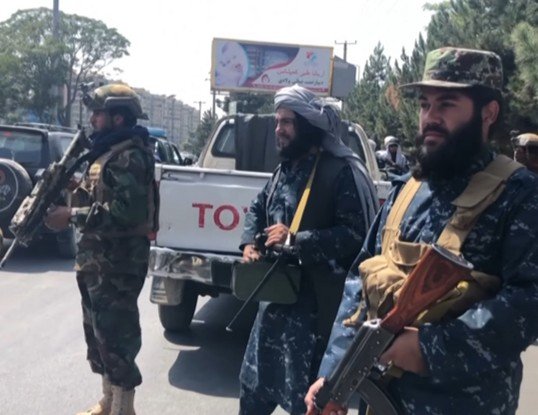
Five years after reasserting control, the theocratic regime remains dogmatic at home, especially in restricting women’s rights. Yet its hardline leadership shows increasing pragmatism externally, partnering with Russia and India while adeptly navigating the modern information environment in pursuit of greater legitimacy.
This week marks the fifth anniversary of renewed Taliban rule in Afghanistan, two decades after the movement was toppled in the United States’ post-9/11 on Terror. The “new” Taliban has worked to improve its image at home and abroad since re-establishing the Islamic Emirate of Afghanistan, rebranding itself as a guarantor of “security” and “stability” in contrast to its first attempt at governance. The Taliban’s earlier fundamentalist rule over most of the landlocked South Asian country, between 1996 and 2001, is remembered mainly for harbouring Osama bin Laden and destroying Buddhist statues.
Anti-regime activists point to rising internal tensions as signs of growing instability. Yet the regime’s increasing normalisation in international politics, driven by shifting foreign allegiances and an astute public diplomacy campaign. Aided by the absence of an organised civil society and a shared memory of a pre-war “golden age” in Afghanistan, the prospect of the Taliban’s downfall appears increasingly difficult to contemplate
Normalising Taliban 2.0
Since swiftly toppling the Washington-backed government of President Ashraf Ghani in August 2021, the Taliban have promised the Afghan people stability and security. The regime parrots this narrative to the world, maintaining that it is the sole governing force capable of preventing Afghanistan from sliding back into prolonged warfare. Taliban 2.0 has gauged the global information environment more shrewdly than its predecessor, tailoring its messaging accordingly and deploying it to considerable effect.
Social media has also helped amplify the “security narrative” surrounding Taliban rule in Afghanistan. International vloggers nicknamed “Talibros” have documented their travels to Afghanistan for content-hungry audiences, portraying an exotic “unseen Afghanistan”. Their videos present an idealised picture of everyday life under Taliban rule, and “friendly” encounters with Taliban soldiers. “Talibros” content can also sanitise the Taliban regime’s brutality, downplaying its repression and the systematic exclusion of women from public life.
One year after the takeover, the Taliban regime banned women from education after the age of 12 “until further notice”, undoing two decades of gains in women’s literacy and empowerment. Regime officials have been evasive when pressed on a possible lifting of the ban, citing an unstable security situation and leadership disputes as pretexts. More recently, the Taliban issued a decree permitting child marriage and granting male relatives greater authority over women’s decisions, reinforcing concerns that the education ban is part of a wider effort to impose early marriage and strictly regulate all aspects of women’s lives.
Some domestic voices are avoiding criticising Taliban, such as Afghan Tolo TV owner Saad Mohseni, hoping to curry favour with it. The media outlet was only launched because of the press freedom that followed the Taliban’s overthrow in 2001 — with Mohseni himself returning to Afghanistan at that time from exile — and its crew was subject to a lethal Taliban attack in the mid-2010s over its criticism of the movement (then an armed opposition militia fighting US forces and its Afghan government ally). However, since the fundamentalists’ return to power, Mohseni has repositioned Tolo as a supporter of regime normalisation. Mohseni has made inaccurate claims that women enjoy a certain degree of freedom in major cities compared to rural areas — remarks sparking accusations of whitewashing the regime by Afghan expatriates.
The UN and other international organisations, normally cautious of judging a country’s internal affairs, have instead advocated against “normalisation of Taliban rule” in Afghanistan. Marking the group’s five-year anniversary since retaking the country, a group of senior UN special rapporteurs issued a communiqué asserting, “the idea that Taliban oppression is a reality that must be accepted to encourage moderation remains dangerous and misguided”, pointing to the continued exclusion of women from public life.
Public diplomacy, Taliban style
Alongside its security-oriented messaging, the Taliban regime has embraced digital diplomacy to portray its five years in power as a series of successes. To celebrate its anniversary, the regime launched a social campaign under the slogan “the fifth anniversary of the victory”, promoted through Pashto-language hashtags such as “#٢٤اسد” (Asad 24, the date of the takeover in the Afghan calendar). Tapping into emotional and historical themes, the campaign frames renewed Taliban rule in Afghanistan as restoring national “honour” and expunging the humiliation of “foreign occupation”. Regime officials have shared messages of hope and promised prosperity, while official spokesperson Molavi Zabihullah Mujahid touted “accomplishments” such as new jobs and improved telecommunications during the “Government in the Mirror of the Press” conference.
The Taliban regime has leveraged pockets of international sympathy, favourable media coverage and diplomatic realpolitik to present their fifth anniversary in power as an opportune moment for more countries to normalise relations. Qatar’s Al Jazeera, particularly its Arabic-language content, has magnified the “security narrative” and other positive messaging about the regime, praising the Taliban’s infrastructure investment and adherence to the Qatari-brokered Doha Agreement while framing the regime as a victim of US-led attempts of isolation and denigration. The Doha-based think tank Middle East Council on Global Affairs, successor to the Brookings Institution’s Qatar branch, similarly cast the UAE’s pragmatic engagement with the Taliban as the sought-after “breakthrough” in ending its pariah status.
Shifting interests: Russia legitimises a Taliban state
Anti-Islamist Abu Dhabi’s outreach to an avowedly Islamist regime demonstrated hard-headed realism trumping ideology, foreshadowing developments once thought unimaginable. Russia — successor to the Soviet Union that battled the Taliban’s ideological forebears in Afghanistan (the US-backed mujahideen) — became the first country to officially recognise Taliban rule in Kabul in 2025. The Kremlin announced its recognition on 4 July, a move widely interpreted as a deliberate reminder of America’s hasty withdrawal — or as many see it, defeat — in 2021.
Yet Moscow’s decision was dictated by more than shared opposition to US interests. It reflected a calculation that early contacts could secure commercial and diplomatic advantages before rivals inevitably recognise the regime. Afghanistan’s position as a gateway between South Asia and Central Asia — where Russia already enjoys considerable leverage through its former Soviet republics — also offers Moscow opportunities to expand trade networks and blunt the effects of Western sanctions imposed over its Ukraine war.
Russian media has echoed the realist calculus, arguing that attempts to isolate the Taliban have backfired, and stressing that the Taliban regime is not an expansionist threat. Despite Taliban-like Islamist militancy in Russia’s Dagestan and other Caucasus republics, the Russian press has framed the Taliban as a counter-terrorism partner in Central Asia. Moscow’s rapprochement is portrayed as a forerunner to inevitable US recognition, bolstered by the Taliban’s diplomatic outreach to Washington.
Ten months after recognition, Moscow concluded a military and technical cooperation deal with its new Taliban partner. Observers assess that the agreement could strengthen the regime’s capabilities in confronting its newest and far stronger foe: Pakistan.
Once a best friend, now the main enemy: Pakistan
While global attention was on the Iran–US conflict, Pakistan resumed extensive airstrikes against the Taliban, following initial exchanges of fire in October 2025. Western media has described the clashes as an unending “open war”, with global condemnation following Pakistan’s bombing of a drug rehabilitation centre in Kabul and the conflict’s high civilian death toll, especially among children.
Islamabad, once the Taliban’s principal economic and military lifeline, accuses the Taliban of sheltering terrorist groups such as Tehreek-e-Taliban (TTP) and the Baloch Liberation Army, and even sponsoring training camps for cross-border assaults. The Taliban denies the accusations, retorting that TTP is a domestic Pakistani group and internal matter for Islamabad, while accusing its neighbour of backing ISIS’ Khorasan branch to destabilise Afghanistan.
Pakistan maintains that there will be no change in its military posture unless the Taliban ceases allowing Afghan territory to be used as a terror base. Islamabad has severed the once-robust commercial ties, hoping that economic coercion can resolve the standoff. Rather than bowing to Pakistan, however, the Islamist theocrats have cultivated the most unlikely of partners: India’s Hindu-nationalist government.
The Taliban’s new regional partner: Hindu polytheists
Almost as soon as Pakistani airstrikes began in October 2025, Afghanistan and India issued a joint statement affirming their longstanding “friendship” and pledging strengthened economic ties. Since the takeover, India has become a leading stakeholder in Afghanistan through “humanitarian diplomacy”. New Delhi’s approach is novel in light of Prime Minister Narendra Modi’s Hindu-centric nationalism (Hindutva) and its undercurrents that some consider anti-Muslim. The about-face is all the more remarkable given the alarmist reaction in India upon the Taliban’s return to power: local media highlighted the group’s uncompromising religious fanaticism as a potential catalyst for war, while some Hindu-nationalist-affiliated outlets warned that its example could inspire India’s 14% Muslim minority and constitute an “internal threat”.
India’s embrace of Taliban Afghanistan is driven chiefly by geostrategic objectives: countering Pakistani and Chinese influence, particularly the China–Pakistan Economic Corridor and the larger Chinese Belt and Road Initiative. These trade routes traverse the disputed Kashmir region and solidify Pakistan’s position on its northern and western flanks. Bybuilding goodwill with Kabul’s Islamists, New Delhi hopes to secure a strategic economic corridor linking India and Central Asian republics through Iran’s Chabahar port, bypassing Pakistan.
Both sides now characterise the relationship as more than just geopolitical opportunism. The Taliban has invited Hindu and Sikh refugees who had fled in 2021 to return — a stark reversal from its enforced persecution of these religions during its Taliban 1.0 iteration. Concurrently, some voices in the Indian press have applauded the regime’s commitment to protect non-Muslim minorities. Both sides are seemingly willing to downplay their considerable differences in pursuit of shared objectives.
Five years in retrospect: unstable, but no conditions for change
Five years of Taliban rule in Afghanistan are remodelling its image and alliances, but its domestic policies have barely changed: women remain marginalised, officials are mostly religious clerks without formal education and ethnic violence persists. Anti-regime movements, meanwhile, show scant capacity to seriously challenge the Taliban from within.
Over the past few weeks, the north-eastern Badakhshan province bordering Tajikistan has become a centre of anti-Taliban violence, with the National Resistance Front — the successor to the Taliban 1.0-era Northern Alliance — spearheading the fighting. The NRF, ISIS’ Khorasan branch and other regime opponents have killed a number of regime officials. A rogue commander, Juma Khan Fateh, briefly seized part of the province before surrendering. Yet he was no ideological rival, rather a local leader aggrieved by the Pashto-dominated leadership’s treatment of his Persian-speaking minority. According to a BBC interview with Fateh, his revolt also appears motivated more by profits from local gold mines than by opposition to Taliban control.
International concern has translated into little concrete action: aside from, scattered advocacy for Afghan women and small demonstrations in a few dozen cities, no sustained global campaign has emerged to address the country’s humanitarian crisis or its treatment of women. In this sense, the regime’s rebranding has largely succeeded, notwithstanding UN objections to its “normalisation”. A weak domestic civil society and limited diaspora activism further reduce the odds that Afghanistan’s plight will gain traction on the international human-rights agenda.
An Afghan spell of destiny?
Two centuries after the original Great Game, Afghanistan again sits at the centre of a geostrategic contest. Former patrons like Pakistan are now implacable foes; former enemies like Russia are now leading advocates; opportunists like India have set aside ideological discomfort for strategic benefit. Others are content to watch the regime fight terrorist groups and curb the opium trade from a distance. The United States — once ally, then enemy, now undecided — calibrates its policy issue by issue, treating Kabul differently on counter-terrorism, women’s rights, migration and prisoner exchanges. That calculus could shift if Afghanistan becomes a theatre of US–China competition.
Despite ethnic grievances and deep disillusionment with the leadership, no sustained opposition to the regime has emerged. Decades of war have left little memory of peacetime. No charismatic leader such as a diaspora businessman or an exiled monarch has emerged to unite the Afghan opposition. King Mohammad Zahir Shah was deposed in 1973 and died in exile in 2007. As opposed to Iran’s Reza Pahlavi, there was no royal successor designated by Zahir Shah, while Washington itself shut down ideas of restoring the monarchy following the removal of the first Taliban regime.
Local warlords may take inspiration from Juma Khan Fateh, but a more capable challenger would likely only plunge the country into renewed war without end. Taliban rule in Afghanistan therefore appears durable for now, courted by rival powers as a valuable asset in their own regional ambitions. Even amid this relative stability, Afghanistan’s citizens — and above all, its women and girls — will still be denied their basic dignity and fundamental rights that are taken for granted elsewhere.