


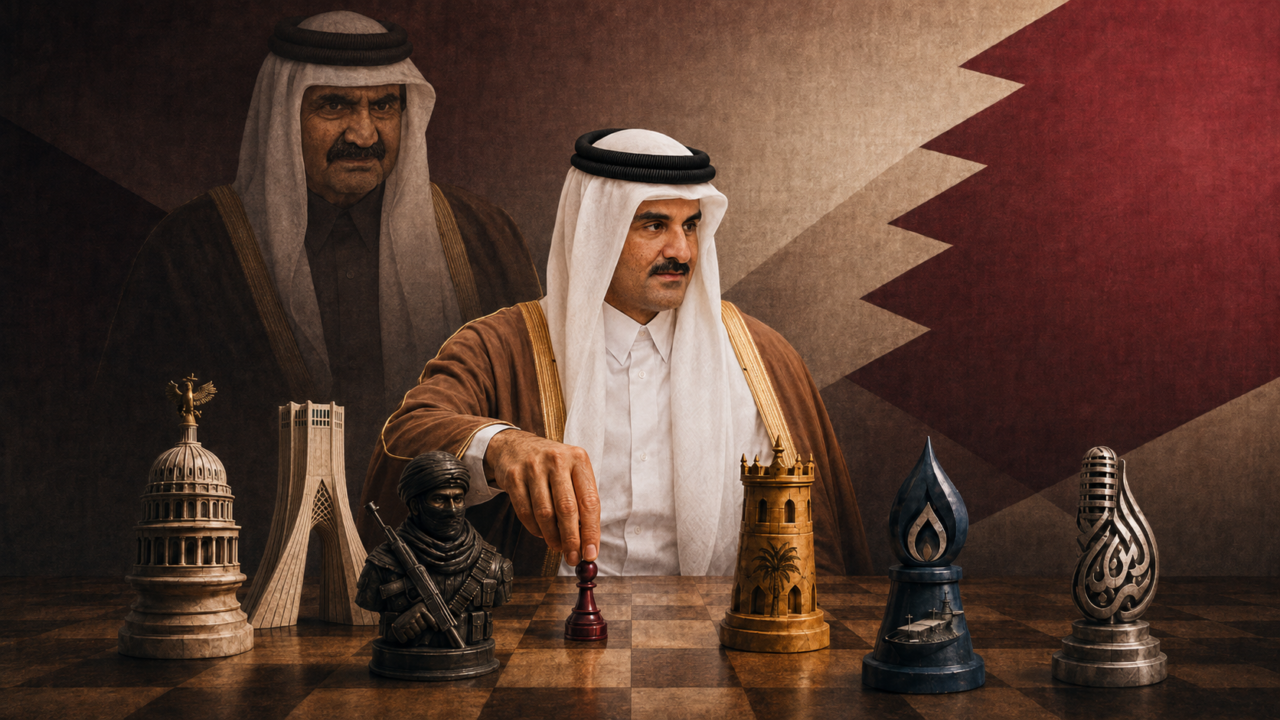
Qatar built its brand around resisting its neighbours. Can it now join them in its hour of need?
Commentary by senior state-affiliated Qatari analysts, published around the signing of the Mecca Joint Defence Agreement between Saudi Arabia, Turkey and Pakistan last Friday, suggests that Doha wants to build upon the new pact. Qatar’s emerging foreign policy envisions a security network built around a GCC core, backed by the US, Europe and “other regional powers”, that would give the Gulf a more independent source of security. This continues a Qatari effort, under way before and since the recent Iran war, to persuade its neighbours that they share common interests. The central question is what, if anything, Doha could tangibly bring to such a partnership — and whether the independent-minded Gulf state has anything that its neighbours cannot provide for themselves.
A small fish in a big gulf
Qatar is, by some distance, the GCC’s smallest state by native population: no more than 400,000 people, or roughly 10–15% of its residents. To understand Doha’s strategy, it helps to compare it with its fellow small Gulf monarchies. Bahrain offers the clearest contrast. Its Sunni dynasty rules a Shia majority, leaving it little choice but to rely on Saudi Arabia to preserve the domestic status quo. Kuwait occupies the middle ground. The trauma of Iraq’s 1990 invasion and half-year occupation pushed it towards a permanent US military presence, close GCC security cooperation and wider international defence commitments, while its dependence on the Saudi-dominated oil market gives it every incentive to avoid straining ties with its larger neighbour. Its National Assembly — the oldest and most vocal parliament among the Gulf monarchies — also constrains how far and how fast the House of Sabah can move, unlike Qatar’s more autocratic emir.
Hamad bin Khalifa, recently deceased “Father Emir”, always wanted to be treated as an equal among his fellow Arab rulers, and was content with a life of luxury only for as long as Saudi Arabia — Qatar’s sole land neighbour — permitted it. The country’s immense offshore gas reserves in the North Field (also known as South Pars) allowed it to build an LNG-based economy unconstrained by local pipelines or OPEC quotas, and gave it one of the world’s highest per capita incomes. Sharing that field with Iran also nudged Doha towards a warmer relationship with its theocratic Shia regime than its Sunni Arab neighbours were ever comfortable with.
The Hamad Doctrine upends the Arab system
After seizing power from his father in a bloodless 1995 palace coup, staged while the aging emir was vacationing abroad, how did Hamad set about securing Qatar’s freedom of action from the Saudi-led GCC? First, he fused Qatar’s foreign policy with domestic gestures, choreographing his support for political liberalisation and democratisation, he won the backing of a West recently triumphant over the Soviet bloc. This support proved crucial in protecting his rule from relatives who might have visited on him what he had just done to his own father. Transfers of power within the Al Thani family had rarely been peaceful, and a 1996 intervention by the French president, Jacques Chirac, is credited with halting a counter-coup by forces loyal to his father and backed by Saudi Arabia, the UAE, Bahrain and Egypt.
That same year, Hamad began building the Al Udeid airbase, a facility far larger than Qatar’s own air force would ever need, at a cost exceeding $1 billion. In 2003, the US agreed to relocate its CENTCOM headquarters there from Saudi Arabia; Doha shrewdly exploited Riyadh’s rift with Washington over basing rights for the Iraq war, and Al Udeid grew into the largest American base in the Middle East. Once his rule was secure and ties with the West effectively irreversible, Hamad quietly dropped the pretences of liberalisation and political pluralism.
In parallel, Hamad broke with the tacit bargain that binds the region’s other Sunni autocracies: stay out of one another’s internal affairs, and even cooperate against shared domestic threats. Qatar’s small and religiously homogenous Sunni population meant he could spend the country’s growing gas wealth ensuring that citizens’ material, cultural and spiritual needs were met almost entirely by the state and by loyalist-run “civil” institutions it funded. A population with little cause for unrest freed him to go on the offensive elsewhere.
1996 also saw Hamad launch Al Jazeera, the first satellite channel to openly air the internal grievances of every Arab state — bar Qatar’s own. The network became one pillar of Doha’s emerging alliance with the Muslim Brotherhood — its then-unprecedented, round-the-clock airtime giving Doha an unrelenting platform to needle rival governments — and amplified the movement’s populist Islamist, occasionally anti-Western message to Arabic-speaking audiences. The relationship ran deep enough that Qatar remains, to this day, the only country where the Brotherhood voluntarily wound up its local activities, back in 1999 — sacrificing influence at home to secure the group’s support elsewhere. The revolutionary TV network became the anchor of Qatar’s foreign policy to influence the regional Arab agenda, proof of what soft power could accomplish that hard military strength could not.
Through Al Jazeera and its alliance with the Brotherhood, Qatar has maintained an adjustable baseline of pressure on its neighbours, turned up or down according to how accommodating each proves. Turkey’s growing alignment with the Brotherhood under President Recep Tayyip Erdoğan has since drawn Ankara and Doha closer too, giving Qatar a further counterweight to its Arab neighbours alongside Iran, the Western powers and its LNG customers in Asia.
How Qatar outfoxed its Gulf neighbours
In 2017, four years after Hamad ceded power to his son Tamim, the so-called “Arab Quartet” — consisting of Saudi Arabia, the UAE, Bahrain and Egypt — moved to curb Qatar’s autonomous decision-making, severing diplomatic and economic ties and closing their borders to Qatari traffic. Their demands included shuttering Al Jazeera, cutting ties with the Brotherhood and other Islamist movements, downgrading relations with Iran and closing Turkey’s military base—in effect, forcing Qatar’s foreign policy to align with broader regional priorities. This attempted geopolitical blockade represented the crisis Hamad’s two decades of delicate statecraft had prepared Qatar to withstand.
Turkey and Iran moved swiftly, opening an air and sea bridge to supply food, water and other essentials Qatar had previously sourced through its Saudi land border; Turkey even dispatched extra troops to deter any invasion. Gas revenue from customers in Europe and Asia kept flowing throughout.
President Trump initially showed sympathy for the Quartet’s demands, as his first administration viewed Islamist networks as a primary security threat, but more immediate realpolitik prevailed: Washington’s interests were too enmeshed with Qatar, generous host of CENTCOM and vital to operations against ISIS, the Taliban and other extremist groups in the region, and the White House reportedly talked Saudi Arabia and the UAE out of an armed invasion. Al Jazeera and the Brotherhood, meanwhile, kept up relentless pressure on the blockading states across the Arab world and beyond.
By 2021 the Quartet relented, having achieved nothing beyond vindicating Hamad’s strategy. Qatar had taken on four of the region’s most powerful states alone and prevailed; within months, hosting the 2022 World Cup cemented its reputation as a small state that had mastered the soft-power art of punching above its weight.
Tamim’s catch-22
Can the toolkit that helped Qatar outmanoeuvre its neighbours now be turned to supporting them within a regional security architecture — one that reduces reliance on the West, guards against Iran and finally lets Doha cooperate as an equal? In hard military terms, Qatar’s tiny population and territory render it marginal next to giants like Saudi Arabia, Turkey and Pakistan.
Its special relationship with Washington makes it effectively unconquerable and immune from attack by American allies, but that has not addressed the actual threat at hand: Iranian aggression, which neither its warm ties to Washington nor to Tehran have forestalled, and which has already struck strategic infrastructure to devastating effect. Nor did the US security umbrella prevent an Israeli air strike on Hamas leaders in Doha in September 2025. It would plausibly do no more to stop further embarrassing breaches of Qatari sovereignty, against which the House of Al Thani has no readily available countermeasure. Doha also has capital to offer, of course, but that is hardly a scarce commodity among its well-endowed GCC partners.
What is left, then, are Qatar’s unique foreign-policy instruments — Al Jazeera and its partnership with the Brotherhood. Designed to unsettle its Arab neighbours and give Doha leverage over them, these tools have amply proved their worth. But that very success makes joining a security alliance as an equal harder, not easier. The most Tamim can offer, and only informally, is a gradual softening of support for the Brotherhood and a more constructive posture from Al Jazeera. Neither commitment is easy to guarantee or codify, making them difficult to trade credibly for real security guarantees.
There is a deeper bind, too: the less provocative and edgy Al Jazeera becomes, the more it risks losing the popularity that drew its viewership to begin with and gave Doha its regional leverage; the less Qatar backs the Brotherhood, the less influence it wields and the greater the risk of provoking the movement’s own displeasure. The nuisance value of both instruments is precisely what keeps Tamim a respected equal among his fellow autocrats — which leaves the House of Al Thani almost unable to switch them off, and limited even in how far it can turn them down.
Qatar officially welcomed the Mecca pact. Yet for Tamim’s fellow rulers, whom Washington once had to stop from invading Qatar, watching Doha remain dependent on American protection while they build independent, localised joint-defence capabilities may look like a net gain. Nor is the irony likely to be lost on them that Qatar—more exposed to Iran than any of them, partly by its own choice to cultivate friendlier ties with Tehran—could end up the more vulnerable party. It may yet be Qatar’s neighbours who get the last laugh, returning the favour after being outfoxed half a decade earlier.