


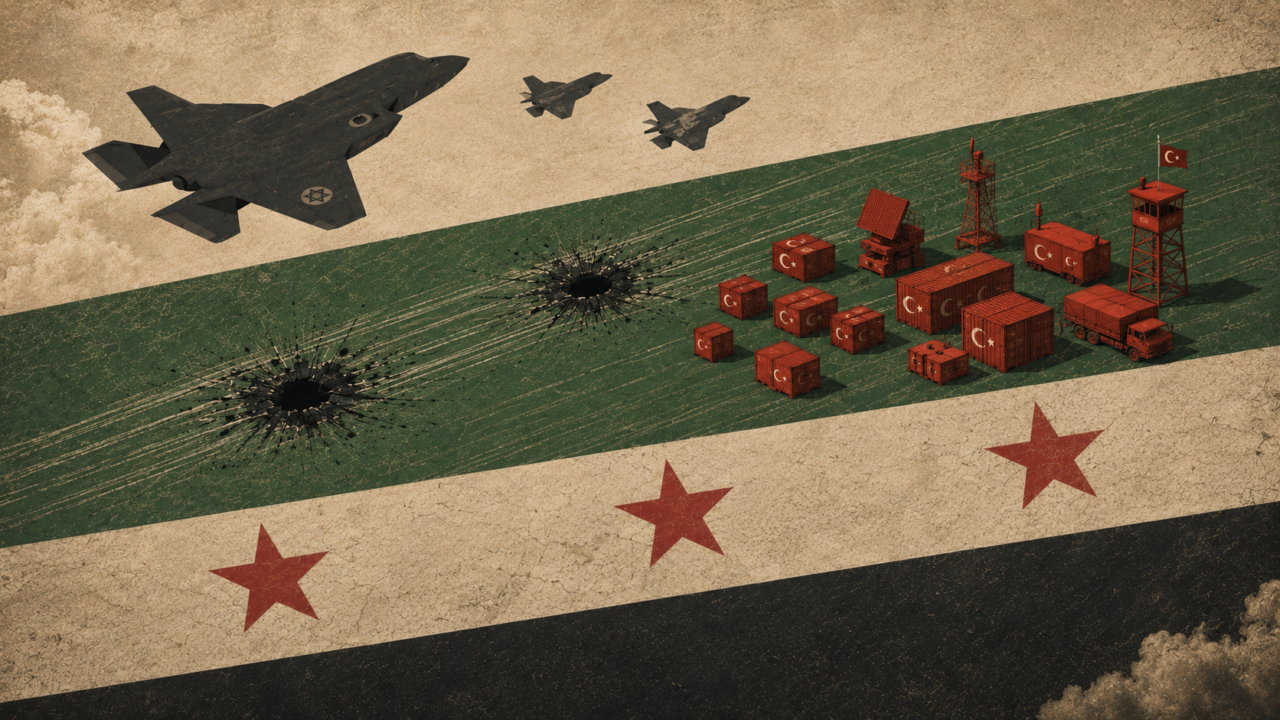
A dormant airbase reveals how far two former partners have drifted apart. Israel and Turkey are not at war, and neither wants one. But in post-Assad Syria they have become strategic rivals, and Washington is starting to treat them as such.
On 18 August, Israel struck an airbase in Syria’s north-western Idlib province. The Israeli military declined to comment. Syria’s state television, Al-Ekhbariya, cited a military source saying eight Israeli strikes hit the runway and storage facilities at Abu Al-Duhur airbase, a mostly disused airfield some 70 kilometres south of the Turkish border. A second military source and a local resident both said there were no casualties. The Turkish foreign ministry condemned the attack as a violation of Syria’s “territorial integrity and unity”. Observers saw the airstrike as evidence of a deepening Israeli–Turkish rivalry in Syria. As Israeli strikes in Syria go, this was a modest one. What made it notable was Israel’s explanation for the strike, and the scenario it said it is trying to prevent.
Twenty hours after the strike, the office of Israeli Prime Minister Benjamin Netanyahu took responsibility, stating that Damascus had been “on the verge of breaching” an “agreed-upon” security arrangement by allowing Turkish forces to deploy at the base, despite repeated Israeli warnings. Turkey’s Communications Directorate weighed in, rejecting the allegation as a “frivolous” attempt to legitimise Israel’s “unlawful” strikes on Syria. A Turkish official told Axios that there was no Turkish presence at the airbase, accusing Israel of “inventing pretexts to bomb neighbouring countries and destabilise the region”. The Syrian Observatory for Human Rights, however, said Turkey had been rehabilitating the base, which had been out of service for years, and that a Turkish military delegation had visited it days before the strike.
Until relatively recently, Israel and Turkey were among the region’s closest strategic partners. That a strike this small could now carry a message for Ankara shows how far the relationship unravelled. If any further proof were needed, the US special envoy for Syria and ambassador to Turkey, Tom Barrack, revealed that Ankara had not been warned about the operation, and could “reasonably” have prepared its own response. It is exactly the kind of miscalculation Washington now fears most: an Israeli strike aimed at Syria mistaken by Turkey for a threat to itself, and answered as one. Washington is now scrambling to build a trilateral deconfliction mechanism between Israel, Turkey and Syria — the sort of channel normally reserved for adversaries, not for two American allies.
From honeymoon to divorce
For decades, the Israeli–Turkish relationship was a model of what relations between Israel and the Islamic world could achieve. In 1949, Turkey became the first Muslim-majority country to recognise Israel, doing so less than a year after Israel declared independence. In the 1990s, Turkey’s secular military establishment and Israel built a close security partnership, sharing an interest in containing Syria, which then supported the Kurdish PKK and treated Israel as an enemy. Military training, intelligence-sharing, disaster-relief and strategic defence-industry ties followed, including joint exercises, pilot training and arms deals, culminating in a cooperation agreement in 1996.
The relationship survived the rise of Recep Tayyip Erdoğan, under whose leadership Turkey gradually became less democratic and more Islamist. For years, the Erdoğan administration maintained economic and security ties with Israel even as its rhetoric over the Palestinians sharpened. What eroded it was a sequence of shocks: the 2008–09 Gaza war, Mr Erdoğan’s furious walkout from a panel with Israel’s peace-minded President Shimon Peres at Davos in 2009, and the deadly Mavi Marmara incident in 2010. Bilateral relations deteriorated and then, seemingly normalised, all while Turkey deepened its relationship with Hamas. By 2022, the two countries had formally restored full diplomatic relations, culminating in an elaborate state visit of President Isaac Herzog to Ankara in March. In September of that year, Mr Erdoğan met Israel’s then-prime minister, Yair Lapid, in New York; a year later, he met Mr Netanyahu there as part of a wider Turkish outreach to Israel and its neighbours.
Weeks later came Hamas’s 7 October attack, followed by Israel’s response in Gaza. On 28 October, Erdoğan stated that Hamas was not a terrorist organisation but a liberation movement. He later accused Israel of conducting genocide and denounced it as a “terrorist state”. The two countries downgraded their relations and, in May 2024, Turkey officially suspended all trade with Israel.
The deterioration accelerated when Hamas’s political leader, Ismail Haniyeh, was killed in a suspected Israeli operation in Tehran in July 2024. After his assassination, Turkey declared a day of national mourning and flew its flags at half-mast at official missions worldwide, including at its embassy in Israel. By these acts, Islamist-oriented Ankara chose to pivot from its stance as a pragmatic partner to one of Israel’s leading critics, forfeiting most of the trust that had survived earlier crises.
Then Assad fell
Assad’s collapse in December 2024 turned a diplomatic irritation into a full-fledged Israeli–Turkish rivalry in Syria. For Israel, his fall removed an Iranian proxy and further severed Hezbollah’s link to its main state sponsor. But it also opened a dangerous vacuum. Israel was quick to respond, destroying large stocks of Syrian military equipment on the assumption that, whatever Syria became, it should not inherit the means to threaten Israel.
Turkey read the moment differently. Having spent years cultivating Syria’s opposition, it became the new government’s principal backer, helping Ahmed Al-Sharaa’s administration rebuild state institutions and, increasingly, its armed forces. In May, Syrian units took part in EFES-2026, one of Turkey’s largest combined military exercises, the first time the post-Assad Syrian army had trained abroad. Turkey was helping Syria build the military capacity that Israel had spent two years trying to prevent it from acquiring.
Israel is also concerned that Turkey could help Damascus develop sophisticated airbases, radar and more capable air defences, constraining its freedom of action in Syrian airspace, which has been important to Israeli operations against Iran and its regional proxies. Turkey is reportedly training Syrian soldiers to operate its air-defence systems and providing military equipment.
The case for calm
For all the tension, both governments have domestic incentives to sound tougher than they act. Mr Netanyahu faces an election this autumn shadowed by 7 October, and Mr Erdoğan may call one next year; each is a convenient foreign villain for the other’s electoral base. Turkey is bound to Washington by NATO’s treaty, while Israel is bound by decades of close alliance with America. Both have felt America’s pressure to tone down their rhetoric.
The economic case for cooperation is real, too. Before the Gaza war, the trade volume between the two countries reached $9.5 billion, according President Erdogan — a figure that had continually climbed even in the face of earlier crises. Turkey also benefited from hundreds of thousands of Israeli tourists annually, epitomised by Turkish Airlines growing into the second-largest carrier at Tel Aviv’s airport. A future rapprochement could revive that commerce and tourism, while Israeli investment and technology could bring benefits to Turkey. Beyond that lies the larger prize of energy. Eastern Mediterranean gas offers an joint project for two countries wary of Iran’s grip on the Strait of Hormuz. Israeli gas could, in principle, be carried through Turkey towards European markets, giving Israel another export route while strengthening Turkey’s ambition to become a regional energy hub.
The trouble with this argument is that it explains why Turkey and Israel do not want a war. But Ankara’s rhetoric, its unequivocal support for Hamas and its broader ties to Islamist causes are pushing Israel to regard Erdoğan’s Turkey with growing suspicion. Israel has been here before. Iran was once a close, if unofficial, strategic partner; the 1979 Islamic revolution transformed it into Israel’s principal adversary.
In 2025, the Nagel Committee, an Israeli defence advisory panel, warned that a Turkish-backed Syria could emerge as a security threat potentially more dangerous than Iran and recommended that Israel prepare for a possible direct confrontation with Turkey. Unlike Iran, however, Turkey does not call for Israel’s destruction, does not currently pursue a military nuclear programme, and has no comparable network of proxies. It has also maintained diplomatic relations with Israel despite the exacerbating crises of the past years.
But Ankara has something Tehran never possessed to the same degree: a large conventional military, a sophisticated defence industry and, increasingly, a military presence in Syria. And geography adds another potential source of friction absent from the Israel–Iran conflict: Turkey and Israel operate in the same maritime space in the Mediterranean. Turkey’s already large navy dwarfs Israel’s, and is expanding further and undergoing modernisation through the MILGEM programme. Ankara is capable of projecting maritime force well beyond its shores, raising the prospect that future clashes with Israel could occur not only in Syria or the skies of the Middle East, but also at sea.
Taken together, these developments help explain Israel’s changing strategic assessment of Erdogan’s Turkey and why Syria has become such a sensitive flash point. An increasingly Islamist-leaning Turkey establishing a military foothold on Israel’s northern doorstep while strengthening the combat capabilities of an ideologically aligned government presents an intolerable scenario. It has responded by deepening ties with Greece and Cyprus, overcoming historically frosty relations, by expanding military exercises and forming a trilateral strategic partnership with American backing. On 19 August, a day after the strike, Israel’s military announced that its chief of staff, Lt Gen Eyal Zamir, had met his Greek counterpart, General Dimitrios Choupis, during an official visit to Israel. Indeed, the Mediterranean has become another arena in which Israel and Turkey increasingly view their interests in zero-sum terms.
Drawing the line
The danger, then, is less a deliberate rush to war than a rivalry that neither side knows quite how to contain. Turkey wants a stronger, more unified Syrian state: one exercising full sovereignty, containing armed Kurdish groups along Turkey’s border and creating the conditions for refugees to return. Israel wants almost the opposite. At best, it fears that the growing Turkish–Syrian military relationship could leave Damascus with the air defences and other capabilities needed to constrain Israel’s freedom of action.
At worst, Israel fears that Al-Sharaa has not fully broken with his jihadist past and that, together with Turkey, Syria could constitute part of a new Islamist bloc on Israel’s northern frontier. Yet that outcome is not inevitable. In his statement on the attack, the US envoy, Tom Barrack, said Al-Sharaa’s government had “repeatedly indicated a preference for de-escalation with Israel”. A Syrian–Israeli accommodation could therefore remove one of Israel’s main concerns about the new order, even if it would not dispel its suspicion of Turkey’s and Syria’s long-term intentions. A day after the strike, Reuters reported that Syrian Foreign Minister Asaad Al-Shaibani and Israel’s new spy chief, Roman Gofman, had recently held a call largely focusing on Turkish military involvement in Syria — suggesting that, despite their sharp differences, a high-level channel for deconfliction is already taking shape.
The underlying problem remains. Each side can portray its own moves as defensive while viewing the other’s as preparations for future hostilities. In that sense, the Israeli–Turkish rivalry, in Syria and other theatres, has an echo of the Cold War: the United States and the Soviet Union rarely wanted a direct war, but competing attempts to secure their interests repeatedly brought them into dangerous proximity.
That analogy, though, has limits. Israel and Turkey are not superpowers, and their ties to Western alliances, especially to the United States, could provide a restraint that the Cold War superpowers lacked. But Syria could become a Cold War-style testing ground, where influence with local actors, military deployments and red lines overlap, and where a move intended to deter the other side can instead provoke it. The Abu Al-Duhur strike offered a possible preview of that danger.
Washington’s effort to build a deconfliction mechanism is therefore less about preventing an Israeli–Turkish war than about ensuring that competition between two American allies does not accidentally trigger one through miscalculation. The old partnership is gone. What replaces it may be a rivalry that can be managed — but only if both sides recognise how easily deterrence can become miscalculation.