


In an age of artificial intelligence, the Mawlid invites a more ancient question: what is a human being for?
Artificial intelligence has given humanity an unusual mirror. For centuries, people distinguished themselves from other creatures through their capacity to reason, calculate, remember and create. Machines can now perform increasingly impressive versions of all four. They compose sentences, diagnose patterns, imitate voices and retrieve more information in seconds than an individual could absorb in a lifetime.
This has produced an understandable anxiety about what machines may become. A more interesting question is what human beings should become.
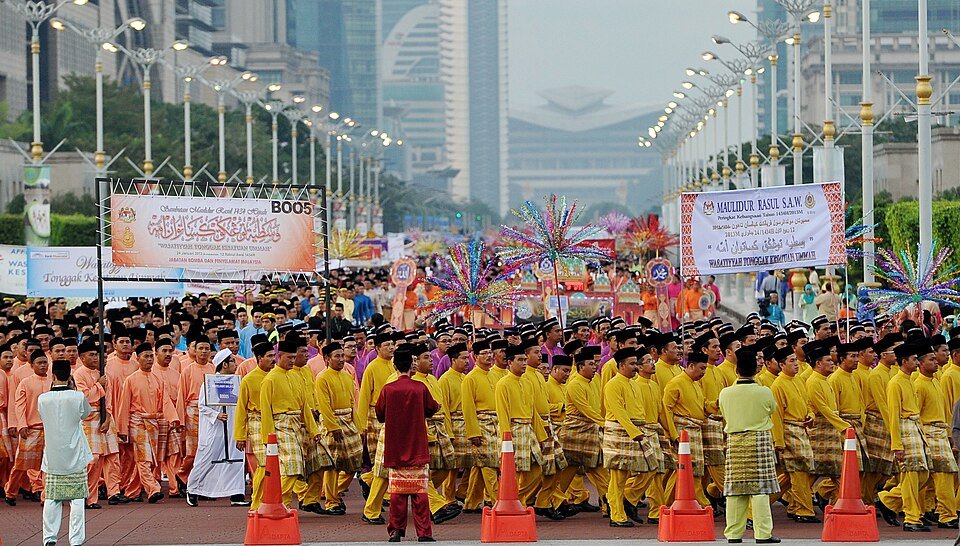
Mawlid Al-Nabawi, the commemoration of the birth of the Prophet Muhammad ﷺ on 12 Rabi’ Al-Awwal, is observed this year between 25 and 28 August, depending on the country, offers an occasion to consider that question. Beyond the gatherings, poetry and inherited expressions of love lies a profound spiritual proposition: that the highest possibilities of a human life are not measured by intelligence, power or productivity, but by the degree to which a person becomes conscious of God—and allows that consciousness to transform the way he inhabits the world.
Islam does not present Muhammad ﷺ as a divine being. The Qur’an insists on his humanity. He ate, slept, travelled, grieved, loved, forgave and endured. This is precisely what gives his example its spiritual force. Perfection, in the prophetic sense, is not an escape from being human. It is the fullest realisation of it.
That distinction feels particularly relevant now.
The technology industry speaks frequently of “models”. An artificial intelligence model is trained on enormous quantities of human expression in order to recognise patterns and generate plausible responses. Its achievement is imitation at extraordinary scale. Yet it possesses no inner moral horizon simply because it can reproduce the language of one. It can describe mercy without being merciful, write about longing without longing, and produce a discourse on God without seeking Him.
The prophetic model points in almost the opposite direction.
Its concern is not how much information a person can acquire, but what knowledge does to the knower. Does knowledge produce humility or vanity? Does strength lead to domination or restraint? Does suffering make a person bitter or compassionate? Does success deepen gratitude or merely enlarge the self?
These are not questions of intelligence. They are questions of formation.
The Arabic and Islamic tradition contains a rich vocabulary for this interior work: tazkiyah, the purification and growth of the soul; ihsan, the cultivation of spiritual excellence; rahmah, mercy; and dhikr, remembrance. Together they suggest that a human being is not a finished object but a possibility. The self can be trained, disciplined and refined. One can become more truthful, more patient, more generous and more awake to the presence of the divine.
Seen this way, the Prophet ﷺ is not simply a figure to admire from historical distance. He represents a horizon of human possibility.
This is perhaps one of the deeper meanings that the Mawlid can carry. To love the Prophet is not merely to celebrate his arrival in history. It is to ask what kind of humanity entered the world through his example—and what traces of it might be cultivated within ourselves.
The question becomes especially sharp in an age fascinated by optimisation. We optimise work, attention, sleep, communication and even relationships. Artificial intelligence promises to make many of these processes faster still. But spiritual traditions have always suspected that the most important dimensions of life cannot be accelerated.
Patience takes time. Character takes repetition. Forgiveness may require struggle. Wisdom often arrives after knowledge has exhausted itself. Love cannot be automated because its meaning lies partly in the freedom with which it is given.
And the search for God is perhaps the least efficient undertaking imaginable. It leads through silence, uncertainty, discipline, wonder, failure and return. Its purpose is not to produce something but to transform someone.
Muhammad ﷺ embodies this movement with unusual clarity. Before proclamation came contemplation. Before public mission came solitude in the cave of Hira. The prophetic story begins, in an important sense, with a human being withdrawing from the noise of his society and searching for truth.
That image feels unexpectedly contemporary.
Our machines increasingly answer before we have finished asking. They predict the next word, recommend the next song and anticipate the next desire. The danger is not necessarily that machines will become human. It may be that humans will begin to resemble machines: endlessly responsive, perpetually stimulated, efficient but inwardly absent.
The Mawlid offers another image of the human person.
A being capable of stopping.
Of remembering.
Of receiving knowledge with humility.
Of turning intelligence into wisdom, power into mercy and existence into gratitude.
Artificial intelligence may eventually force humanity to surrender some flattering definitions of itself. We may discover that calculation was never our highest distinction, nor memory, nor even linguistic brilliance.
Perhaps what remains uniquely significant is something harder to measure: the capacity to seek meaning beyond ourselves, to recognise the sacred, to struggle against the tyranny of the ego, and to choose mercy when another choice is available.
Machines may become increasingly good models of what human beings can do.
The Mawlid asks us to remember a model of what a human being can be.