


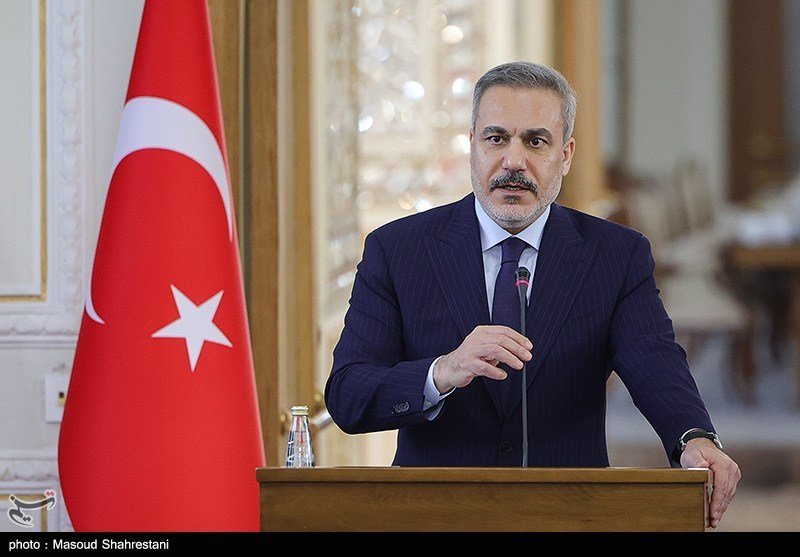
From spymaster to foreign minister, Hakan Fidan has been central to Turkey’s transformation into a more assertive regional power. His influence is likely to outlast the man who elevated him.
For much of his two-decade career in the inner circle of Turkish policymaking, Hakan Fidan was the man behind the curtain. As head of Turkey’s externally facing National Intelligence Organisation (MİT), its principal agency for intelligence and covert operations abroad, he was rarely seen and seldom heard. President Recep Tayyip Erdoğan called him his government’s “black box”. Since becoming foreign minister in June 2023, however, Mr Fidan has moved into the light. His importance lies not simply in his loyalty to the Turkish president. His rise reflects a broader transformation in which Turkish foreign policy has become more closely fused with intelligence, military power and the pursuit of strategic leverage abroad.
Mr Fidan’s unconventional biography helps explain that transformation. Born in Ankara’s historic Hamamönü district in 1968, he grew up between different strands of Turkish society. His father was a Kurdish civil servant from Varto in eastern Turkey; his ethnically Turkish mother came from Denizli in the west. One profile portrays this mixed background as giving him an unusual ability to understand Kurds and Turks, easterners and westerners, and secular Kemalists and Islamists. It also describes a childhood shaped by a strong sense of duty to the Turkish state.
His career was similarly eclectic. He served in the armed forces, studied in the United States while on a NATO posting and obtained advanced degrees in international relations from Turkey’s pre-eminent academic institution. His military training gave him a distinctly security-minded perspective, while his subsequent academic work deepened his interest in international affairs and Turkish foreign policy. After leaving the armed forces, he lectured in international relations at two universities in Ankara, creating an unusual bridge between military experience, academic thinking and the state bureaucracy. That combination of military pragmatism and an analytical approach to foreign policy would become a defining feature of his leadership of key government agencies.
His first senior management role in government came in 2003, when he became director of the Turkish Cooperation and Coordination Agency (TİKA), overseeing Ankara’s development and foreign-aid programmes. He was instrumental in expanding Turkey’s use of soft power to extend its influence across the Turkic world, Central Asia, the Balkans and Africa. He became head of MİT in 2010 and remained there for 13 years, making him one of its longest-serving spy chiefs and transforming the intelligence service into an increasingly central instrument of power projection abroad. Under Mr Fidan, the agency moved beyond gathering intelligence towards conducting diplomacy, managing back channels and dealing directly with foreign governments and armed groups. He was involved in the Oslo talks with the PKK and became one of the principal architects of Turkey’s security policy towards Syria during the Syrian civil war.
Hakan Fidan’s promotion to foreign minister therefore represented more than a change of personnel. It brought the methods of the intelligence service into the centre of diplomacy in Erdoğan’s Turkey.
A pragmatist sympathetic to neo-Ottomanism
It is tempting to describe Mr Fidan as an Islamist, given his closeness to the president and the politically Islamic character of the government he serves. But that would be too simplistic. There is little reliable public evidence that he is an Islamist ideologue. One profile suggests that, while he observes Islamic practices and prays daily, he does not appear to approach policymaking from an Islamist ideological perspective. A recent analysis instead portrays him as a pragmatist increasingly fluent in the language of Turkish-Islamic “civilisational independence”.
That distinction matters. Mr Fidan’s foreign policy is better understood as calibrated and strategic, rooted in the classical European conception of realpolitik rather than in the theological and ideologically driven worldview exhibited in places such as the Islamic Republic of Iran. But a strategy-driven approach does not mean ideology is irrelevant.
Many observers have described the foreign policy of Mr Erdoğan’s Turkey as “neo-Ottoman”, seeking to restore Turkish influence across regions governed for centuries by the Ottoman Empire, particularly the Balkans, Middle East and North Africa. The concept became associated especially with Ahmet Davutoğlu, a foreign minister and prime minister during the first half of Erdoğan’s rule, whose doctrine held that Turkey’s history and geography gave it a special role in its former imperial sphere of influence.
Mr Fidan is not simply reproducing Mr Davutoğlu’s doctrine. He explicitly rejects the idea that Turkey seeks regional domination. In a December 2024 interview with Al Jazeera, days after the fall of Bashar Al-Assad’s regime in Syria, he dismissed talk of Turkish or “neo-Ottoman” domination and contrasted it with co-operation between regional states.
Yet the substance of Turkish policy makes the label hard to discard entirely. Ankara has become deeply involved in Syria, Iraq, Libya and the eastern Mediterranean while building an increasingly consequential presence in the Horn of Africa and the Sahel. Turkey operates military bases or training missions in places such as Libya and Somalia, combining security agreements with trade, infrastructure, development aid and political mediation. Commentators have identified neo-Ottoman rhetoric and historical ties as part of the logic behind Turkey’s expansion in Africa.
Perhaps a better description, then, is neo-Ottomanism unclouded by nostalgia: an effort to convert historical, cultural and religious connections into modern geopolitical influence. Mr Fidan’s contribution has been to give that ambition the tools of an advanced security state.
From mediation to intervention
Turkey once sold itself primarily as a bridge between East and West, leveraging its hybrid identity in multilateral contexts such as its NATO membership, EU accession bid and central role in the Organisation of Islamic Cooperation (OIC). Under Mr Erdoğan, that conciliatory posture evolved into a more muscular and assertive doctrine, with Hakan Fidan serving as an operational architect of the transformation. Ankara still mediates between Russia and Ukraine, speaks to Iran while remaining a NATO member and presents itself as an honest broker in other regional conflicts. But under Mr Fidan’s stewardship, it increasingly does so from positions of physical power and strategic confidence, willing to pursue bold moves beyond established group consensus and test how far its partners will tolerate them.
In Africa, Somalia illustrates the evolution of Turkish leverage particularly well. Turkey had already cultivated close ties with Mogadishu through TİKA aid, trade and military training during Mr Fidan’s tenure at MİT. Under his stewardship, however, security co-operation has become a central component of the relationship. Turkey operates a large military training facility in Mogadishu and has combined defence co-operation with investment, energy exploration and diplomacy. When Ethiopia and Somalia became embroiled in a dispute over the breakaway territory of Somaliland, Ankara positioned itself as mediator. Mr Fidan could draw on a relationship with Mogadishu built over years of military and intelligence engagement, while Turkey’s growing security role gave its diplomacy greater weight. Mediation was no longer an alternative to power projection; it had become one of its instruments.
Mr Fidan is particularly suited to such a foreign policy because he comes from the institution that thinks in precisely these terms. As MİT chief, he helped turn intelligence from an information-gathering service into an operational instrument of statecraft. During his tenure, the agency became deeply involved in contacts with foreign governments, armed groups and political organisations, while its relationship with the presidency was strengthened.
The result is a style of diplomacy that prizes personal channels, flexibility and multiple lines of communication. Ankara can speak simultaneously to Washington, Moscow, Tehran, Doha, Riyadh, Damascus and Hamas. For Mr Fidan, years in intelligence make such parallel relationships an asset rather than a contradiction.
This helps explain Turkey’s unorthodox position over Russia’s war in Ukraine. Turkey remains a NATO member while maintaining extensive economic and political ties with Russia. It has supplied Ukraine with weapons while keeping channels to Moscow open. Mr Fidan has sought to preserve Turkey’s role as an intermediary rather than joining a policy of Russia’s complete isolation.
The same logic applies to Iran. Turkey avoided involvement in the American-Israeli campaign against the Islamic Republic, even while Iranian missiles have threatened Turkish territory. Ankara instead seeks to retain channels through which it can communicate with Tehran and Western governments.
As practised by Hakan Fidan, this is not neutrality. It is leverage.
Fidanism in a post-Assad Syria
Nowhere is this approach more apparent than Syria, where Hakan Fidan’s career has come full circle. As intelligence chief, he was deeply involved in Turkey’s response to the civil war. As foreign minister, he has become one of the principal architects of Ankara’s strategy towards the allied government of Ahmed Al-Sharaa.
Turkey wants Syria to remain territorially intact, but a unified Syrian state also serves Turkish interests if it can absorb or neutralise Kurdish armed groups that Ankara regards as an existential threat. Hakan Fidan has sought closer co-operation between Turkey, Syria, Iraq and Jordan against jihadist groups while pressing for the dissolution or integration of Kurdish-led forces in Syria. He has also sought to avoid a direct confrontation with Israel in Syria’s post-Assad landscape, while forcefully defending Ankara’s red lines against any perceived attempt to partition the country along ethnic or sectarian lines.
Balancing these two objectives has been complicated by Israeli military intervention in 2025 on behalf of Druze communities in the southwest during clashes with Syrian government forces. For Mr Fidan, the Druze question illustrates Ankara’s broader fear of minority grievances becoming vehicles for external intervention and territorial fragmentation — while also testing his ability to prevent Turkish–Israeli competition in Syria from escalating into armed conflict.
Turkey therefore finds itself defending Syrian territorial integrity while maintaining military positions inside Syria. Ankara says its objective is to prevent terrorism and another fragmentation of the country; in practice, its military presence gives it influence over the political settlement. The fall of Al-Assad in December 2024 made that leverage more valuable. Turkey developed close relations with Al-Sharaa’s new administration and has sought to shape Syria’s security architecture. In this context, it was no surprise that Mr Fidan was present in Washington when the Syrian leader made a historic visit to the White House, reportedly at the invitation of President Donald Trump. His presence underlined how instrumental Turkey — and Mr Fidan himself — had become to the future of its southern neighbour.
Again, Hakan Fidan’s method is strikingly visible: a relationship that looks like a liability can become an instrument of influence.
The lasting, transformative legacy of Hakan Fidan
None of this means that Hakan Fidan has become an independent foreign-policy czar. Turkish foreign policy remains highly personalised around Mr Erdoğan. His extraordinary rise was enabled by his loyalty to the president and his role in consolidating the security order following the failed 2016 coup. But that is no longer the most interesting part of the story. The more consequential question is what happens when a state whose foreign policy was once conducted principally through diplomats increasingly conducts it through the habits of an intelligence service.
Mr Fidan embodies that strategic transformation. His Turkey does not abandon diplomacy; it makes diplomacy more coercive. It does not foresake alliances; it activates them selectively. It does not reject mediation; it seeks to mediate from a position of military and geopolitical strength. For Mr Erdoğan, Mr Fidan may still be the “black box”. For modern Turkey, however, he is becoming something more consequential: the engineer of a foreign policy that combines the historical reach of neo-Ottomanism with the hard-headed pragmatism of a professional intelligence service.
Having turned 58 last month, the spymaster-turned-chief diplomat is young enough to shape Turkish statecraft for at least another decade. His loyalty to the president has brought him deep institutional trust, while his long tenure at the centre of the security apparatus has given him relationships and influence that extend beyond any single administration. At nearly 15 years the president’s junior, Mr Fidan could remain a powerful figure in Ankara well into the post-Erdoğan era — perhaps eventually entering electoral politics and even succeeding his former patron. Either way, the mustachioed securocrat’s greatest legacy may be less the invention of a particular doctrine than the effective deployment of Turkey’s military, intelligence and diplomatic assets to enhance the country’s place in the world: a Turkey that is more assertive, more interventionist and increasingly willing to turn power into diplomatic leverage.