

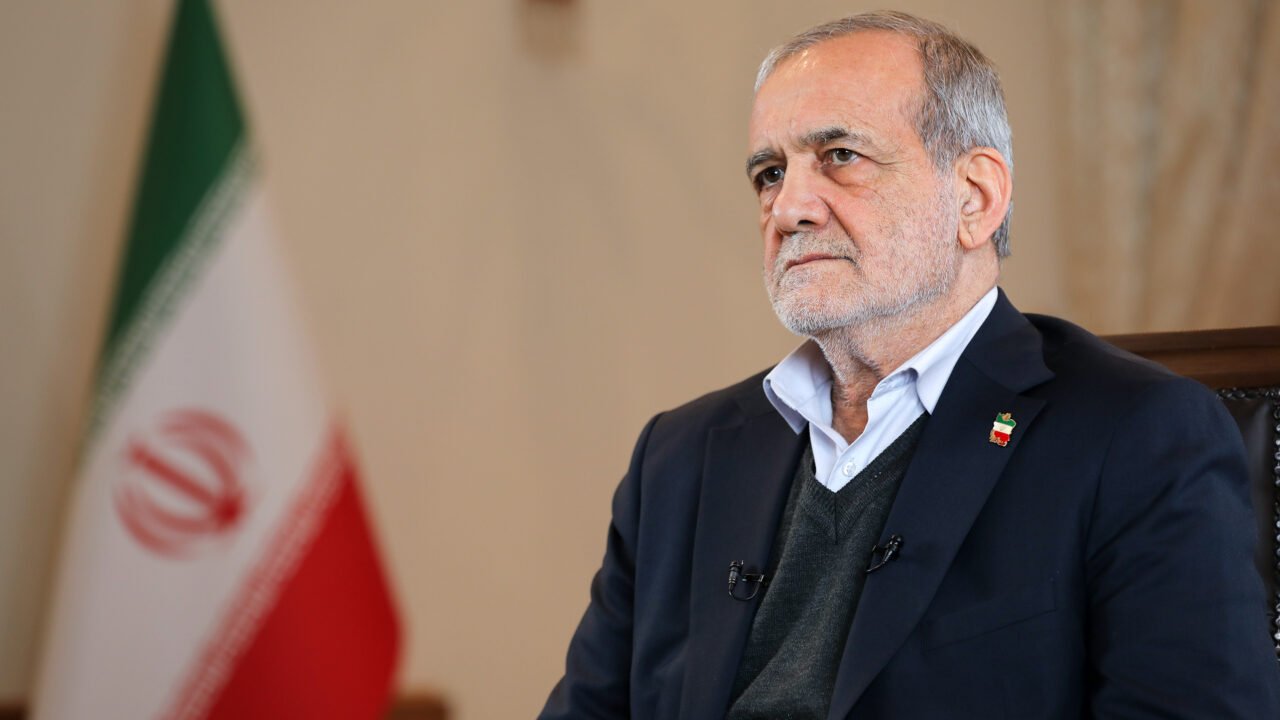
When Iranians woke on Monday morning to reports that the resignation of Masoud Pezeshkian had been submitted, some interpreted it as a sign of political upheaval. It is not. The state news agency Tasnim was swift to deny the reports, carried by the opposition channel Iran International, which alleged that Mr Pezeshkian had stepped down in protest at the complete seizure of government by hardline factions within the Islamic Revolutionary Guard Corps (IRGC). Yet whether or not the reports are accurate, the episode illuminates something important about the Islamic Republic: its civilian institutions are becoming an increasingly threadbare fiction.
The Iranian presidency has always been something of a performance. Since the revolution, presidents have been selected from a narrow slate of candidates vetted by the Supreme Leader, and once in office have found themselves unable to take any decision of substance without the approval of unelected power centres — the Supreme Leader above all, but also the IRGC and a constellation of opaque institutions beyond public accountability. The public sees the president’s face; the real decisions are made elsewhere.
Mr Pezeshkian appeared to understand his predicament clearly enough. During budget debates earlier this year, he admitted that his hands were tied and that his inability to improve ordinary Iranians’ lives was sapping his will to remain in office. “My goal is to solve the people’s problems”, he said, “not to stay in power”. It was a candid confession of impotence from a man nominally running one of the Middle East’s most consequential states.
The pressures on him have since multiplied. Iran has faced sweeping protests, suppressed with characteristic brutality. A regional war has deepened an already severe economic crisis, widened the gulf between a beleaguered public and a government unable to deliver, and intensified Iran’s international isolation. Most destabilising of all, the death of Supreme Leader Ali Khamenei on the war’s first day created a vacuum at the top of the system. His son, Mojtaba Khamenei, is said to have assumed the role, yet has made no public appearances; whether he is actually governing remains unclear. Into that vacuum have stepped the IRGC‘s senior commanders, who have consolidated authority and pushed for continued regional escalation regardless of the domestic cost.
The prospect of the resignation of Masoud Pezeshkian reflects the increasingly untenable position occupied by Iran’s civilian leaders. Accountable to the public for failures over which he had little control, and sidelined by military figures pursuing a course he could not alter, Mr Pezeshkian found himself trapped between public expectations and the realities of power. The contradiction is not new, but it has rarely been so starkly exposed.
Should the resignation of Masoud Pezeshkian indeed come to pass, little in Iran’s day-to-day governance would change. The IRGC would carry on; policy would continue to be set by men in uniform rather than men with mandates. What would change is the optics. For decades, the Islamic Republic has maintained the pretence of a functioning civilian administration — elections, a cabinet, a president — as a veneer of legitimacy over a system that is, in practice, a security-state oligarchy. The veneer is wearing thin. If the resignation was ultimately driven by his political irrelevance, it would not be a sign of democratic vitality. Rather, it would signal that the machinery of make-believe sustaining the Islamic Republic’s civilian façade is beginning to break down.