

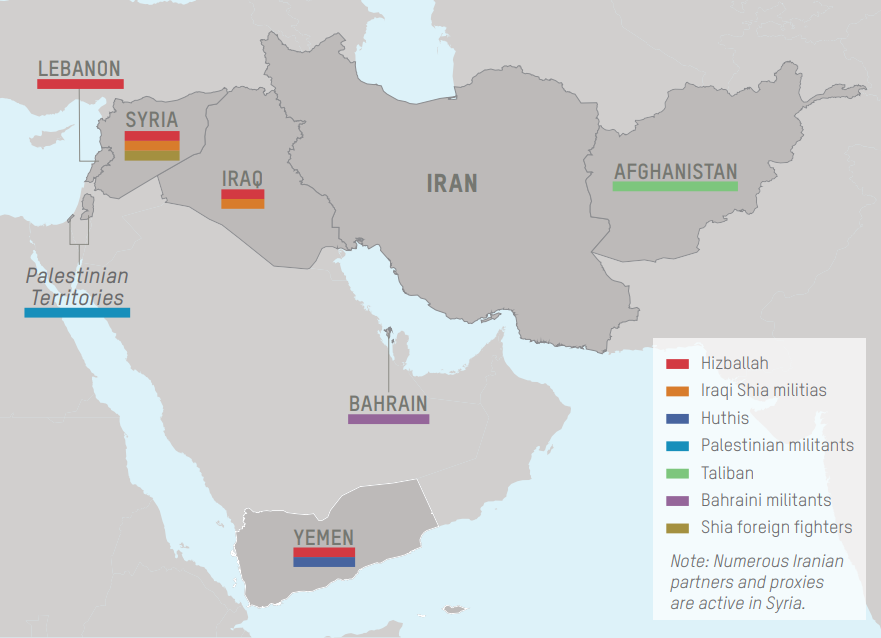
As Iran developed its formal “Axis of Resistance”, it simultaneously built a parallel infrastructure of criminal proxies far beyond the region. As international attention fixes on the Gulf region and the uncertain trajectory of the 2026 conflict with the regime, Iran’s criminal proxies continue to operate with relative impunity.
For decades, Iran’s Islamic Republic has cultivated an unconventional tool of statecraft: criminal proxies. Quietly assembled across Asia, Africa, Europe and the Americas, these networks now function as an extension of the Islamic Revolutionary Guard Corps (IRGC), conducting surveillance, harassment and, on occasion, assassination on behalf of the state.
The revolution of 1979 reshaped Iran’s foreign policy around two animating principles: hostility toward the West, particularly the United States and Israel, and the suppression of dissent wherever it takes root. What followed was a gradual, largely secretive effort to project those principles outward. As Iran developed its formal “Axis of Resistance” — backing allied militias across the Middle East — it simultaneously built a parallel infrastructure of criminal proxies far beyond the region.
The networks serve three purposes: targeting members of the Iranian diaspora who publicly oppose the regime; threatening Jewish institutions and Israeli interests abroad; and conducting espionage in foreign countries.
Early signs of this strategy were visible in 1991, when Hitoshi Igarashi, a Japanese scholar who had translated Salman Rushdie’s The Satanic Verses, was assassinated at his university office in Tsukuba. The killing came after Supreme Leader Ayatollah Khomeini issued a fatwa calling for the deaths of Rushdie and those involved in publishing his book. Three years later, a bombing at the AMIA Jewish community centre in Buenos Aires killed 85 people. Though formally attributed to Hezbollah, investigators concluded the operation had Iranian state backing — a pattern that would repeat itself in the years ahead.
The threat to diaspora figures has grown more brazen over time. Masih Alinejad, an Iranian-American journalist and activist, has become one of the regime’s most prominent targets. Since 2021, the Federal Bureau of Investigation has documented multiple plots against her. In October 2024, an Iranian general and six alleged operatives were charged in the United States in connection with a scheme to assassinate her. Further arrests followed in November 2024 and again in 2025, each with alleged ties to the IRGC.
Europe has seen a marked increase in Iran-linked activity. In Sweden, the Foxtrot criminal network has carried out attacks on the Israeli embassy and on Elbit Systems, an Israeli defence company, with investigators tracing the instructions back to Iranian handlers. France has been a target since the 1991 assassination of Shapour Bakhtiar, the last prime minister to serve under the Shah, killed in Paris by IRGC agents alongside his secretary. The United Kingdom has faced its own incidents, including a plot — referred to by authorities as “the Wedding” — to kill journalists working for Iran International, a Persian-language broadcaster critical of the regime, as well as attempts against the Israeli embassy and, most recently, attacks targeting London’s Jewish community in 2026.
Germany, France and the United Kingdom all publish annual intelligence assessments that highlight Iranian interference in their domestic affairs. The reports share a common theme: the regime’s increasing reliance on organised crime and, troublingly, the recruitment of minors to carry out tasks on its behalf.
Australia has not been immune. The most significant episode came in 2024, when Sayed Moosawi allegedly directed a group of arsonists to target Lewis Continental Kitchen, a Jewish restaurant in the Sydney suburb of Bondi, followed by an attack on Adass Israel Synagogue in the Melbourne suburb of Ripponlea. Both incidents were linked by investigators to Iranian direction. A subsequent investigation in 2026 revealed that Iran-linked intelligence networks had been operating across the country, using the encrypted messaging platform Telegram to gather information on Israeli and Jewish communities in exchange for cryptocurrency payments. The method was not unique to Australia — British authorities uncovered a similar operation in which teenagers were reportedly offered £500 to film and photograph potential targets, illustrating how the regime recruits from the margins of society to maintain distance from its own fingerprints.
As international attention fixes on the Gulf region and the uncertain trajectory of the 2026 conflict with the regime, Iran’s criminal proxies continue to operate with relative impunity. The current moment may, however, present a rare opportunity. With the Axis of Resistance significantly weakened, Iran under sustained pressure to abandon its nuclear programme, and the prospect of political transformation inside the country no longer unthinkable, Western governments have more leverage than they have had in years. Dismantling Iran’s criminal proxy networks — through coordinated law enforcement, intelligence sharing and targeted sanctions on IRGC-linked intermediaries — should be treated as a strategic priority, not an afterthought. The infrastructure Iran has spent decades quietly assembling will not dismantle itself. If the opportunity afforded by the current moment of Iranian vulnerability is not seized, the window to act may prove narrower than it appears.