

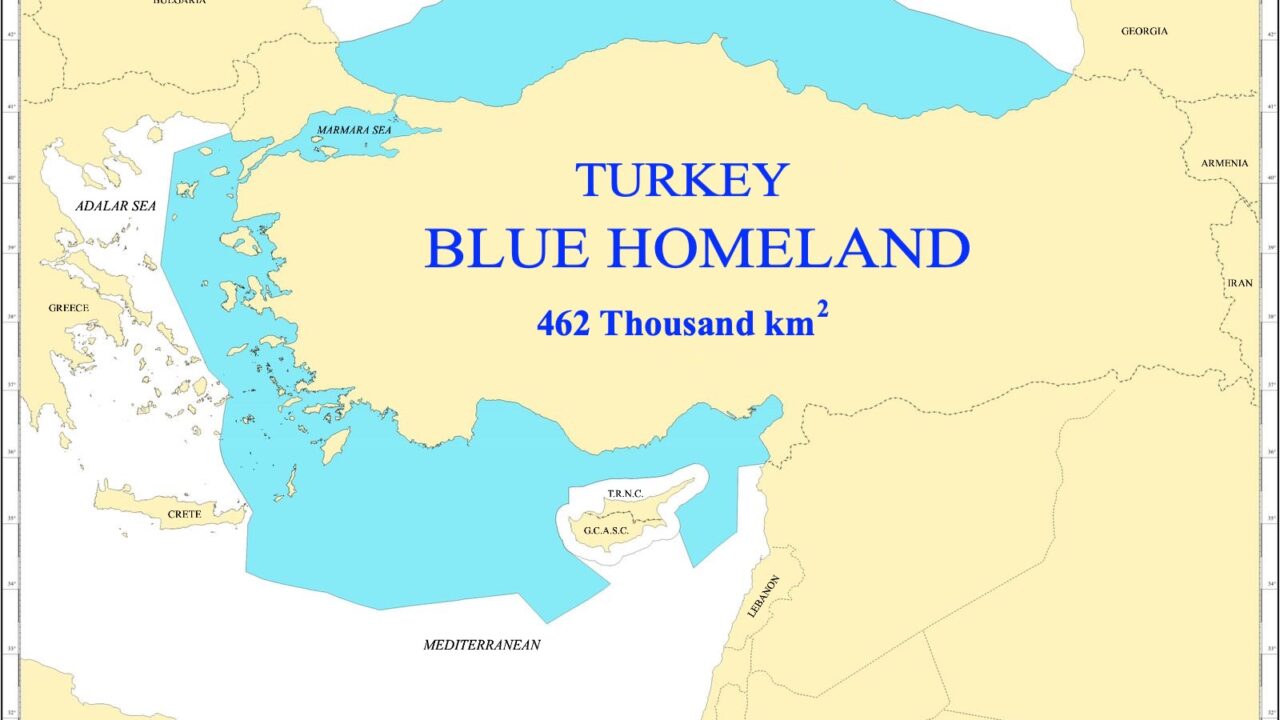
According to reports in the Turkish media, the draft legislation addresses the legal status of islands, islets and rocks in the Aegean Sea. The definitions and status of these geographical formations will be codified in the so-called “Blue Homeland Law,” based on Turkey’s own interpretations of international maritime law.
The long-standing dispute over maritime jurisdiction in the Eastern Mediterranean between Turkey, Greece and the Republic of Cyprus has reached a new peak after Turkish media recently reported that this coming June the Turkish parliament would be debating a new bill. Referred to as the “Blue Homeland” law, the move would unilaterally define Turkey’s maritime claims in the Eastern Mediterranean.
As is well known, over the past decade, the discovery of rich hydrocarbon reserves in the Eastern Mediterranean — particularly off the coasts of Egypt, Israel and Cyprus — has transformed the issue of delimiting maritime zones into a matter of national interest and pride, comparable in significance to land border disputes.
While Turkey has been actively exploring hydrocarbon resources in the Black Sea, it has fallen significantly behind Egypt, Israel, and Cyprus in the Eastern Mediterranean. A key constraint for Ankara is the fact that both Greece and the Republic of Cyprus — which Turkey does not officially recognise — have signed the 1982 United Nations Convention on the Law of the Sea (UNCLOS). The treaty is also recognised by the European Union, of which Athens and Nicosia are members, and the EU’s official maritime boundaries have been mapped accordingly in a document commonly referred to as the “Seville Map.”
This map, drawn according to UNCLOS criteria, generally grants islands their own continental shelves, independent of surrounding coastlines, and allows them to claim a 12-nautical-mile territorial sea, just like mainland coastal states. The dispute between Turkey, Greece and Cyprus arises precisely at this point. In the Aegean Sea, Greek islands lie directly opposite the Turkish coast, and in the Eastern Mediterranean, the island of Kastelorizo cuts across Turkey’s seaward approach. If these islands indeed would assert their full 12-mile territorial waters as UNCLOS dictates, then despite having the longest coastline in the region, Turkey would see its maritime jurisdiction shrink significantly.
At this juncture, Turkey has rejected UNCLOS and remains a non-signatory, while maintaining a 6-nautical-mile territorial sea in the Aegean. Turkey argues that its maritime position reflects legitimate national interests, though critics contend that Turkey’s maritime claims conflict with established international law. Moreover, Turkey has passed a bill declaring that it will regard any Greek declaration of a 12-nautical-mile territorial sea in the Aegean as a “casus belli”. Parallel to that over the years Ankara has sought to negotiate with Athens for a “median line” through the middle of the Aegean, effectively proposing an equal division of the sea measured from the mainland coasts. Naturally, acceptance of the Turkish position would turn the Greek islands opposite the Turkish coast into de facto Greek enclaves within Turkey’s territorial waters. It is hardly surprising, however, that Athens — its position reinforced by UNCLOS — has consistently rejected Ankara’s claims.
The Cyprus question, meanwhile, remains at an impasse due to Turkey’s 1974 military invasion and the unilateral declaration of maritime zones by Turkey and by the so-called Turkish Republic of Northern Cyprus (TRNC), a puppet state recognised by no international actor other than Turkey, which also claims areas extending into the southern part of the island.
Despite this disruptive approach, Republic of Cyprus, whose sovereignty over the entire island is recognised under international law, has deliberately refrained from declaring maritime boundaries in the north to avoid further escalation with Ankara. In line with the aforementioned Seville Map, Nicosia asserts its claims only over the southern and south-western portions of the island.
Turkey, acting entirely outside the framework of UNCLOS, has chosen to publish its own maritime map around Cyprus, arguing that islands cannot generate their own continental shelf. Ankara’s interpretation of maritime law has become central to broader debates surrounding Turkey’s maritime claims in the Eastern Mediterranean. This approach effectively limits Cyprus’s maritime zones while expanding Turkey’s own claims. However it should also be noted that Turkey’s unilateral stance is further complicated by the fact that both Greece and the Republic of Cyprus are members of the European Union. In practical terms, any Turkish naval operation in the Eastern Mediterranean that infringes on the UNCLOS-defined maritime zones of Cyprus and Greece also risks encroaching on territory recognised as EU maritime space, making such actions politically sensitive.
Bearing in mind the above, while hydrocarbon resources may appear primarily as an energy commodity, they also serve as a catalyst for state cooperation, providing the backbone for strategic alliances against so-called traditional “rival” nations. At this point, the strategic partnership formed by Greece, Cyprus and Israel around hydrocarbon exploitation — also in response to Turkey’s antagonist aggressive foreign policy — cannot be overlooked.
Certainly, the historical rivalry between Turkey and Greece and the chronic problems around the maritime delimitation, Cyprus question and the status of Greek and Muslim minorities have turned Ankara and Athens into perpetual rivals. Israel, however, represents a notable exception. Following the Hamas attacks on Israel on 7 October 2023, Ankara’s Pan-Islamist, Neo-Ottoman and pro-Palestinian foreign policy effectively pushed Israel to Greece–Cyprus axis. With Egypt providing background support, these three nations also signed on to the East-Med pipeline project, aiming to channel Eastern Mediterranean hydrocarbon reserves to Europe.
Left on the sidelines, Turkey sought to undermine the UNCLOS-based maritime partnership by signing a maritime boundary agreement in 2019 with Libya’s Government of National Accord (GNA). The deal specifically envisaged expanding Turkish and Libyan waters at the expense of Greek territorial waters between Crete and Rhodes. In effect, Turkey created its own international framework in opposition to UNCLOS. To ensure the agreement’s practical viability, Ankara did not hesitate even to intervene in Libya’s civil war, contributing to the country’s de facto division.
Thus in light of the said above, the new bill, scheduled for consideration by the Turkish parliament in June, represents a significant escalation. According to reports in the Turkish media, the draft legislation addresses the legal status of islands, islets and rocks in the Aegean Sea — areas occasionally described as “grey zones” that have sparked tensions between Turkey and Greece. The definitions and status of these geographical formations will be codified in the so-called “Blue Homeland Law,” based on Turkey’s own interpretations of international maritime law. Vice-Chair of the Presidential Council for Security and Foreign Policy, Çağrı Erhan, commented, “Turkey will no longer be merely an executor of maritime law terminology; it will now be a state that directly contributes to the creation and legal definition of these concepts”.
In conclusion, Turkey’s maritime claims in the Eastern Mediterranean extend far beyond energy resources and national interests, emerging as a complex issue shaped by international law, regional power dynamics and strategic alliances. The “Blue Homeland” doctrine reflects Ankara’s determination to assert its own legal interpretations and to unilaterally define its maritime zones. This process spans a wide spectrum, from the status of islands and rocks in the Aegean to the implementation of agreements with Libya, all while interacting with both regional and global actors. Consequently, the issue of maritime boundaries in the Eastern Mediterranean remains central to Turkey’s foreign policy, encompassing not only hydrocarbons but also national sovereignty, strategic security and international law. Given Turkey’s persistent disregard for international legal norms in the region and its repeated challenges to the sovereignty of the Republic of Cyprus and Israel, the bill now before the Turkish parliament signals Ankara’s intent to further inflame tensions in Eastern Mediterranean waters.