


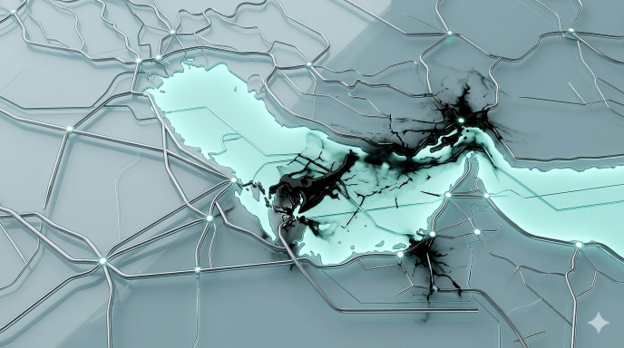
Since February 28th, Iran has been engaged in a violent attempt to export its own economic misery. By lobbing drones and missiles at the Gulf’s energy arteries, Tehran is betting it can force the rest of the world to pick up the tab for its war. The most surgical damage has been inflicted on Qatar. Over March 18th and 19th, strikes on Ras Laffan, the nerve centre of the country’s liquefied natural gas (LNG) industry, crippled two production “trains.” With nearly a fifth of Qatari export capacity knocked sideways and repairs likely to drag on for years, the shockwaves are radiating far beyond the peninsula. Qatar provides some 20% of the world’s LNG. When its infrastructure is sabotaged, it is the global consumer who feels the chill.
Saudi Arabia has, for now, been luckier. A drone strike on the SAMREF refinery in Yanbu on March 19th proved more of a warning shot than a knockout blow, with operations resuming shortly thereafter. Even so, the risk is clear. Aditya Saraswat of Rystad Energy reckons that a truly serious disruption could yank 5m-6m barrels a day from the market, sending crude screaming past $150.
Meanwhile, Kuwaiti units at Mina al-Ahmadi have been left charred, and debris from intercepted missiles has rained down on the Emirates’ Habshan and Bab fields. Even Fujairah, once considered a safe bypass outside the Strait of Hormuz, is finding that distance is no shield against a determined drone.
The reaction in the pits was predictably frantic. On March 19th Brent crude, the international benchmark, briefly touched $119 a barrel before settling at $108.65. Its American cousin, West Texas Intermediate (WTI), breached the $100 mark before retreating. By the morning of March 20th, prices had softened slightly on whispers that America and its allies might forcibly reopen the Strait of Hormuz, but Brent remained on track for a 5% weekly gain.
The “shape” of the risk is as telling as the price. Traders are currently betting on a sharp, nasty supply shock rather than a permanent loss of capacity. This is reflected in the “curve”: contracts for immediate delivery are dearer than those for the future, a state of affairs known as backwardation. It signals a desperate scramble for barrels today, paired with a prayer that the taps will be turned back on tomorrow.
The geography of the conflict has also blown open the spread between Brent and WTI to its widest level since 2015. Because Brent is the price of seaborne global trade, it is hyper-sensitive to the sounds of splashing in the Gulf. WTI, tethered to the American heartland, is more insulated. For the moment, the Atlantic is looking like a very expensive moat.
Optimists at Goldman Sachs expect a gradual recovery from April, with Brent drifting back into the $70s by late 2026. But the risks are skewed heavily to the upside. Should the wreckage at Ras Laffan prove a harbinger of things to come, or the Strait remains a no-go zone, prices could comfortably reside above $100 for years. Goldman warns that a prolonged outage could even see Brent eclipse its 2008 peak of $147.
The IMF, ever the gloomy librarian, notes that such a sustained spike would be a double-whammy: stoking inflation while throttling growth. The transmission mechanism is as old as the internal combustion engine. Dearer oil hits the petrol pump and the utility bill first, before bleeding into the price of a loaf of bread or a shipping container.
Europe, which can least afford a fresh energy crisis, is already recalibrating. The European Central Bank has hiked its 2026 inflation forecast to 2.6% while trimming its growth outlook. On March 19th, Christine Lagarde and her colleagues kept rates at 2%, but the accompanying “hawkish” tone suggested that the era of easy money is being held hostage by Middle Eastern geopolitics. The Federal Reserve followed suit; investors, sniffing the return of “sticky” inflation, have beat a hasty retreat from their bets on imminent rate cuts.
Equity markets have duly taken fright. On March 19th, the S&P 500 and the Nasdaq both dipped as the “Goldilocks” scenario of falling rates and steady growth evaporated. In Europe, the STOXX 600 headed for its third weekly loss. For the oil producers, the chaos brings a windfall of petrodollars. For everyone else, it is a grim reminder that while the Gulf may be the battlefield, the world gets the bill.