

The offensive exposes significant Russian vulnerabilities in protecting its Malian client. Russian setbacks in West Africa should not, however, be a cause for complacency among Moscow’s geopolitical rivals, least of all the United States.
For global policymakers and security analysts, Saturday, 25 April should have marked the beginning of a quiet weekend — a hoped-for respite from wide-ranging tensions generated by the Iran War. A three-week truce between the United States and Iran had held, albeit uneasily, while ongoing, if erratic, negotiations sought to undo the profound shocks to global security and economic stability generated by weeks of conflict. Armed hostilities continued in other Middle Eastern theatres, such as the Sudanese civil war and Hezbollah-Israel fighting in Lebanon, yet these were burning at a low intensity, without any decisive developments. The Russia–Ukraine War ground on deep into its fourth year, similarly devoid of any transformative breakthrough.
Yet, as decision-makers and commentators awoke that Saturday anticipating calm, they were confronted with a new flashpoint posing significant geostrategic risks. In the heart of West Africa — eyed by the world community as a key future source of critical minerals — a resurgent Islamist threat emerged with implications far beyond its immediate environs: a jihadist insurrection led by Al-Qaeda’s affiliate in Mali, Jama’at Nusrat al-Islam wal-Muslimin (JNIM).
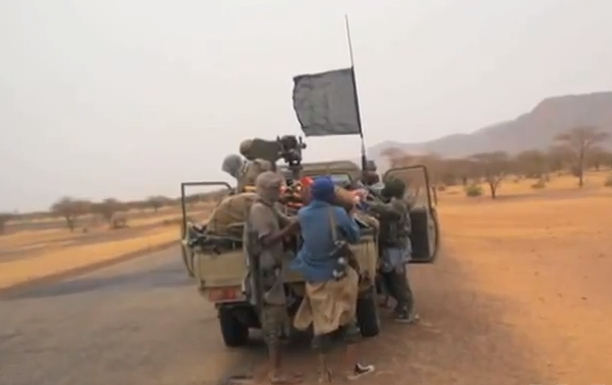
At dawn, thousands of JNIM fighters mounted on pickup trucks and motorbikes, launched coordinated nationwide attacks against Mali
s military-led government and its Russian patron. JNIM’s assault in northern Mali was synchronised with forces from the Azawad Liberation Front (FLA), a coalition of Tuareg Berber and Arab tribes from northern desert regions who seek independence from the more economically developed and densely populated south. The jihadist–secessionist alliance deployed a range of conventional and unconventional military tactics, including roadside ambushes, suicide bombers, car bombs, rocket-propelled grenades, one-way attack drones, artillery and small arms fire directed at key military bases and strategic towns. Concurrently, JNIM conducted independent, multi-pronged assaults on government targets in the southern and central regions, including the capital Bamako and its nearby international airport.
The offensive represented the most sophisticated anti-government action since 2012, when Al-Qaeda and Tuareg separatists jointly seized the northern two-thirds of Mali, prompting French military intervention and the subsequent deployment of the United Nations peacekeeping force MINUSMA. Whilst it caught many international observers off guard, JNIM’s campaign follows several years of escalating warfare on the Malian state, including the seizure of key transportation networks and fuel supplies within the state’s southern and central industrial heartland, as well as the abduction of foreign nationals. These actions simultaneously symbolised the junta’s inability to provide basic security and inflicted severe economic damage — most visibly in recurring disruptions to water and electricity supply.
The JNIM–FLA coalition swiftly captured Kidal in Mali’s far north; subsequent reports confirmed the retreat of both government troops and Russia’s mercenary Africa Corps, the successor organisation to the Wagner Group. More than just a military defeat, the fall of the city is a symbolic blow to Russia’s reputation in the country, given the Corps’ role in ending a decade of insurgent rule there in November 2023. Several hundred kilometres to the south, rebels secured partial control of Gao, cornering Malian and Russian forces. JNIM incursions were also reported in the central cities of Mopti and Sévaré, towns that had nominally remained under government authority throughout the preceding decade but had been subject in recent years to Islamist blockades and religious dictates. These two cities now appear to be divided along contested lines of control, with the insurrectionists gaining ground.
Fighting was likewise documented in the capital itself, where the government seemingly retains overall authority, imposing an indefinite night-time curfew and establishing checkpoints along major roads. Flights from Bamako’s airport were suspended during the initial 24 hours. The Al Qaeda rebels for their part countered with an attempted blockade of roads leading into Bamako, seeking to starve the junta of supplies and encouraging residents to flee the city.
JNIM’s attacks are motivated as much by the desire to seize strategic assets as to decapitate the junta’s political and military leadership and reorient Mali’s foreign relations. An official JNIM statement in Arabic claiming responsibility for the synchronised assaults outlined such priorities. It notably featured a warning to the Russians to stay out of the fighting, threatening them if they did not heed the call but promising productive relations with Moscow by a successor Malian government if they did. One assault targeted the junta’s stronghold of Kati on the northern outskirts of Bamako, killing Defence Minister Sadio Camara and reportedly wounding intelligence chief Modibo Koné and Chief of Staff Oumar Diarra. President Assimi Goïta was reportedly evacuated to a secure location by special forces and took four days to make his first public statement. While the junta chief assured Malians in a televised address that the situation was “under control“, and released footage of himself visiting wounded soldiers in a hospital, many saw his belated appearance and indecisive demeanour as a sign that the government was losing its grip on power.
The offensive exposes significant Russian vulnerabilities in protecting its Malian client and casts doubt on Moscow’s broader regional strategy in the Sahel and West Africa. Russia was instrumental in engineering Goïta’s 2020 coup against a civilian government and subsequently secured the ejection of French forces in favour of its own. The Africa Corps had been entrusted with protecting the now-deceased defence minister and tasked with suppressing the northern insurgency; the events of the past week represent a conspicuous failure to deliver on either mission. The Kremlin would struggle to provide meaningful reinforcements to the 1,000-strong force, given its continued manpower strain in Ukraine and its determination to preserve existing geocommercial interests elsewhere in Africa, particularly in Libya and Sudan.
Russia had similarly helped engineer coups in neighbouring Burkina Faso and Niger in the early 2020s. Together with Mali, these states formed the Moscow-aligned Alliance of Sahel States (AES), withdrawing from the US and EU-supported Economic Community of West African States (ECOWAS). Yet, in Bamako’s hour of need, its AES partners have offered little beyond condemnatory statements rather than concrete military aid, suggesting that the alliance exists more on paper than in practice.
Russian setbacks in West Africa should not, however, be a cause for complacency among Moscow’s geopolitical rivals, least of all the United States. The breadth and coordination of JNIM’s offensive illustrates its capacity to pose an existential threat to Mali’s regime, even if the current onslaught is ultimately repelled. The audacity of the campaign, and the humiliation it has inflicted on Russia, is likely to embolden similarly minded Sunni jihadist groups active across the Sahel — a region already mired in terrorism that in 2024 alone accounted for 50% of global terrorism-related deaths. The successes of JNIM’s opening blow against the junta may serve as a template for militant movements operating in areas of weak governance and longstanding ethnic and territorial grievances, including Nigeria and beyond, as well as embolden local ISIS affiliates, which are arguably even more ideologically extreme and willing to deploy wanton violence.
Ascendant Islamist militancy in the Sahel also poses security and economic risks to Morocco, a stalwart pro-Western ally whose long-term strategic planning depends upon regional stability as it prepares to co-host the 2030 World Cup. JNIM and comparable terrorist groups can, moreover, draw encouragement from contemporary jihadist successes in toppling governments in Syria and Afghanistan, adopting a patient, long-term approach as both local and great-power enemies exhaust their resources in protracted counterinsurgency campaigns.
Mali’s perceived geographical isolation and limited geopolitical significance, as suggested by some observers, should not downplay the threat posed by an Islamist-jihadist regime in Bamako. Were the country to fall under Al-Qaeda rule, it would provide transnational jihadist networks with a territorial base from which to arm, train and export terrorism. It would likewise provoke hostilities with its neighbours and impede efforts to extract critical raw materials essential to 21st-century technologies. The precedents of Afghanistan as a sanctuary for Osama bin Laden in the years preceding the 11 September 2001 attacks, and of ISIS’s de facto state in parts of Syria and Iraq as a base for planning terrorist attacks in Europe a decade ago, serve as a stark reminder of what such “safe havens” can produce. It is a risk that the international community ignores at its own peril.