
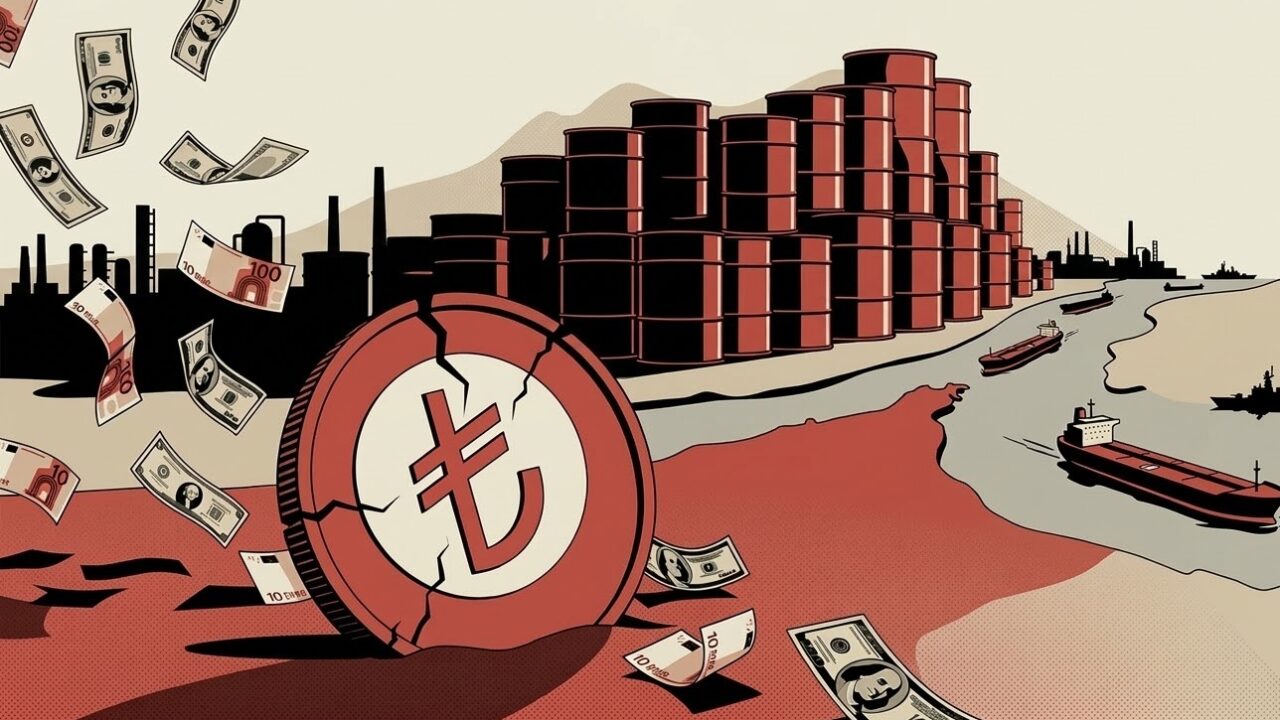
On March 12th the Central Bank of the Republic of Turkey left its one-week repo rate (its main policy rate) unchanged at 37%. Such a lofty rate reflects the stubborn inflation in Turkey under Recep Tayyip Erdoğan. Recent geopolitical turmoil has added to the pressure.
Following joint American–Israeli air strikes on Iran, the Islamic Republic threatened retaliation against global energy markets. It launched drone and missile attacks on energy infrastructure in Qatar, Bahrain and Saudi Arabia, while attempting to disrupt shipping through the Strait of Hormuz—a chokepoint through which roughly a fifth of the world’s oil consumption passes. The United States Navy destroyed much of Iran’s naval capacity, though Tehran reportedly remained able to deploy mines in the channel.
Energy markets reacted swiftly. The benchmark Brent crude oil price climbed above $103 a barrel on March 13th, with futures for May trading at roughly the same level. Higher oil prices risk fuelling a fresh bout of global inflation. For an energy-importing economy such as Turkey’s, they threaten to aggravate an already acute domestic problem.
Yet the Gulf crisis is a sideshow. The deeper causes of the inflation in Turkey lie closer to home. In January 2026 broad money (M2) was expanding at an annual rate of roughly 42%—a pace far in excess of economic growth.
This monetary surge is striking because Turkey’s public finances are not especially strained. The budget deficit stood at about 3.1% of GDP in 2025, while public debt amounts to roughly a quarter of national output, low by international standards.
The roots of the problem lie in years of politicised monetary policy. For much of the past decade, Ankara kept interest rates artificially low in an attempt to stimulate growth. Cheap credit weakened the lira and eroded confidence in the currency. Households and firms responded by shifting savings into foreign currencies, swelling the stock of foreign-currency deposits in the banking system.
As the lira came under pressure, the central bank repeatedly intervened in foreign-exchange markets to support it, running down its reserves. At the same time, it continued to supply domestic liquidity to sustain credit growth. The result has been a financial system reliant on rapid monetary expansion and burdened by entrenched inflation.
Turkey’s inflation problem, then, is less a consequence of events in the Persian Gulf than of policy choices in Ankara. Years of political interference in monetary policy have weakened the credibility of the central bank and left the country grappling with persistently high inflation.