
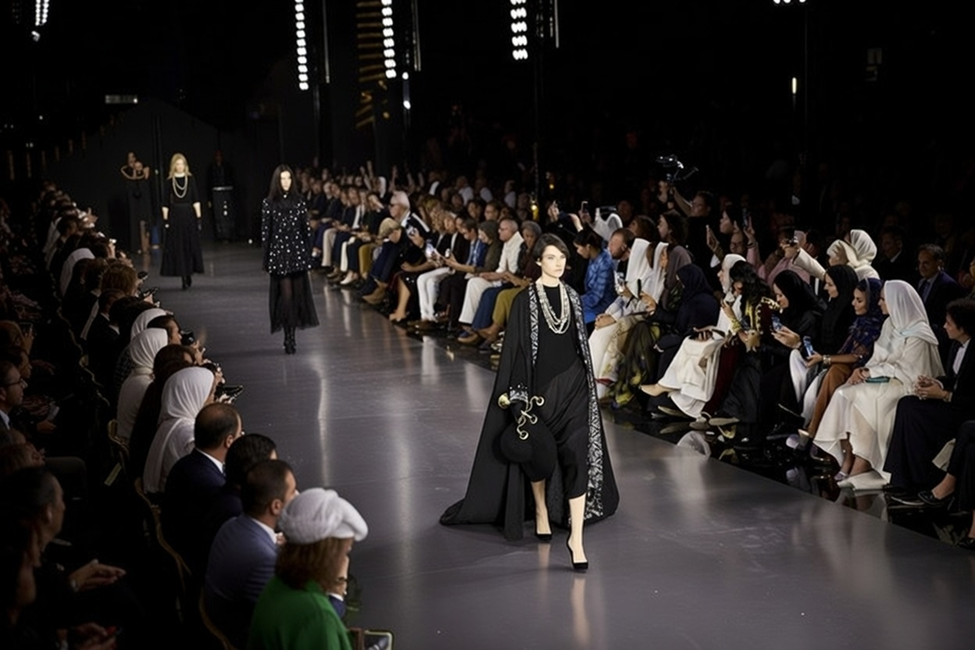
When examining fashion across the Middle East in 2026, it is clear that the story is not one of tradition versus modernity, but of negotiation. Closets hold inherited garments alongside global luxury purchases. Young women scroll through runway clips from Dubai Fashion Week (February 2026) while adjusting the folds of an abaya before leaving home. Headlines from Riyadh Fashion Week (October 2025), where international names shared space with Saudi designers, circulate widely on social media. Fashion here is not just about taste; it is about navigation between desire and duty, individuality and expectation, visibility and restraint.
The Abaya remains one of the most recognizable garments in the region, but it no longer represents a single aesthetic. In Riyadh or Dubai, one may encounter a minimalist matte, black crepe design or an organza version with feathered cuffs and sculptural sleeves. Both are abayas, yet they convey very different identities. The tension lies in how far a garment can evolve before it is perceived as straying from cultural and religious norms. Designers experiment with wider silhouettes, sharper sleeves, lighter fabrics, and subtle transparency. Consumers respond enthusiastically, until perceived boundaries are reached. Each innovation is filtered through a careful internal calculus of what is fashionable and what is permitted.
This negotiation is evident on regional runways. When Stella McCartney and other global houses, alongside local labels, presented in Riyadh Fashion Week, the message was clear: international participation does not require erasing cultural identity; it requires translation. Many collections demonstrated floor-length silhouettes, structured layering, and high necklines—fashion forward yet attentive to modesty.
International brands also recognize that market entry requires more than design adaptation. Alina Bernau, a specialist in supporting brands in international markets, told Fashion Network: “Of course, you have to adapt your offer to meet the criteria of modest fashion, especially if the brand wants to enter Doha, Saudi Arabia or other Gulf countries. But marketing is still very important. It can be complicated, but once you create a community, people are pretty loyal. I think you have to work with local talent. What I like is that they’re really taking pride in their market, in their culture, in what’s going on in this region”. Her perspective underscores that negotiation extends beyond fabrics and silhouettes: it is about cultivating trust, respecting local norms, and engaging communities, all while maintaining a brand’s creative identity.
The same balancing act applies to the Hijab. Social media tutorials demonstrate different wraps, voluminous drapes, and layered textures that echo global streetwear trends. The hijab has become both a symbol of modesty and a fashion statement, coordinated with oversized blazers, wide-leg trousers, or luxury handbags seen on Dubai’s front row audiences. Yet, high fashion reinterpretations are scrutinized: for some, they risk trivializing a religious obligation; for others, they assert personal agency. The question is constant: how to blend in, stand out, or honor faith without being swept by global trends.
Ceremonial garments such as the Kaftan and Jalabiya highlight another layer of complexity. At weddings and Eid celebrations, opulence—metallic threadwork, crystal embellishments, velvet panels or dramatic capes—is expected and celebrated. On runways in Dubai, eveningwear often mirrors this extravagance. Yet in everyday public settings, the same designs may be considered excessive. Context dictates acceptability; fashionability is elastic but bounded by shared cultural understanding.
By 2026, modest fashion has moved from reactionary adaptation to proactive design language. Flowing maxi skirts, architectural layering, high-neck tailoring, and fluid suiting are influencing international runways rather than merely responding to them. Coverage of Dubai Fashion Week and Riyadh Fashion Week demonstrates that the Middle East is not merely adapting to global fashion; it is helping shape it.
The idea of what is “allowed” is far from uniform. Regulations, social norms, and interpretations of modesty differ across countries and communities. A look considered daring in one city may be unremarkable in another. In some contexts, violations result in social criticism; in others, they may trigger legal consequences under morality or public decency laws. Fashion adapts to these micro-climates, producing localized aesthetics within a shared cultural framework.
Observing fashion in the Middle East today, one sees neither suppression nor unchecked liberalization. Negotiation occurs daily through fabric and form. A woman adjusts her cuff before entering a family gathering. A designer debates lowering a hemline by a few centimeters before sending a look down a Riyadh runway or uses the culture as inspiration, integrating traditional embroidery, geometric patterns, metallic threadwork, filigree lace, or locally sourced fabrics like silk and velvet into contemporary cuts. Individually small, these choices collectively define the aesthetic pulse of the region.
In 2026, fashion in the Middle East reflects the aspirations of women seeking to engage with global trends while remaining rooted in local tradition. This desire sometimes brings individuals into tension with cultural expectations or regulatory frameworks, as innovative styles or reinterpretations of classic garments push the boundaries of what is accepted. Each garment, from intricately embroidered abayas to reimagined thobes, reflects this balance, navigating both opportunities for innovation and the limits imposed by local customs and regulations. The result is a fashion landscape defined by thoughtful risk, subtle boundary-pushing, and a continual dialogue between tradition, personal expression, and global influence. It asserts that identity can be layered, that faith and fashion are not mutually exclusive, and that creativity often flourishes most vividly within constraint.