
On 25th February, Yeni Şafak, a newspaper closely aligned with President Recep Tayyip Erdoğan’s administration, made headlines with a provocative stance on nuclear armament. In an editorial titled “Nuclear Weapons Are Only Forbidden for Muslims,” the paper contended that Turkey, along with other Muslim nations, must acquire nuclear weapons to enhance national security and establish an effective deterrent.
In its revisionist stance, the newspaper framed the current world order as a double standard, arguing that the Islamic world cannot strengthen its global influence without nuclear capabilities. The newspaper went on and questioned the fragile current nuclear world order by underlining the “injustice” of possession of those lethal weapons solely by the five major powers and other actors like North Korea.
Beyond military might, nuclear weapons are presented as a strategic tool for asserting international status, while countries like India and Israel were accused of using their nuclear capabilities to bolster their security on the global stage. Interestingly, the newspaper ignored the fact that Pakistan, a Muslim-majority country, possesses nuclear weapons. It argued instead that the world order it described creates a double standard, and that for the Islamic world to strengthen its international power, acquiring nuclear capabilities is essential. In their view, acquiring nuclear power has become a necessity for Muslim countries to secure their place in the international arena.
This bold editorial raises a key question about the future of nuclear proliferation and its impact on global security, especially when the pursuit of nuclear weapons is seen as essential for national power and deterrence in certain regions, while restricted for others.
The contribution of Yeni Şafak to the nuclear debate extends beyond this article. The newspaper has seemingly adopted a mission to persuade Turkish public of the necessity of acquiring nuclear weapons. Just a day before the aforementioned article, on 24th February, Yeni Şafak also published a column by İbrahim Karagül, a so-called journalist closely associated with President Erdoğan and often seen accompanying him on international trips. Karagül’s piece is worthy of scrutiny. In his article, Karagül argued that Turkey must possess nuclear weapons, particularly as a bargaining chip against Israel. He went further, calling for a preemptive war against Israel, and suggested that Jerusalem’s right to exist should be taken away.
In a period where top decision-makers in Ankara frequently label Israel as Turkey’s number one national security threat, it should come as no surprise that Karagül and Yeni Şafak are framing their push for nuclear armament through an anti-Israel narrative. By presenting this policy in the strongest terms, they are attempting to lend legitimacy to their call for nuclear weapons, using Israel as the primary justification.
In retrospect, it could be argued that Yeni Şafak is, to some extent, operating under the guidance of Turkish Foreign Minister Hakan Fidan. On 9th February, in an interview with journalist Ahmet Hakan on CNN Türk, Fidan’s comments on nuclear issues revealed that Turkey is entering a new political phase on the matter. While he acknowledged Turkey’s commitment to the Nuclear Non-Proliferation Treaty (NPT), he also pointed out some of its unjust provisions. Fidan noted that the treaty allows only the five permanent members of the UN Security Council to possess nuclear weapons, and in return, these countries were meant to share technology for peaceful nuclear energy with other countries which don’t possess nuclear capabilities, and work towards disarmament. However, he argued, neither of these latter commitments has been honoured. “Therefore, there is a nuclear injustice,” he concluded.
Fidan not only criticised Turkey’s signature on the Nuclear Non-Proliferation Treaty (NPT), but also, during the same interview, his deep and strategic silence when questioned about whether Turkey should possess nuclear weapons signal
led a significant turning point. This response, or rather the lack of it, goes beyond a mere refusal to answer. It indicates that Turkey is starting to adopt a doctrine similar to Israel’s, which has long kept its nuclear weapons ambiguous under a policy of “nuclear opacity.” By remaining silent and smiling at the cameras, Fidan effectively declared that Turkey will not be confined by the comfortable yet restrictive boundaries of the existing international order. In other words, we are witnessing Turkey begin to project itself as a “threshold state” in the global arena, one on the brink of nuclear capability.
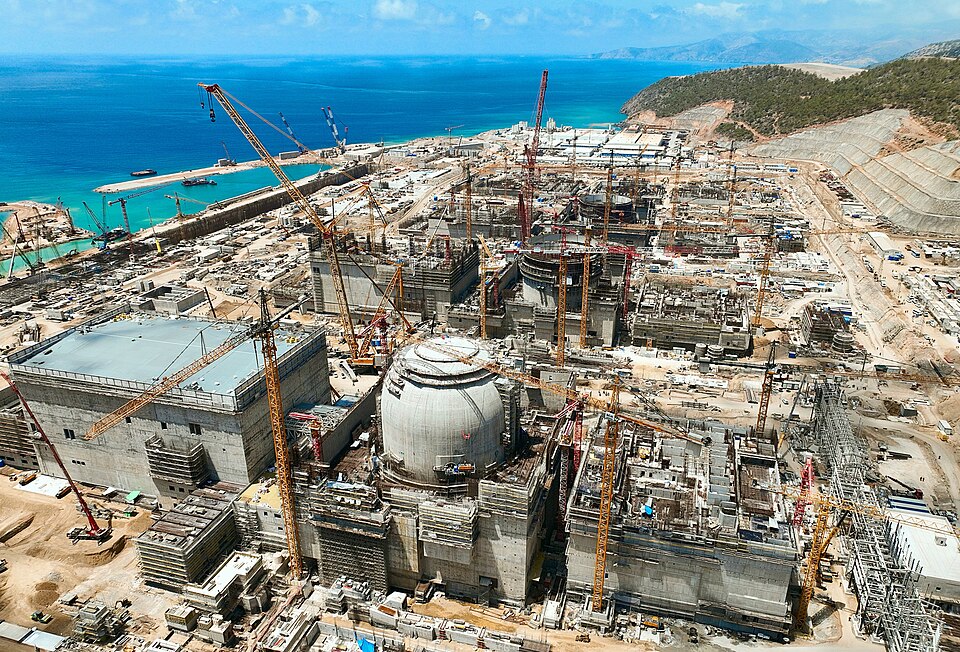
It should also be noted that Turkey has been cooperating with countries such as Russia, which possesses technological infrastructure in nuclear energy, and uranium-rich nations like Niger and Chad in the field of mining. Alongside these developments, Ankara, making sure to take advantage of its NATO membership, signed the Strategic Civil Nuclear Cooperation Memorandum of Understanding in September 2025, following a meeting between President Erdoğan and U.S. President Donald Trump at the White House. This agreement aims to deepen cooperation in nuclear energy. The importance of this memorandum should be emphasised, particularly as it presents a significant opportunity for the establishment and expansion of small modular reactors (SMRs) in Turkey.
The developments mentioned above, along with Minister Fidan’s tacit acceptance of not ruling out nuclear weapons, bring to mind a statement made nearly ten months earlier, in May 2025, by Admiral Ercüment Tatlıoğlu, the Commander of the Turkish Naval Forces. In an exclusive interview with Warships IFR, Tatlıoğlu raised the issue of Turkey’s nuclear-powered submarine construction project. In the interview, Admiral Tatlıoğlu stated, “We will take an important step towards building nuclear-powered submarines, which are essential for our long-term deterrence capabilities and our vision of becoming a medium-sized global power.” He went on to add, “Building a submarine that meets all our operational needs, with design and construction entirely under our control, independent of external dependencies, has been our national aspiration for 139 years.“
It seems that the Turkish Armed Forces’ ambitious vision is closely aligned with a historic speech made by President Erdoğan on 5th September 2019 at the Central Anatolia Economic Forum. In this landmark speech, Erdoğan made a veiled yet clear statement regarding Turkey’s need to possess nuclear weapons, saying, “Some have nuclear warheads on missiles, not just one or two… But I shouldn’t have nuclear warheads? I don’t accept that. Look at the situation now, where are they, what race are they running, and what do they say to us? ‘Don’t you dare do it,’ they say. Right next door, Israel. Do they have them? Yes. And they use everything to intimidate us. My dear brothers and sisters, we are working on this issue right now.“
This remark implicitly but undeniably declared Turkey’s ambition to develop nuclear capabilities. It is also important to note that this statement was made despite Turkey having signed the Nuclear Non Proliferation Treaty (NPT) in 1980 and the Comprehensive Nuclear Test Ban Treaty (CTBT) in 1999.
Turkey is rapidly advancing towards acquiring nuclear capabilities in order to enhance its deterrence against both regional and global threats, taking steps towards becoming a “threshold state.” However, it should not be forgotten that these steps could seriously affect not only Turkey’s national security but also the preservation of global peace. Turkey’s military bases in the Middle East and beyond, along with its ongoing occupations in Cyprus, Syria, and Iraq, could deepen the threats to international stability. Especially, with a government adopting an ideological approach and following a controversial strategy like Neo-Ottomanism, the possession of nuclear weapons by Turkey poses serious risks to global security. In this context, Turkey’s nuclear weapons acquisition process must be closely monitored, and it is clear that the international community must take sensitive precautionary steps in this regard.