
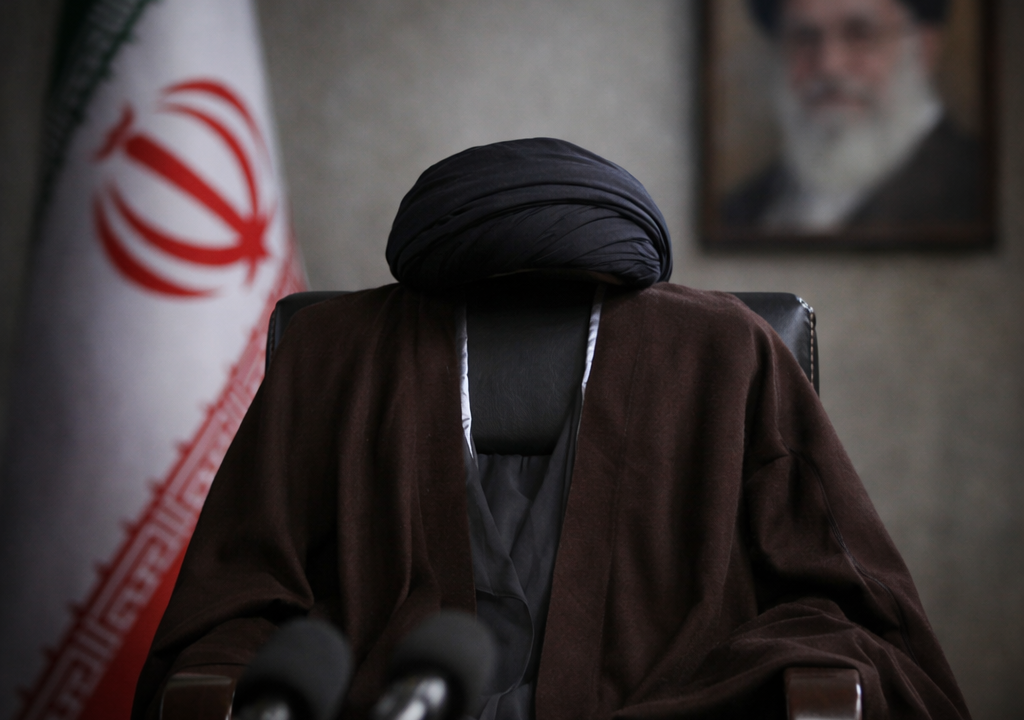
Since being named Iran’s third Supreme Leader, Mojtaba Khamenei has not appeared in public. He has spoken to no one, appeared to none, and shaken no hand. Instead, the public is served a thin gruel: a state-television newsreader, AI-generated portraits and posts from a dubious, unverifiable X account. The question asked quietly across Tehran and loudly beyond it is simple: is anyone actually there?
In Hans Christian Andersen’s tale The Emperor’s New Clothes, two swindlers persuade a crowd they have woven magnificent garments visible only to the wise. No one wishes to admit they see nothing. The emperor parades naked through the streets while the crowd applauds—until a child blurts out the obvious: “He has nothing on.”
On March 9th 2026 Iran’s Assembly of Experts announced a new Supreme Leader: Mojtaba Khamenei, the 56-year-old son of Ali Khamenei, who had been killed in the opening strikes launched by Israel and the United States at the start of the current war. The announcement took several days to appear, reportedly because the process was disrupted by the fighting and by internal debate. The urgency, however, was clear. A country at war—one aimed openly at regime alteration—needed to project continuity.
Yet since that announcement the new leader has effectively vanished, at least to anyone seeking proof that he is alive and well.
The agreed facts are sparse. Mojtaba Khamenei has not been seen in public since the war began. Official Iranian media rely on old archival photographs alongside images that visual analysis suggests were generated by artificial intelligence. His first message as Supreme Leader, released on March 12th, was not delivered by him but read aloud by a state television announcer. His voice has not been heard. His face has not been seen. The X account of his late father redirected followers to a new account in Mojtaba’s name, hosted abroad.
Iran’s ambassador to Cyprus, Alireza Salarian, told The Guardian that he had heard Mojtaba was injured in his legs, hand and arm and was likely in hospital, and that he was in no condition to deliver a speech. Such remarks from a senior diplomat lend colour to speculation, even if they fall short of independent confirmation.
The written statement itself was revealing in its own way. It praised Iran’s armed forces, vowed retaliation against those responsible for the strikes and insisted that revenge for the war’s dead would remain, in his words, “a file that will remain open”. It also doubled down on keeping the Strait of Hormuz closed to global shipping. Yet the message offered no proof that the man issuing it had written—or even read—it.
Wartime leaders usually make themselves seen. If only in a brief video call or a single dated photograph. Mojtaba Khamenei has done neither. His silence raises questions official Iran declines to answer.
It is important to be precise. There is no hard evidence that Mojtaba Khamenei’s condition is worse than the limited accounts suggest. He might simply be injured, recuperating and exercising wartime caution. Equally, he might be gravely hurt, incapacitated or, in the most extreme speculation, no longer alive.
Cui bono?
In political analysis the first question is always cui bono—who benefits? In this case, as in Andersen’s tale, the answer is fairly obvious.
The Islamic Revolutionary Guard Corps appears to have gained most from the current arrangement. According to a report cited by Reuters, the Guards engineered Mojtaba’s selection from the outset, overriding objections from clerics and politicians. “Mojtaba owes his position to the Revolutionary Guards,” Alex Vatanka, a researcher at the Middle East Institute in Washington told Reuters, “and at this stage he will not be ‘supreme’ to the same degree his father was.”
The regime’s hardline conservative faction wants continuity rather than reform. An absent leader cannot surprise anyone, alter course or develop independent positions. He fulfils a symbolic function without threatening the real centres of power.
The statement issued on March 12th declaring that the Strait of Hormuz will remain closed and that American bases should be driven from the region does not necessarily tell us what Mojtaba Khamenei thinks. It tells us what whoever drafted the statement thinks. In a regime such as Iran’s, the distinction between the two may be the difference between war and diplomacy.
Here lies the deeper irony. Twelver Shiism rests in large part on a theology of absence. The Twelfth Imam, Muhammad al-Mahdi, is believed to have disappeared in 874 AD at the age of five. According to Shia doctrine he continues to guide the world during the period known as the Occultation.
The Islamic Republic itself rests on the doctrine of Velayat-e faqih (the guardianship of the Islamic jurist) which holds that clerics rule as deputies of the Hidden Imam until his return.
Now, in 2026, reality has produced a situation Iran’s narrative managers surely never intended: the country’s new Supreme Leader appears to function in a manner strikingly similar to the Hidden Imam himself. He is not seen. He is not heard. His words arrive through intermediaries. An entire nation is expected to act in his name without hearing his voice.
The paradox is that, within Shia political theology, the disappearance of a leader does not necessarily weaken authority. For believers it may even strengthen it. “Ready for full obedience and sacrifice in service of the Supreme Leader’s commands,” declared the Revolutionary Guards. Whose commands those are remains an open question.
In Andersen’s story the truth is eventually spoken. In this case it is less clear where it will come from. There may be no innocent child to cry out. But several pressure points could yet crack the narrative.
External diplomacy will eventually require proof of life. Countries negotiating over Hormuz, ceasefire arrangements and the nuclear file cannot conduct diplomacy indefinitely through anonymous intermediaries.
Iranians themselves are already asking questions. And time is the narrative’s greatest enemy. One might manage a week, perhaps two, without a public appearance. But a prolonged war, an economic crisis and mounting American pressure will demand a face, a voice, a presence. In 2026 AI-generated images will not withstand scrutiny for long.
Andersen’s fable teaches that the lie survives only as long as everyone agrees to participate in it. The moment one person speaks plainly, the crowd realises what it has seen all along. Iran has built a governing system adept at managing virtual presence. Decades of propaganda, media control and opaque institutions have ensured that. Yet even such a system was not designed to manage a leader who may be incapable of leading.
The question is not only what condition Mojtaba Khamenei is in. The question is how much longer Iran’s government can continue pretending.