
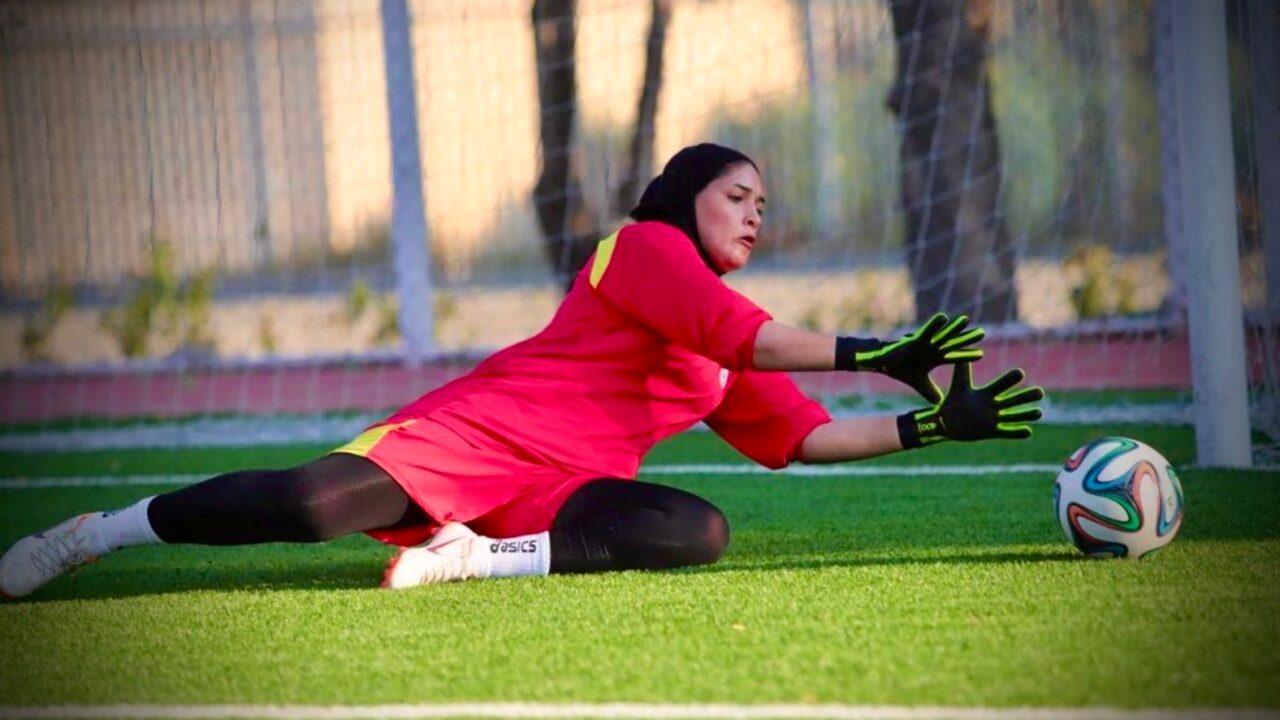
The image of the Iran women’s footballers lasted only a moment. As the team bus pulled away from Gold Coast Stadium in Queensland on March 8th, after Iran’s final match at the Women’s Asian Cup, supporters crowded along the road caught a glimpse through the glass: at least three players making what witnesses described as the international hand signal for help. Within hours, five of them had left the hotel and placed themselves under police protection.
The gesture that lasted only a second, may outlast the regime that made it necessary.
Iran’s women’s team did not arrive in Australia as dissidents. They arrived as athletes, under heavy supervision, to compete in a regional tournament, but from the moment they stood silent during the national anthem before their opening match, their story became something larger than football. In a country where protest means prison, where women are arrested for uncovering their heads, and where the supreme leader has decreed that athletes who refuse to face Israeli opponents are performing an act of religious sacrifice — silence during an anthem is a radical act.
A long history of coded resistance
Sport has long served authoritarian regimes as a showcase of national strength. Time and again, it has also embarrassed them. The Iranian regime’s relationship with its athletes follows a familiar arc: the state uses them as symbols; the athletes, granted a rare window onto the outside world, sometimes use that window to climb out.
The defections did not begin yesterday. In 2019, Saeid Mollaei, then Iran’s world judo champion, fled to Germany after officials pressured him to deliberately lose a match rather than face an Israeli opponent. In January 2020, Kimia Alizadeh, Iran’s sole Olympic medalist, announced from the Netherlands that she was leaving permanently. She described years of wearing whatever regime officials told her to wear, and repeating every sentence they ordered her to say. At the Paris Olympics in 2024, 14 of the 37 athletes competing for the Refugee Olympic Team were Iranian — more than from any other nation. The bus in Gold Coast was a vehicle to freedom.
What distinguishes the case of these Iran women’s footballers is its visibility. Alizadeh slipped away quietly; a letter on Instagram was her farewell. The five footballers in Queensland acted before cameras, crowds and a watching diaspora — Iranian expatriates who had flocked to the stadium with signs, some in tears, some holding placards in support of Reza Pahlavi, son of the deposed shah. The political theatre was dense and not always spontaneous, but the fear, by most accounts, was real.
The particular burden of Iran women‘s footballers
For Iranian women athletes, the constraints are structural rather than merely political. They compete internationally in full hijab, regardless of sport. They are dispatched abroad accompanied by regime-appointed guardians, and they return to a country where women were, until recently, barred from entering stadiums to watch men’s matches.
The regime’s grip on women’s sport is not incidental. Tensions within the Islamic Republic over the control of female bodies in public space surface with regularity. The nationwide protests that were crushed with brutal force, at a cost estimated by some human rights organisations at thousands of lives, were ignited in 2022 by the death of Mahsa Amini in morality police custody. They returned with renewed fury in 2025 and were present again in the massacres the regime carried out in 2026. The government’s response, internet blackouts, mass arrests, executions and snipers on rooftops, has only sharpened the atmosphere in which athletes operate.
When the team was reportedly compelled to sing the anthem before their second match, having stood silent before the first, the coercion was legible to any observer. The silence was the message.
Sport’s uncomfortable gatekeepers
The episode has exposed the limits of international football’s self-image as a force for good. FIFA issued a careful statement affirming that player safety was its “top priority”, while maintaining deliberate vagueness about what that might actually require. The Asian Football Confederation, which organised the tournament, declined to comment. Football Australia said little. The Australian government, which holds the actual power to grant the players protection, equivocated.
Meanwhile, Donald Trump announced via Truth Social that the United States would offer the players asylum should Australia fail to act.
The more substantive question is whether governing bodies like FIFA can continue to treat national teams as representatives of their governments, when those governments use teams as instruments of surveillance and ideological display. Craig Foster, a human rights advocate, put it plainly:
“No athlete group should ever be effectively held hostage by their own member federation and denied access to external support networks.”
The pitch as the last public square
There is something important in the specific geography of these moments of defiance: they happen abroad, in stadiums, on international soil, in front of cameras. They cannot happen inside Iran, where the public square has been closed off, where the national pitches have become besieged military compounds. The one place where Iranian women can be seen by the world, performing in public, physically free, has become the last venue where resistance is possible.
This is not unique to Iran. Athletes from authoritarian states have long understood that the international sporting event is one of the few occasions when the state’s grip loosens. The East German swimmers who stayed behind, the Soviet gymnasts who vanished after tours, the Cuban boxers who melted into Miami crowds — all understood that sport creates a temporary freedom, a gap between the performance and the person performing it.
What is striking about the Iranian case is how systematically the regime has tried to close that gap: the minders on the team bus, the enforced anthem, the tight security at the hotel door. And how, despite all of it, five women still found their way out.
On March 10th, Australia granted humanitarian visas to five of the players: Zahra Ghanbari, Fatemeh Pasandideh, Zahra Sarbali Alishah, Mona Hamoudi and Atefeh Ramezanizadeh. Some of their teammates chose to return. These five Iran women’s footballers are finally free.