

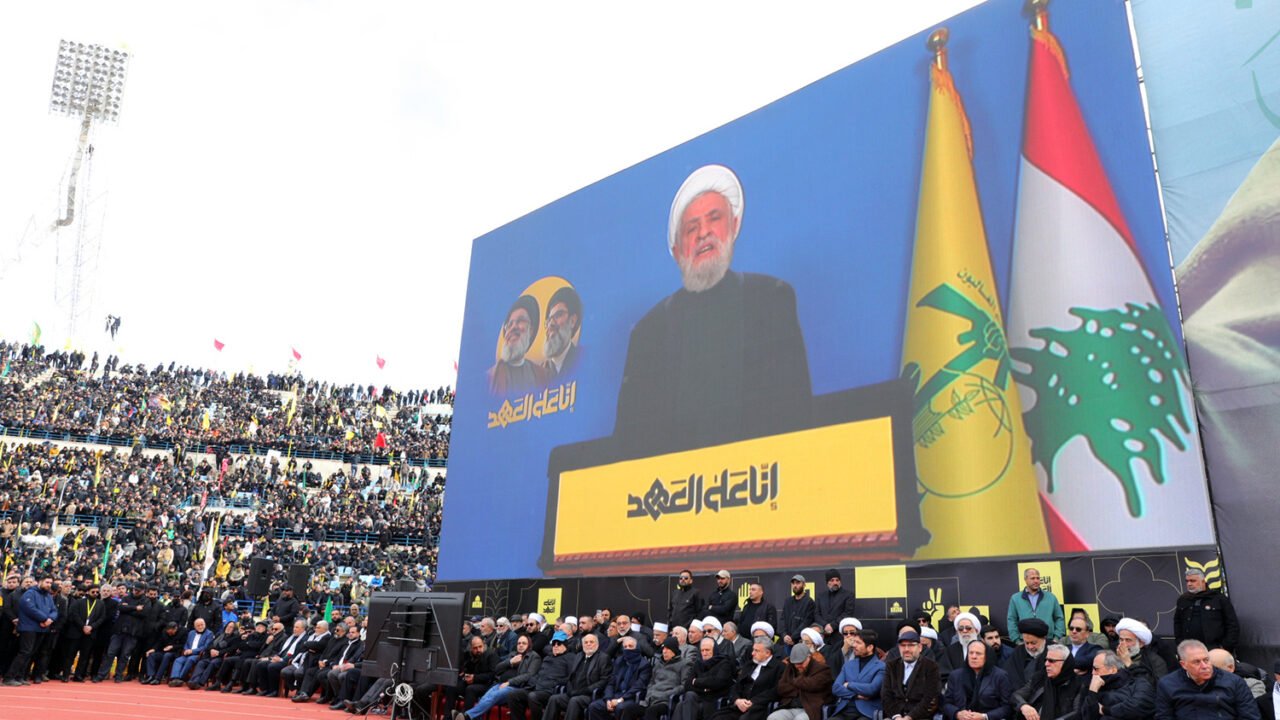
The Lebanese government, along with many non-Shia political factions, has intensified calls for Hezbollah to relinquish its weapons or at least curtail its autonomous military role. International actors are amplifying the Lebanese demands. It is perhaps this accumulation of pressures that explains Hezbollah’s increasingly uncompromising rhetoric.
Amid tenuous ceasefires in Iran and Gaza, and despite an official truce between Hezbollah and Israel, southern Lebanon has increasingly become a theatre of escalation in the ongoing Middle Eastern confrontation. In recent weeks Israel has intensified its military operations putting Hezbollah under pressure, reportedly with tacit American approval, including renewing widespread evacuation orders for Lebanese civilians. The broader objective appears to extend beyond Lebanon itself: increasing pressure on Iran at a time when negotiations between Tehran and Washington — over both the nuclear issue and commerce in the Strait of Hormuz — have slowed considerably.
Yet Israel’s calculations are not purely geopolitical. They are also operational. Hezbollah can point to relative success in deploying explosive-laden, fibre-optic-guided drones against Israeli forces operating in southern Lebanon. Such systems are harder to disrupt through conventional electronic warfare and therefore pose a growing tactical challenge, while raising the human cost to Israel’s presence in Lebanese territory. Israel’s response has been to expand its operations aimed at destroying the military infrastructure Hezbollah has spent years constructing near the border, infrastructure that Israeli officials believe was intended for a future large-scale assault on northern Israel that would have dwarfed 7 October. These operations have gone north of the Litani River, beyond the self-declared buffer zone that Israel established upon the formal cessation of hostilities in mid-April.
From Israel’s viewpoint, Hezbollah provided the justification for this escalation from the moment it opened a northern front in support of Hamas following the attacks of 7 October, without any prior Israeli provocation, launching thousands of rockets into Israeli territory.
Since then, the conflict along the Lebanese border has evolved into a grinding war of attrition, if temporarily interrupted by a 15-month US-brokered ceasefire that Israel exploited to further pound the organisation. But the costs have become increasingly uneven, especially for Lebanon’s already fragile multi-ethnic society.
Israeli strikes and military operations have displaced Shia residents of villages close to the border, pushing them northward and adding another layer of social and economic strain to a country already suffering one of the worst financial collapses in modern history. Hezbollah, long accustomed to presenting itself as both protector and provider within the Shia community, now faces growing difficulty in containing the cumulative effects of war, displacement and economic hardship.
At the same time, pressure on the group is mounting from within Lebanon itself. The Lebanese government, along with many non-Shia political factions, has intensified calls for Hezbollah to relinquish its weapons or at least curtail its autonomous military role. The loss of its Assad ally in Syria as a weapons conduit and the weakening of its Islamic Republic ally in Tehran following two wars in less than a year have intensified global momentum. International actors are amplifying the Lebanese demands, arguing that no state can function effectively while a heavily armed non-state actor retains independent control over decisions of war and peace.
For years Hezbollah justified its massive rocket and missile arsenal under the banner of “resistance” against Israel. But that narrative appears less persuasive to a growing number of Lebanese citizens who increasingly view the country as an arena for Iran’s regional ambitions rather than a sovereign state pursuing its own interests. The perception that Lebanon is paying the price for conflicts whose strategic logic lies elsewhere has deepened public frustration, even among the traditionally fiercely loyal Shia constituency.
It is perhaps this accumulation of pressures that explains Hezbollah’s increasingly uncompromising rhetoric. Recent threats directed at Lebanon’s political leadership, warning against continued demands for disarmament, suggest a movement that feels its domestic position becoming less secure. Armed organisations under political pressure often respond by hardening their rhetoric, seeking to deter challengers before opposition consolidates into a broader front.
But such escalation carries obvious risks. Lebanon’s institutions are weak, its economy in freefall, its infrastructure damaged by Israeli strikes and its sectarian divisions unresolved. Under such conditions, political confrontation can easily spill into armed clashes. The prospect of internal violence, once considered a relic of the 1975–1990 civil war, no longer appears entirely implausible.
The more difficult question concerns Israel’s likely response should Lebanon slide into serious internal conflict. Within Israel there is already mounting pressure — from both military circles and residents of northern border communities — for the government to intensify operations against Hezbollah, especially its southern Beirut nerve centre. Israel is particularly concerned about the seemingly unsolvable threat posed by the fibre-optic drones, which have proven increasingly challenging to intercept and have exacted a heavy toll on its military.
Israel’s domestic politics further complicates the picture. With parliamentary elections to be held sometime in the autumn months, the Israeli government faces growing criticism from constituencies demanding stronger action on its northern border. Failure to respond decisively could leave the government’s coalition parties vulnerable to accusations of weakness at a politically sensitive moment.
In the event of major internal unrest in Lebanon, Israel may see an opportunity to inflict a decisive blow on Hezbollah’s military capabilities, much as it exploited the fragmentation of Lebanon during the civil war to weaken Palestinian armed organisations operating there. The Trump administration, seeking greater leverage on Iran to reach a conclusive deal, may agree and grant its ceremonial blessing. The historical circumstances of 2026 versus 1982 differ in important ways, but the strategic logic may remain similar: periods of internal Lebanese disorder have often provided external actors with opportunities to reshape the country’s balance of power.
There is a deeper irony underlying Hezbollah’s current predicament. In 2000, the movement compelled Israel into withdrawing from southern Lebanon, an achievement widely regarded across the Arab world as a historic victory. At that moment Hezbollah possessed an opportunity to transform military legitimacy into long-term political and economic advancement for Lebanon’s Shia community within the framework of the Lebanese state.
Instead, the organisation pursued a different course. It retained and expanded its military structure, deepened its integration into Iran’s regional strategy and increasingly sought dominance within Lebanon’s political order. Over time this approach drew the Shia community ever more deeply into regional confrontation, exposing it repeatedly to war, displacement, sanctions and economic isolation.
Today Hezbollah finds itself confronting a question that has haunted many armed movements after military success: whether the very instruments that once secured power eventually become the source of strategic overreach and encourage internal rot. Its drones and military capabilities may have enhanced its battlefield effectiveness against Israel. Yet they may also have intensified the pressures — domestic, regional and international — that now threaten both the organisation itself and the community on whose behalf it claims to act.