
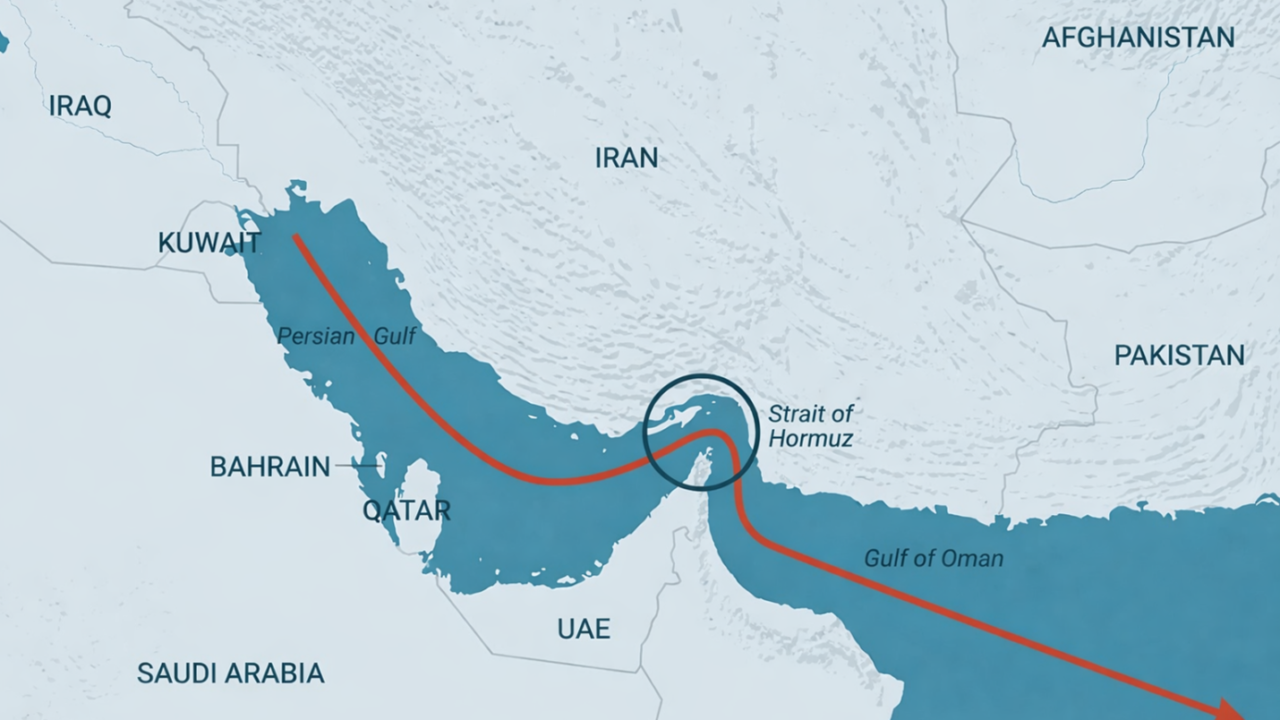
Every time tensions spike between Washington and Tehran, the same threat rises from the Persian Gulf like a recurring fever: Iran will close the Strait of Hormuz. Iranian parliamentarians repeat it. IRGC commanders rehearse it with live-fire naval exercises. State media amplifies it with cartographic precision, as if the map itself were a weapon. In January 2026, as the United States deployed two carrier strike groups to the region and nuclear negotiations collapsed, Iranian officials warned again that the world’s most important oil chokepoint could be sealed.
The international oil market flinched. Analysts reached for their calculators. Iran’s threat did exactly what it was designed to do – without a single shot being fired.
This is the central, underappreciated reality of the Strait of Hormuz crisis: the closure threat is Iran’s most powerful strategic weapon precisely because carrying it out would be an act of national economic suicide. Tehran’s leaders understand this. The threat works because it never has to be executed. But with this being the defining contradiction of Iranian statecraft in 2026, the very desperation that has narrowed Iran’s strategic options is also the condition under which rational self-constraint begins to erode.
The Numbers That Make Closure Impossible
The Strait of Hormuz is a navigable channel roughly 21 miles wide at its narrowest point, sitting between Iran and Oman at the mouth of the Persian Gulf. On an average day, approximately 20 million barrels of crude oil and petroleum products pass through it – around one-fifth of global consumption. More than 20 percent of the world’s liquefied natural gas trade transits the same waters. These are figures that rightly command attention.
What receives far less attention is where that oil is going. Only about 6 percent of Hormuz-transiting energy is destined for Europe and the United States. The overwhelming majority – 84 percent of oil and petroleum products, and more than 80 percent of LNG shipments – flows east, into Asia. China alone imports approximately 5 million barrels per day through the Strait. India, Japan, and South Korea are not far behind. A closure of the Strait of Hormuz would be, in energy terms, a weapon aimed almost entirely at Iran’s own customers, partners and the one country whose diplomatic cover has kept the Islamic Republic economically viable through years of Western sanctions.
This matters enormously because China’s relationship with Iran is not merely transactional: it is existential for Tehran. Iranian oil exports have survived successive rounds of US sanctions largely because Beijing has continued purchasing them, running a shadow fleet of tankers and a network of compliant refineries to move product despite Washington’s objections. That arrangement requires the Strait to remain open. Nearly 95 percent of Iran’s crude exports in 2025 were loaded at Kharg Island, an offshore terminal 16 miles from the Iranian coast and shipped directly through the Strait of Hormuz, primarily to China.
The arithmetic is unforgiving. Closing the Strait means cutting off Iran’s own oil revenue. It means directly damaging China, the patron that has kept Iran’s economy from complete collapse. It means paralysing approximately 80 percent of Iran’s total foreign trade, which moves through Gulf ports. Iranian officials occasionally invoke the closure threat as though it were a lever they could pull cleanly and surgically. In reality, it would be the geopolitical equivalent of setting fire to your own house to frighten a burglar.
The Theatre of Deterrence
Understanding why Iran nonetheless keeps making the threat requires separating its strategic function from its operational credibility.
Deterrence is, by definition, most effective when it is feared rather than tested. Iran’s naval posture in early 2026 has been a masterclass in this dynamic. In late January, the IRGC Navy deployed hundreds of fast attack craft and missile-launching vessels in close proximity to the USS Abraham Lincoln in the Arabian Sea. The IRGC’s drone carrier, the Shahid Bagheri, was positioned six kilometres off Bandar Abbas, the naval headquarters that sits astride the Strait, as if daring the Americans to count it. Live-fire exercises in the Strait followed on February 1 and 2. Iranian officials announced the possibility of joint naval drills with Russia and China in the Gulf of Oman.
None of this constituted a closure. All of it communicated capability, resolve and escalatory willingness: the ingredients of a credible deterrent. Iran does not need to close the Strait to make the threat valuable. Every additional aircraft carrier the United States is obliged to deploy, every percentage point added to global shipping insurance premiums, every OPEC member quietly reassessing supply route risk: these are strategic dividends that accrue to Tehran at zero operational cost.
This is an asymmetric deterrence strategy of considerable sophistication. The IRGC Navy’s fast attack craft, anti-ship missiles and mine-laying capabilities are genuine. They could not prevent a US naval response indefinitely, but they could impose significant costs – disruption rather than closure, harassment rather than shutdown. In 2019, when Iran attacked civilian tankers and seized a British-flagged vessel, it demonstrated willingness to manipulate rather than foreclose the Strait. Partial disruption, targeted harassment, and selective seizures are instruments Iran has actually used. Total closure remains in the category of the threatened but never executed.
There are good structural reasons why. The Strait has never been completely closed in modern history, even during the brutal tanker wars of the 1980s when Iran mined the waterway and drew direct US military intervention. The lesson Tehran absorbed from that episode is not that closure is impossible but that it triggers consequences that the Islamic Republic has consistently judged unacceptable.
The Critical Threshold: When the Calculus Changes
The more important question and the one that should preoccupy Western policymakers, is not whether Iran will close the Strait under normal circumstances, but whether the conditions for rational restraint can be sustained.
There are is one key threshold with uncomfortable clarity: Iran is unlikely to attempt closure unless it perceives it has “nothing to lose” – specifically, if US or Israeli action has already severed Iran’s own oil export capability. If Kharg Island were struck or blockaded, if Iran’s export revenue were cut to zero by external action, the economic argument against closure collapses. A regime that cannot sell its oil anyway has nothing to preserve by keeping the Strait open.
This creates a dangerous structural paradox in current US strategy. The maximum pressure campaign, renewed under the Trump administration in February 2025 with explicit instructions to drive Iranian oil exports to zero, including exports to China – is precisely the kind of policy that pushes the closure calculus toward the tipping point. The United States is simultaneously trying to economically coerce Iran and maintain stable energy transit through a waterway that Iran controls. These objectives are not easily reconciled.
The June 2025 Operation Midnight Hammer strikes on Fordow, Natanz and Isfahan followed by Israeli strikes on sites near Bandar Abbas itself, further compressed Iran’s strategic options. A regime that has absorbed strikes on its nuclear programme, faces mass domestic protests that killed thousands in the crackdown that followed and watches its economic lifelines narrowing, is a regime whose remaining options are few. Iran’s leadership is not edging toward confrontation because diplomacy has failed. It is edging there because confrontation has become the least catastrophic option available to a system under existential pressure.
This is where the “Iran can’t close the Strait” argument requires its most important qualification. The statement is true as a description of rational strategic behaviour under normal conditions. It becomes dangerously misleading if it encourages policymakers to assume that because closure is irrational, it cannot occur. Regimes in extremis do not always behave like rational actors in seminar papers.
The Bypass Problem: Less Relief Than Advertised
Optimists point to alternative export routes as evidence that a closure would be manageable. Saudi Arabia’s East-West Pipeline connects Eastern Province production to the Red Sea port of Yanbu, with a nominal capacity of 5 million barrels per day. The UAE’s Habshan-Fujairah pipeline offers an additional 1.5 million barrels per day to a Gulf of Oman terminal outside the Strait. Together, these bypass routes could theoretically carry approximately 6.5 million barrels per day: a meaningful fraction of the roughly 20 million that currently transit Hormuz daily.
The limitations, however, are substantial. Saudi Arabia’s East-West Pipeline is already handling exports and domestic refinery supply; spare capacity is estimated at perhaps 2.5 to 3 million barrels per day, not the full 5 million. More critically, the overwhelming majority of Gulf oil is loaded from facilities inside the Strait: Saudi Aramco’s offshore terminals, Kuwait’s Mina Al-Ahmadi, Abu Dhabi’s Jebel Dhanna – that would be unusable in a closure scenario. The bypass infrastructure serves a specific slice of production; it cannot substitute for the full volume at risk. The International Energy Agency estimates global spare production capacity at around 4 million barrels per day through 2026, but much of that spare capacity is located in Gulf states whose own export infrastructure depends on the Strait being open.
The honest assessment is that the bypass routes would blunt, but not absorb, the economic shock of a genuine closure. Oil markets would face a supply disruption of historic magnitude. The 1973 Arab oil embargo, which involved a far smaller volume, restructured the global energy economy for a decade. The difference today is that Asian economies, not European or American ones, would bear the brunt of the impact. Whether that redistribution of pain changes the political calculus in Washington and Riyadh is a question that deserves considerably more analytical attention than it currently receives.
Four Policy Lessons for the Current Crisis
Several conclusions emerge from this analysis that have direct relevance for decision-makers navigating the current standoff.
The threat’s value is its credibility, not its execution. Any strategy that aims to call Iran’s bluff on the Strait needs to reckon with the fact that the bluff works for Iran regardless of outcome. If the Strait remains open, Iran has demonstrated leverage. If it is partially disrupted, Iran has demonstrated capability. If it is fully closed, the costs to Iran are severe but the costs to global energy markets are catastrophic. Policymakers who frame this as a binary they can win are misreading the strategic geometry.
Maximum pressure creates the conditions for irrational closure. The specific policy most likely to push Iran across the threshold from deterrence to execution is the elimination of its oil export revenue. A Tehran that cannot fund itself through Kharg Island has diminishing incentive to protect the Strait’s functionality. The relationship between sanctions intensity and Strait stability is inverse, not parallel.
China is simultaneously the problem and the solution. Beijing’s dependence on Hormuz-transiting oil gives it extraordinary leverage over Iranian behaviour that Washington has consistently failed to engage constructively. China imports 5 million barrels per day through these waters. It has more to lose from a closure than any other single country. The political architecture for a genuine Hormuz stabilisation framework runs through Beijing, not around it, an inconvenient reality that the current state of US-China relations makes nearly impossible to act upon.
The coalitions need political architecture, not just naval assets. The twin maritime security frameworks established in 2019 and 2020, Operation Sentinel and the European-led Operation Agenor, were designed for a specific deterrence environment. That environment has been fundamentally altered by the June 2025 strikes and the subsequent escalatory cycle. Both coalitions operate under political mandates that did not contemplate this level of tension. A whole-of-government reassessment of coalition objectives, rules of engagement, and diplomatic tracks is overdue. Naval presence without a political framework is posture, not strategy.
The Weapon That Must Never Fire
There is something almost classical about Iran’s Strait of Hormuz strategy, the threat that derives its power from perpetual imminence, the deterrent that works precisely because responsible actors on all sides recognise the catastrophic costs of its actualisation. For twenty years, this logic has held. Iran has harassed, mined, seized and disrupted. It has not closed.
The danger in 2026 is not that Iran has abandoned this logic. It is that the conditions sustaining the logic are deteriorating faster than the diplomatic frameworks designed to manage them. A regime facing domestic uprising, bombed nuclear facilities, shrinking export revenues, and a hardening international posture has fewer rational reasons to maintain restraint with each passing month.
The Strait of Hormuz has never been closed. That is a fact. It should not be mistaken for a guarantee.