
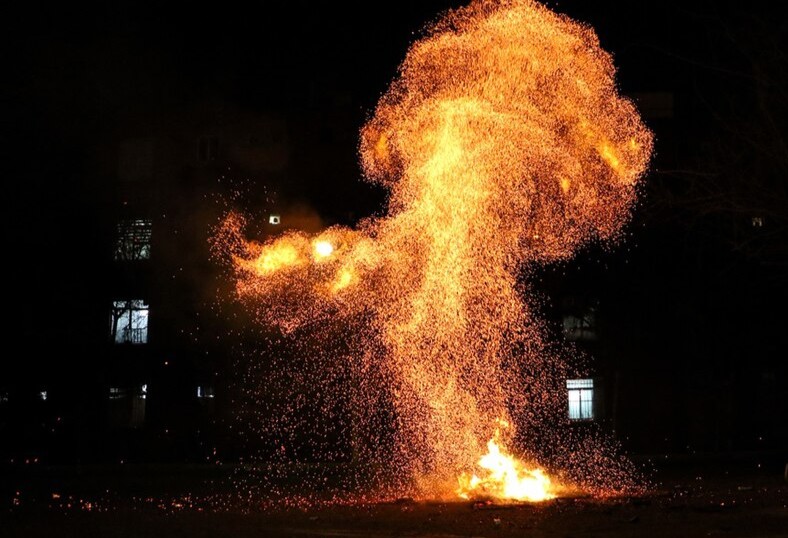
On March 17, Iranians will gather to celebrate the festival of Chaharshanbe Suri, or sometimes known as “the fire festival.” Chaharshanbe Suri is celebrated on the last Tuesday night of the Persian calendar ahead of the New Year (Nowruz) holiday. A pre-Islamic holiday established around 1700 BCE, this holiday traces its roots to Zoroastrianism, one of Iran’s ancient religions. The Zoroastrian faith considers fire as one of four key elements, symbolising ritual purification and renewal. The festival’s customs include celebrants gathering bushes and leaves to prepare bonfires several days earlier, and jumping over a bonfire to the sounds of chants and music.
The holiday’s etymology is disputed. While Chaharshanbe is unequivocally translated as “Wednesday,” (with nights signifying the new day in the Persian calendar, hence Tuesday night being considered as Wednesday), observers differ on the meaning of the Persian word suri. Some note its connection to sur, (feast), highlighting its festive and joyous nature. Others connect it to the word sork (red), referring to the fires that characterise the holiday and the association of red in pre-Islamic traditions with energy and health. In this context, the ritual of jumping over bonfires signifies discarding the past year’s misfortunes and relieving themselves of wrongdoing, entering a new year with optimism, well-being and positivity.
Additional celebratory customs accompanying the festival vary across Iran. In many towns, participants will place a jug next to the bonfire and break it while jumping over. This custom is said to related to a belief that the misfortunes of last year will enter the jug, while shattering it removes any bad luck. In Tehran, it is common for participants to put several coins in jugs, whereas in the Mashhad area of northeastern Iran coal and salt are placed inside.
Some families traditionally roast dried seeds and nuts over the bonfires, such as watermelon, pumpkin, pistachio, and almond. Among youth, it is common for them to bang spoons on bowls full of sweets, chocolates, and money as they deliver them as gifts to relatives, which many compare to trick-or-treating on Halloween. Many public celebrations will be accompanied by fortune telling and specially prepared foods, especially ash-e-reshteh: a noodle soup with legumes and nuts. In all locations, Chaharshanbe Suri is portrayed as a shared bonding of dedicated families and communities to proudly celebrate their longstanding Iranian heritage.
The festival is also celebrated in countries neighbouring Iran with similar cultural heritages, including Azerbaijan, Afghanistan, Tajikistan, and Kurdish regions across the Middle East. Iranian diaspora communities worldwide and student groups, especially in the United States, have continued to celebrate Chaharshanbe Suri outside of their homeland as a means to connect with their traditions.
How Chaharshanbe Suri Became a Platform for Protest
In contemporary Iran, the festival’s pre-Islamic, Zoroastrian nature has served as a catalyst for protests against the Islamic Republic and calls for its downfall. The festival’s modern linkage to fireworks alongside the bonfires has also encouraged rowdy and rebellious behaviour that is often repurposed into anti-regime sentiment. The Islamic Republic authorities’ attempts to ban public celebrations of the holiday in recent years due its “un-Islamic” character have backfired and spurred Iranians to greater defiance, especially among frustrated youth who have only known life under the regime.
In the year following the 2009 Green Movement protests, Iranians celebrating Chaharshanbe Suri assembled in public squares against government decrees as an act of resistance. The regime even went as far as airing normally restricted American movies on state-run TV to encourage celebrants to stay at home. In the 2018 commemoration, Persian-language social media users opposed to the regime circulated the hashtags “#Dictator_on_Fire” and “#Firefest” around the holiday, paralleling appeals for demonstrations by the Marxist-Islamist opposition group People’s Mojahedin Organisation of Iran (MEK) and the proliferation of anti-regime graffiti throughout Iran’s largest cities.
In 2023, during the anti-regime protests that erupted following the death of Mahsa Amini, opposition figures urged Chaharshanbe Suri commemorations to be accompanied by protests against the government. Demonstrators in Tehran, Mashhad, and western Kurdish regions chanted anti-regime slogans including “death to the dictator” (a reference to then-Supreme Leader Ali Khamenei). Protestors in Tehran accused the government of deploying security forces on motorcycles to block pedestrians from safely assembling on sidewalks to celebrate.
Last year, opposition groups themed the Chaharshanbe Suri public gatherings as a “National Uprising of Flames” and calls for celebrants to condemn the theocratic regime. In Tehran, Mashhad, and Isfahan, demonstrators ignited pictures of Supreme Leader Ali Khamenei and clashed with government forces, who responded with rubber bullets, tear gas, and other crowd dispersal measures. Festival-themed protests nevertheless continued in Iran’s large cities and rural areas.
As Iranians prepare for Chaharshanbe Suri in March 2026, the regime faces a combustible mix of symbolism and circumstance. January’s crackdown broadened resentment toward the regime, while the destruction of key regime assets by the United States and Israel, and the elimination of several top leaders, exposed how impotent the Islamic Republic can appear under strain. None of this guarantees a successful uprising. But on a day when Iranians leap over flames to leave the past behind, many may be tempted to treat the ritual less as folklore than as a political metaphor. For a regime now at the lowest point in its 47-year history, the sparks of Chaharshanbe Suri may carry more meaning than usual.